








The world is going through what one may call the biggest global crisis in history, pushing both health and economy down the hill. While certain regions in this world are still building resilience, others have begun planning recovery and acclimatizing themselves to the new normal. The question that arises is this - is the new normal going to remain the new normal, or is there any going back to the older ways of living? This question is bound to create anxiety and chaos in the human mind, and with that the need for “being happy” or “finding happiness” appears far-fetched and irrelevant. Is it that far-fetched and irrelevant though?
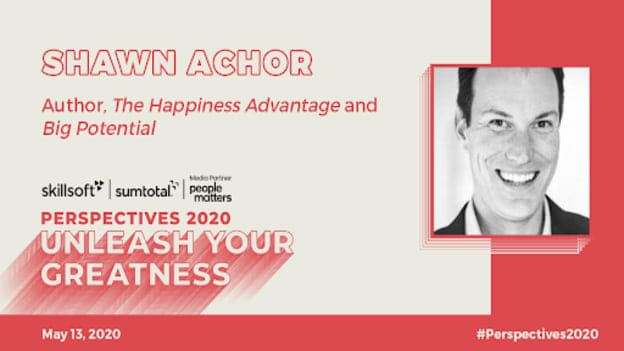
Discussing the need for a positive psychological approach to face crisis in his keynote session at the global digital learning experience Perspectives 2020, Shawn Achor, author of Big Potential and The Happiness Advantage emphasized the need for finding happiness amid crisis to boost optimism, based on research and bringing about a positive psychological shift to approach upcoming challenges.
The key points Shawn emphasized on during the session include:
- Building a resilient positive psychology
- The impact of social connections on happiness
- Steps to build a happiness hygiene
- What are you doing to raise the levels of happiness of your team before you begin work?
Here are highlights of the session.
Building a resilient positive psychology
“This is a crucial time to see all of the research and to find ways in which we can create a positive and adaptive mindset that will help us not only to be able to navigate the current crisis but to be able to come out on the back side of it,” said Shawn Achor as he began the session discussing the research and answers to some of the most common questions on being able to mentally process the ongoing crisis. These questions were:
- How do we mentally process the crisis for the most adaptive response?
- How do we pursue happiness and success in these difficult times?
- How can individuals create positive change in these difficult times?
- How do we ripple positive changes to other people?
- What have we learned from the crisis?
“I think that one of the things we have realized in the midst of this is that people take one of two approaches when the crisis occurs. You get one side that creates an international optimistic approach in which they sugar coat it and turn a blind eye to any of the negatives that are going on...The other is you see a problem and assume it takes up the entirety of your reality and that it is permanent and pervasive and that causes paralysis to the brain.”
Bringing in positive psychology here, Shawn talks about developing and encouraging a mindset of rational optimism to navigate through the crisis. It does not start with rose-colored glasses but a realistic assessment, he said. “When people have that approach, the realistic assessment to maintain the belief that my behavior will eventually matter and it is linked to the right people, what happens is that you get people that do not get paralyzed by the problem, neither do they turn a blind eye to the problem.”
He shares how in the last 100 years, humans have overcome a number of crises they faced for the very first time, adapted to the new normal, and yet in the face of a new crisis feel threatened to lose the familiarity of the older way of living. From World War I, Great Depression, World War II, The Korean War, Cold War, 9/11, financial meltdown of 2008, and now COVID-19, with every passing crisis, humans learned to adapt and get on and about with the new normal.
“As soon as we think something is unprecedented it freaks out the brain, it starts to pull resources from the front part of the brain, the prefrontal cortex. It pulls from the part of the brain that creates solutions to the problem, creating unhappiness for ourselves and others as well. We don't want that to occur. I believe this way that we can help ourselves and other people not have the emotional hijack in the midst of it, while realizing that this is unprecedented in the sense we have never experienced it before,” said Shawn.
What’s common in all the crises above is that they began to turn for the better when people brought about a change in mindset from panic and despair to developing optimism, hope, gratitude for the present, found meaning in their work and invested time in deepening their social bonds.
“The reason why a rationally optimistic approach to the crisis is the most adaptive and important approach is that when the brain is positive it is primed to deal with the crisis in front of us. We are more creative and our problem solving abilities triple as well,” Shawn added.
The impact of social connections on happiness
For his research, studying and working with banks during the financial crisis, when they did not know if the economy would ever recover, they didn't know if the banks would even be able to continue, they didn't know if they would be paid, they were not being paid at the time, they didn't know if they would have a job in the future, and other scenarios as well, working with trauma hospitals in the wake of the Pulse nightclub shooting, schools in the wake of the school shootings, with farmers in Zimbabwe who lost their land, he focused on what is that essentially gets people through the challenges. The answer was - optimism, social connection, gratitude, seeing meaning in their work, hope and “believing that our behavior matters”.
“Overcoming depression and anxiety, finding ways to lead a team virtually, finding ways to care for sick children and aging parents, finding ways to overcome a challenge of sheltering in place while doing work for your kids, in the midst of the challenges if you perceive them and feel like you are with other people as opposed to alone, the height of the challenge changes dramatically. When it changes, your brain releases more energy telling you not only do I have the brain source to overcome that challenge, but let's get started on it now.
The greatest predictor of long-term happiness is your social connection score, shares Shawn. The breath, the depth and the meaning in your social relationships. “We can't pursue happiness in isolation when the greatest predictor of happiness is other people”
When it comes to success, the height of your potential is predicted based on the people around you, so how do we create big potential in the midst of this crisis or any challenge that we have as we move forward and as we rebuild and go on with our lives?
“There was a great study that came out about how much loneliness is based on the fact we don't have an impact on other people. That two-minute positive e-mail is so important. It is not just us thinking of someone in our social support network to increase our connection of social perception but us positively impacting someone else.”
In every meeting, get each person on the call to say one thing they were grateful for before doing their work. “If you believe that optimism and happiness raises our response to the world and success rate, ask yourself - what am I doing to raise the levels of happiness for myself and my team before we do any work?”
“We can just work with the people that we work with and connect with them virtually or in person and just get the work done. But, people that we spend hours with each day, when we express gratitude together, it creates a social bond that is the greatest predictor of resilience in times of challenge...As a leader, what you want to do is to create an interconnected response, that is what we are trying to create. When you create a big potential response using gratitude and praise, it creates a ripple effect.”
How can you build happiness hygiene?
“As we come out of quarantine, whenever that is whether weeks from now or a year from now, as we are emerging from this, what i think is important before we move forward and rebuild is to look forward in this period of time and to look for the things that were good and meaningful, to stand for them, to take pictures of them, write down the gratitude(s).” How does one really go from being perplexed and overwhelmed by crisis to adapting to a positive mindset and being grateful?
How do we create individual change that allows us to create an interconnected positive adaptive response? One might say it’s in the genes, the entire mindset of positive and negative, however, research has found were very simple things you can do to inoculate your brain against stress in the midst of this challenge. Here are some of those things:
- The 21day gratitude challenge: Think of three new things you are grateful for, for 21 days. It does not matter what you are grateful for, what matters is scanning through to find the positives. A study from the time of banking crisis showed that people who tested as low level pessimists in the initial phase of the study, for whom it was assumed they had genes for pessimism, it was found that after six months of keeping up with the gratitude challenge they became moderate optimists, and when they continue this with their kids at the dinner table, they essentially are predisposing their kids to optimism. Akin to other healthy habits, this becomes a happiness hygiene. Such an approach builds a background app in your brain passively scanning the world for the positive and making optimism easy for you.
- Journaling: If not the 21day gratitude challenge, journaling is a great way to think of at least one positive experience in the last 24hours. Write down every detail you can remember.
“When you do this, your brain can't tell the difference between visualization and actual experience.So not only did you have to scan for a meaningful moment in the crisis but you also got to relive it as your brain goes through the memory,” added Shawn.
- 15 minutes of fun cardio: Equivalent to taking an antidepressant, even 15min of regular exercise everyday pumps up your energy, charging up your brain cells. It keeps both your physical and psychological self active and receptive to what lies ahead, and energetic enough to scan through probable alternative solutions.
- Meditation: Observing your breathing pattern and calming your inhaling and exhaling activity helps eliminate all unnecessary noise and negative thoughts that distract you and keep you from living up to your potential.
“It increases your accuracy rate by 10%, raising the level of happiness and optimism and not only impacts you but also brings calmness to people around you through your interactions with them,” shared Shawn.
- Random acts of kindness: Following the 21day rule, find one person to appreciate or extend thanks to everyday. Given the global need for social distancing, this is a great way to reconnect with someone from your life, be it a school teacher, an old friend, your old boss, your ex-colleagues you haven’t been in touch with and let them know how they made a difference to your life. Shawn insists that this is not social distancing as everyone thinks, this is physical distancing. Reach out to people and feel more socially connected in the midst of the crisis than before the crisis.
Highlighting basic human tendency, Shawn said, “Our brains will scan for threats in the midst of a crisis unless we create patterns to allow our brains to see the positive,”
With everything that is keeping the global workforce occupied 24*7, it’s a good time to check-in and restructure our thoughts and approach where needed, and enable a faster and more resilient recovery from the global crisis.