There is one statistic that should make every CHRO, CEO and business leader pause.
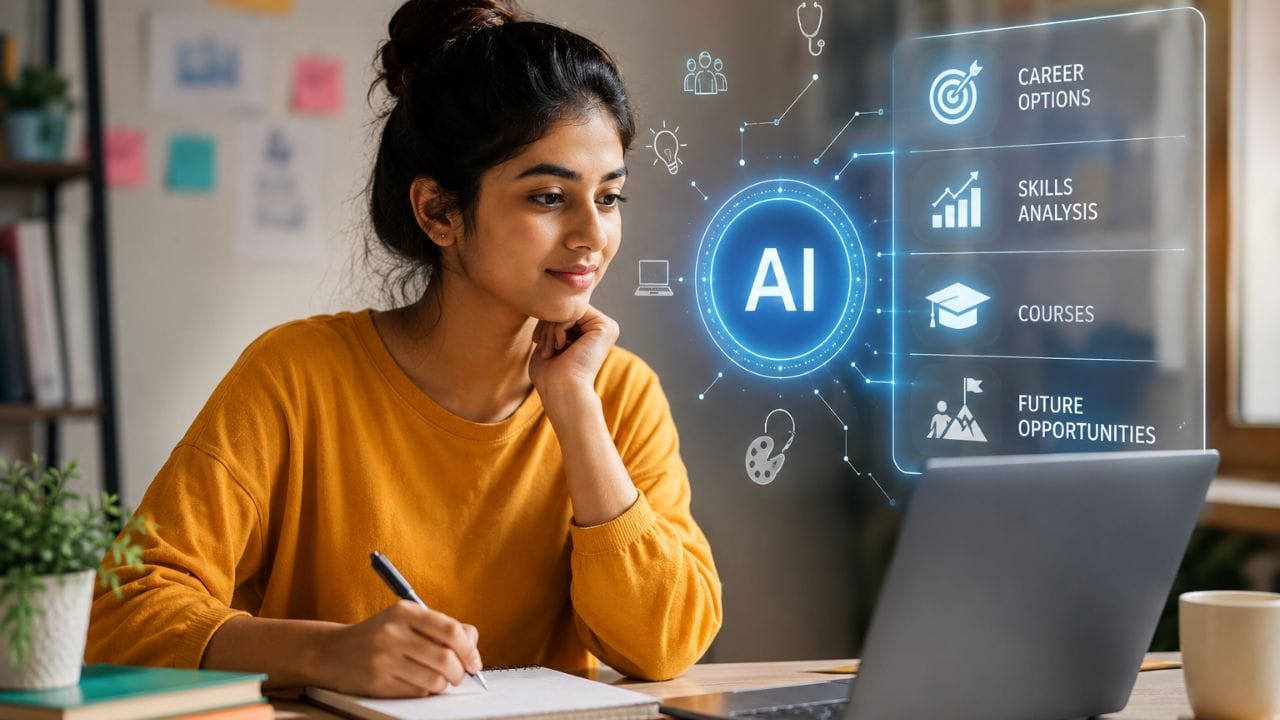
India is rapidly emerging as one of the world’s largest AI learning economies. Yet, according to Coursera’s Job Skills Report 2026, while Generative AI enrollments among enterprise learners grew 234% year-on-year, the broader signal is more sobering: capability is not keeping pace with participation. At the same time, enrollments in critical thinking skills have grown 120% year-on-year — a reminder that organisations are beginning to recognise a simple truth: AI capability alone is not enough.
The real question is no longer whether India is learning AI fast enough.
It is whether India is becoming ready to use it at scale.
That tension sits at the centre of one of the most important workforce conversations of this decade — and it will define the agenda at People Matters TechHR India 2026, Asia’s largest HR and Work Tech conference.
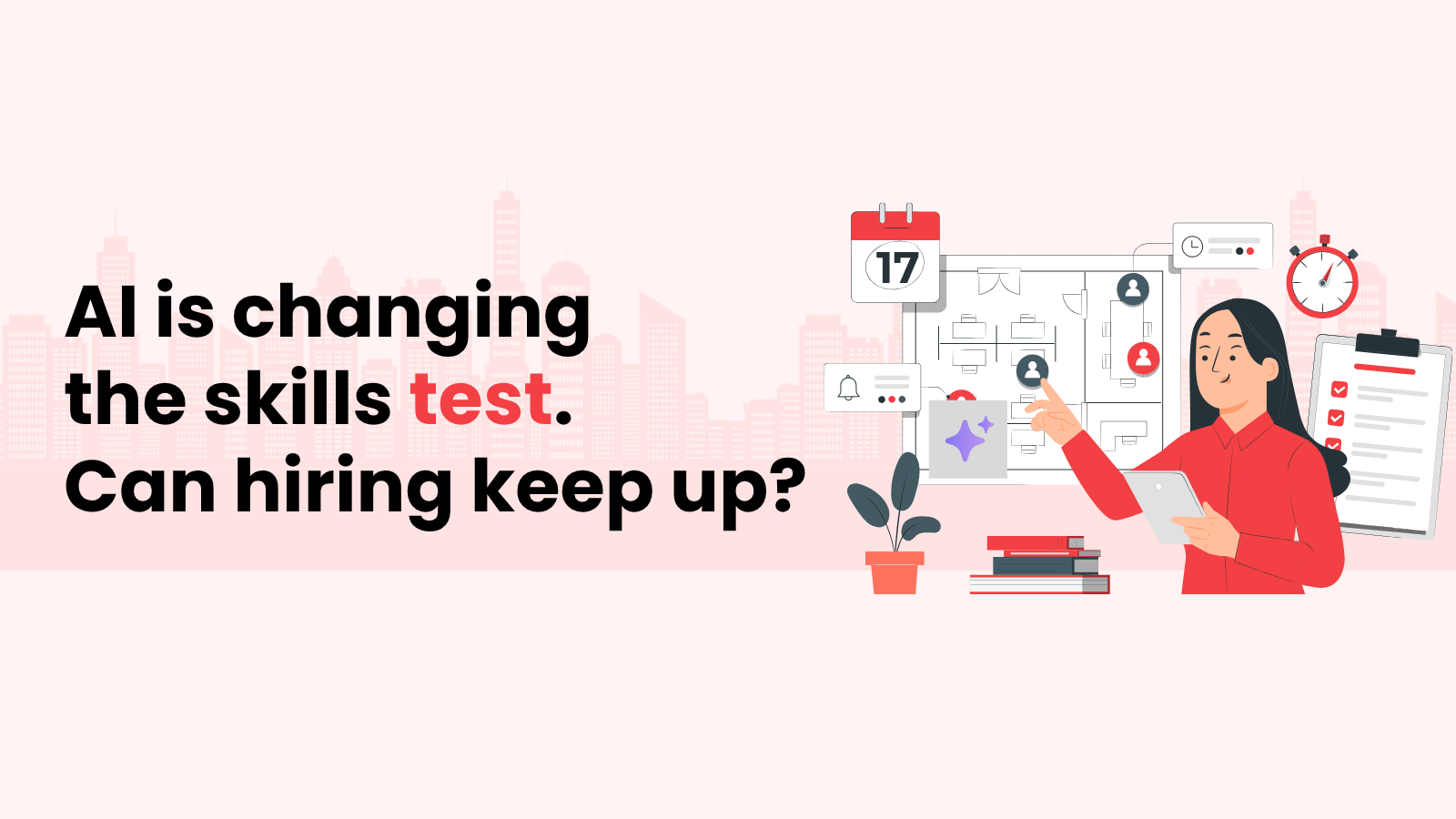
Because the challenge in 2026 is not AI adoption. It is AI readiness.
AI adoption is accelerating. Workforce capability is still uneven. The momentum is visible across the economy.
NASSCOM estimates India’s AI talent demand could cross one million roles by 2026. The World Economic Forum’s Future of Jobs Report 2025 estimates that nearly 40% of existing skill sets globally will change by 2030, while 63% of employers cite skills gaps as the biggest barrier to transformation.
At the same time, India’s skilling ecosystem is expanding across multiple layers — enterprise, government and industry.
Government-led initiatives such as the IndiaAI Mission and FutureSkills Prime (MeitY–NASSCOM) are scaling digital and AI capability-building across industries. These are no longer awareness programs; they are becoming foundational infrastructure for workforce transformation.
Across the private sector, adoption is already visible in how companies are reskilling at scale. Large IT services firms such as TCS, Wipro and Accenture India have rolled out enterprise-wide AI learning programs spanning hundreds of thousands of employees.
But the gap remains structural.
According to MeitY estimates, only around 16% of India’s IT workforce currently possesses AI-relevant skills. Which means AI adoption is accelerating faster than deep capability formation.
And that gap is now shaping how organisations think about work itself.
This is also where several conversations at TechHR India 2026 are expected to land with sharper focus.
A keynote session, Skilling India For The AI Economy, is expected to unpack what large-scale workforce readiness actually requires as India positions itself as a global AI talent hub. Beyond skilling volumes, leaders are likely to discuss what deployable capability, sector readiness and AI-enabled workforce transformation really look like in practice.
Another important discussion on Skills as Strategy: Turning Capability Building Into Competitive Advantage, will examine how organisations are beginning to move beyond learning metrics and certifications toward capability models directly linked to business growth, productivity and innovation outcomes.
Because increasingly, the question is no longer whether employees are learning AI.
It is whether organisations are becoming capable of operating differently because of it.
Beyond enterprises: MSMEs and sectors are reshaping India’s skilling story
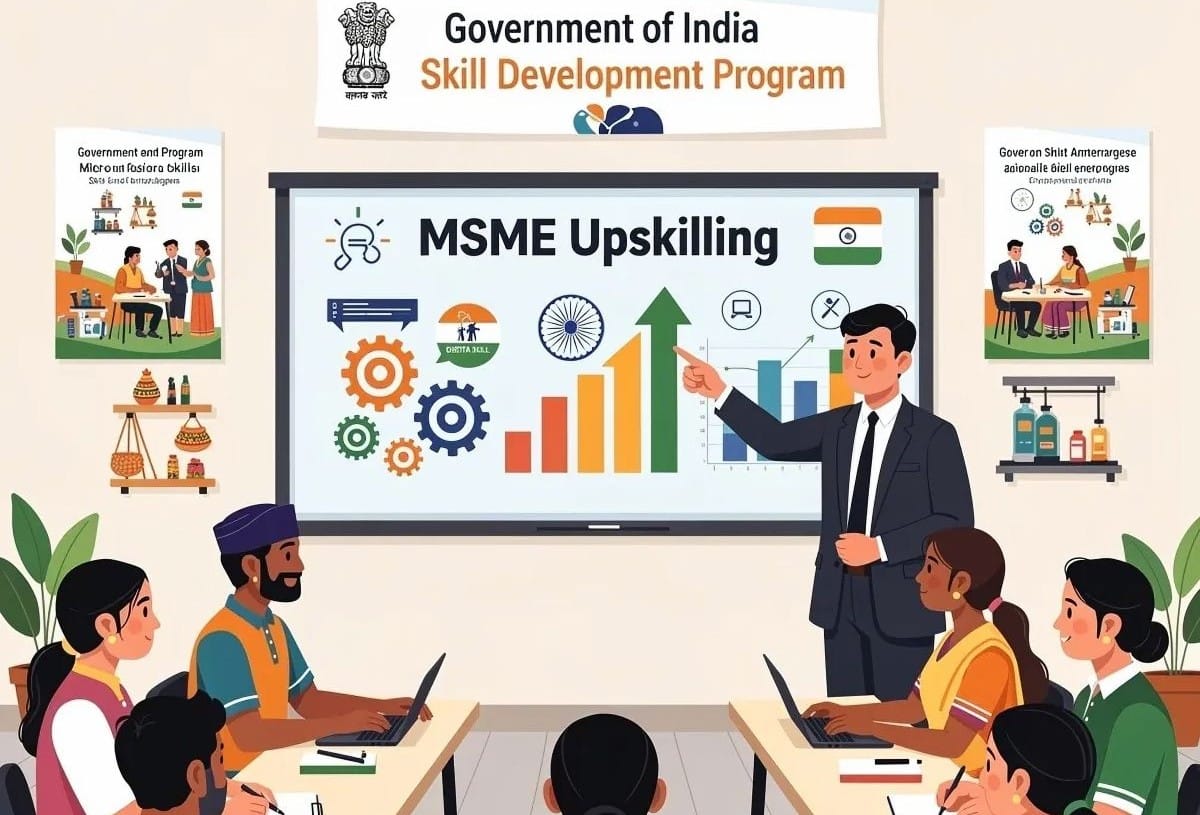
The AI skilling narrative in India is no longer limited to large enterprises or global capability centres.
A quieter transformation is unfolding in MSMEs — which contribute over 30% to India’s GDP and employ more than 110 million people.
Here, skilling is not structured around formal AI roles. It is happening through usage.
AI-enabled accounting tools, customer service automation, digital marketplaces and workflow assistants are driving a form of “on-the-job AI adoption” that is practical, immediate and tool-led rather than engineering-heavy.
At the same time, sector-specific skilling is becoming the real differentiator.
BFSI is embedding AI into fraud detection, risk modelling and compliance workflows
Manufacturing is using AI for predictive maintenance and operational efficiency
Healthcare is adopting AI-assisted diagnostics and workflow automation
IT services are running large-scale internal reskilling programs focused on AI integration
The pattern is clear: AI skilling is no longer horizontal.
It is becoming deeply sectoral, contextual and workflow-specific. And that makes the readiness challenge far more complex — and far more uneven.
The keynote address 'Orchestrate At Speed: Building Capability & Capacity For Excellence' is expected to explore how organisations can scale workforce transformation without losing agility, trust and execution capability along the way — especially at a time when businesses are being asked to balance AI acceleration with sustainable growth.
The leadership questions are getting sharper
As AI moves deeper into workflows, organisations are beginning to confront questions that are no longer theoretical.
Can managers lead teams where humans and AI agents work together?
AI systems are no longer just assistants. They are becoming embedded into execution layers — writing code, generating insights, supporting decisions and automating workflows.
This shifts management from supervising human teams to orchestrating hybrid systems of humans and machines.
Most organisations are still adapting to what that means in practice.
This leadership shift is expected to sit at the centre of Legacy Unplugged: The rise of the superworker: Redefining human potential in the age of AI.
The session is likely to examine how AI is reshaping productivity itself — not by replacing human capability entirely, but by augmenting it. As AI systems increasingly become co-workers inside workflows, leaders will need to rethink performance, collaboration and the future role of human potential itself.
Can organisations redesign workflows without eroding trust, judgment and accountability?
As AI becomes embedded into decision-making, questions of ownership, transparency and accountability are becoming unavoidable.
Who is responsible when AI influences outcomes?
How much automation is appropriate before human oversight becomes compromised?
Where does judgment remain non-negotiable?
These are no longer technology debates. They are governance and leadership decisions.
This is also where sessions such as Legacy Unplugged: Global voices, Indian roots: What the world can learn from India’s talent playbook are expected to become particularly relevant.
As India navigates AI-led workforce transformation at scale, leaders are increasingly examining whether the country’s talent agility, digital adoption and workforce adaptability could offer lessons for global organisations attempting similar transitions.
Can AI improve productivity without creating deskilling or fatigue?
As workflows become more automated, organisations are also beginning to see a second-order challenge.
Employees are working faster — but also adapting continuously.
New tools. New systems. New expectations.
At the same time, global workforce studies, including the World Economic Forum’s Future of Jobs Report 2025, highlight that 59% of workers will require reskilling or upskilling by 2030 — underscoring the scale of continuous change ahead.
Which raises a critical question for leaders: How do organisations build AI capability without creating adaptation fatigue or dependency?
This is expected to shape conversations during the panel discussion: Upskilling at scale: Making learning stick.
Because one of the biggest workforce challenges organisations are now facing is not launching learning initiatives — it is ensuring that learning translates into sustained behavioural change, applied capability and long-term workforce adaptability.
The deeper challenge may not be skills. It may be systems.

One of the most consistent signals across global workforce research is that the biggest barriers to AI transformation are not technological.
They are organisational.
McKinsey has highlighted that legacy operating models, outdated performance systems and leadership inertia remain major blockers to capturing AI value at scale.
Many organisations still measure learning through completion metrics rather than deployable capability.
They still separate technology transformation from workforce transformation — even though AI has now made them inseparable.
This is where the conversation shifts from skilling to leadership design.
And it is precisely where the broader agenda at People Matters TechHR India 2026 is expected to land — through keynotes, workshops, leadership huddles and peer-led discussions designed to help leaders move from AI experimentation toward more sustainable organisational transformation.
Why this moment matters for India
India still holds a structural advantage in the global AI economy — scale, digital fluency and a young workforce.
But that advantage is no longer sufficient on its own.
The organisations that will lead over the next phase of transformation will not be those investing most aggressively in AI tools.
They will be the ones investing most deliberately in workforce adaptability, leadership capability and human-centred transformation.
That is ultimately what Orchestrating Growth With A Human Edge — the central theme of People Matters TechHR India 2026 — is pointing towards.
Because the future of work will not be defined only by how fast AI scales. It will be defined by how intelligently leaders prepare people to work alongside it.
Join the conversation shaping India’s AI workforce future
At People Matters TechHR India 2026, scheduled for 6-7 August 2026 at Yashobhoomi Convention Centre, New Delhi, CHROs, CEOs, CIOs, transformation leaders, HR innovators and policy voices will come together to explore one of the most critical questions of this decade:
How do organisations build AI-powered growth without widening the workforce readiness gap?

From skilling and workforce redesign to governance, human+machine collaboration and leadership transformation, the conference is designed to move beyond theory — into the operating decisions organisations are making right now.
Because the readiness gap is not a future problem. It is already here.
And the organisations that close it first will define what the next era of work looks like — for themselves, and for India.
Be part of the conversations redefining work, skills and leadership for the AI economy. Register for TechHR India 2026.