









In recent months, one of India's largest conglomerates was tasked to deliver quarantine chambers for a large hospital in a south Indian state. Due to COVID-related disruptions, this meant that an impossible amount of work had to be accomplished in just a few days, all with dozens of new restrictions every day. To manage the project, the organization marshaled teams from across its subsidiaries as well from other partners and ended up surprising itself. It finalized the chamber's design in just a week and extended its capacity by seven times to deliver the 551 bed hospital in two months—all during a time of high disruptions and uncertainties.
Such success stories were not uncommon during India's lockdown—considering that, wittingly or unwittingly, many organizations embraced agile practices to cope, and these practices are geared to mount a robust response to crises. Agile drives speed, productivity, customer centricity, and employee engagement.
Agile proves its mettle in unprecedented times
Agile's multifarious benefits have been proven time and again in organizational research. A recent global survey conducted by McKinsey in partnership with the Harvard Business Review confirmed that agile practices are suited to a world of disruptions too. Our survey covered 25 organizations that were undergoing or had already experienced an agile transformation at the time that lockdowns were unrolled globally. Each one of these organizations reported that their agile practices had placed them in a better position to mitigate the pandemic's shock. A senior executive of a European bank told us that if the bank had not undergone an agile transformation, its development would have "completely stalled" during COVID-19.
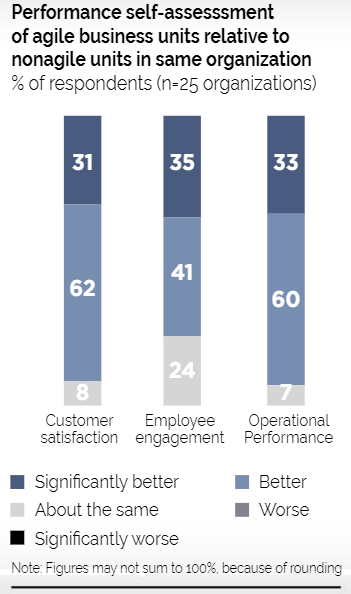
Agile proved its mettle not just across sectors but also within organizations. For instance, highly agile financial services companies and telecom players launched new services on average twice as fast as their nonagile peers. And on measures of customer satisfaction and operational performance, 90 percent of organizations told us that their agile business units performed "better" or "significantly better" than their nonagile units.
The key ingredients of agile's success
We also assessed the specific agile practices that had the greatest bearing on helping companies organize for speed during a period of intense disruptions. Our analysis highlighted the following elements:
- Empowerment and servant leadership. Empowered front-line teams, supported and trusted by the senior leadership, ensured a greater immediacy of response to changing on-ground realities. An Asian telecom company, for instance, did away with complex approval processes within days of the lockdown, and empowered its front-line executives to independently roll out popular content on its video-on-demand service to meet evolved consumer demands.
- Agile ceremonies. Any collaboration during times of crisis demands just the right communication balance—any more and you risk wasting precious time, any less and you risk the ball getting dropped. Therefore, structured team-level events, or agile ceremonies, were crucial for organizations to remain on top of constantly in-flux priorities. While some teams increased the frequency of their daily check-ins, others canceled all weekly staff meetings. A large Indian FMCG company, for example, shortened its planning-to-execution cycle to a daily rhythm to enable a dynamic response to the situation. This helped the company restore its trucking capacity twice as fast as many of its peers.
- Cross-functional teams. Few silos and a high degree of collaboration among functions, both trademarks of agile organizations, were critical to speed up decision-making and launch new services during the lockdown. A leading bank in India, for instance, mobilized executives from across tenures and business units to manage high-priority projects. These cross-functional teams helped the bank launch new features related to KYC (Know Your Customer/Client) and deposit renewals in just a few weeks.
- Customer-centricity. Adopting a customer-centric mindset, as opposed to one focused on processes, was also key to delivering in the trying lockdown times. Many companies intuitively made this shift. A leading telecom player, for instance, understood the heightened need for fast data to support the surge in video-conferencing across the country, and accordingly increased data limits for specific customer groups. This helped it not only to gain new customers but also to earn market goodwill.
Lockdown dispelled entrenched corporate myths
Pivoting to agile practices busted many myths across organizations. The first myth was that large organizations typically operate at close to 100 percent efficiency. This myth was debunked when many organizations delivered months of work in weeks—sometimes even in days—and, that too, at reduced staff levels.
The second myth was that co-location is essential for high-performing teams, even those with embedded agile practices. The lockdown disproved this belief, as productivity levels on average did not suffer due to remote working. In fact, many teams witnessed a productivity boost. In a McKinsey survey conducted in May, more than 30 percent of participants reported that their productivity had increased because of remote working, with one in ten citing a rise of as much as 50 percent in their productivity levels. All in all, about two in three respondents in the survey said that their productivity either increased or remained the same.
In the wake of this realization, many organizations across India are considering moving up to half of their workforce to hybrid models permanently. A financial services company, for instance, is planning to let its customer services division and support functions work remotely even as lockdowns lift across the country. Another Indian IT services firm has already announced plans to shift the majority of its workforce to a permanent work-from-home model by 2025.
The imperative now as India unlocks
Now that the benefits of becoming agile have been confirmed, the writing on the wall for CEOs and HR executives across organizations is clear: embrace agile. Executives could perhaps borrow a leaf from the book of a leading Indian conglomerate, which is applying the lens of "Is this necessary?" to reevaluate processes identified as “agility blockers”. The organization has already crowdsourced more than 150 ideas from its employees to support its transformation and has already implemented more than 40 to cultivate an agile culture.
As enterprises set out on their individual quests to turn more agile, they could benefit from the same framework. We call it RESET:
• REflect on what worked and why it worked
• Structurally Embed through pilots
• Transition by scaling successful pilots
At this crucial juncture in India's corporate history, speed will be of the essence—considering that many organizations have already crafted their agile strategies for the coming years. So, companies that are starting out now must hasten to act, as the price of inertia or a bureaucratic approach could prove to be disproportionately high.