





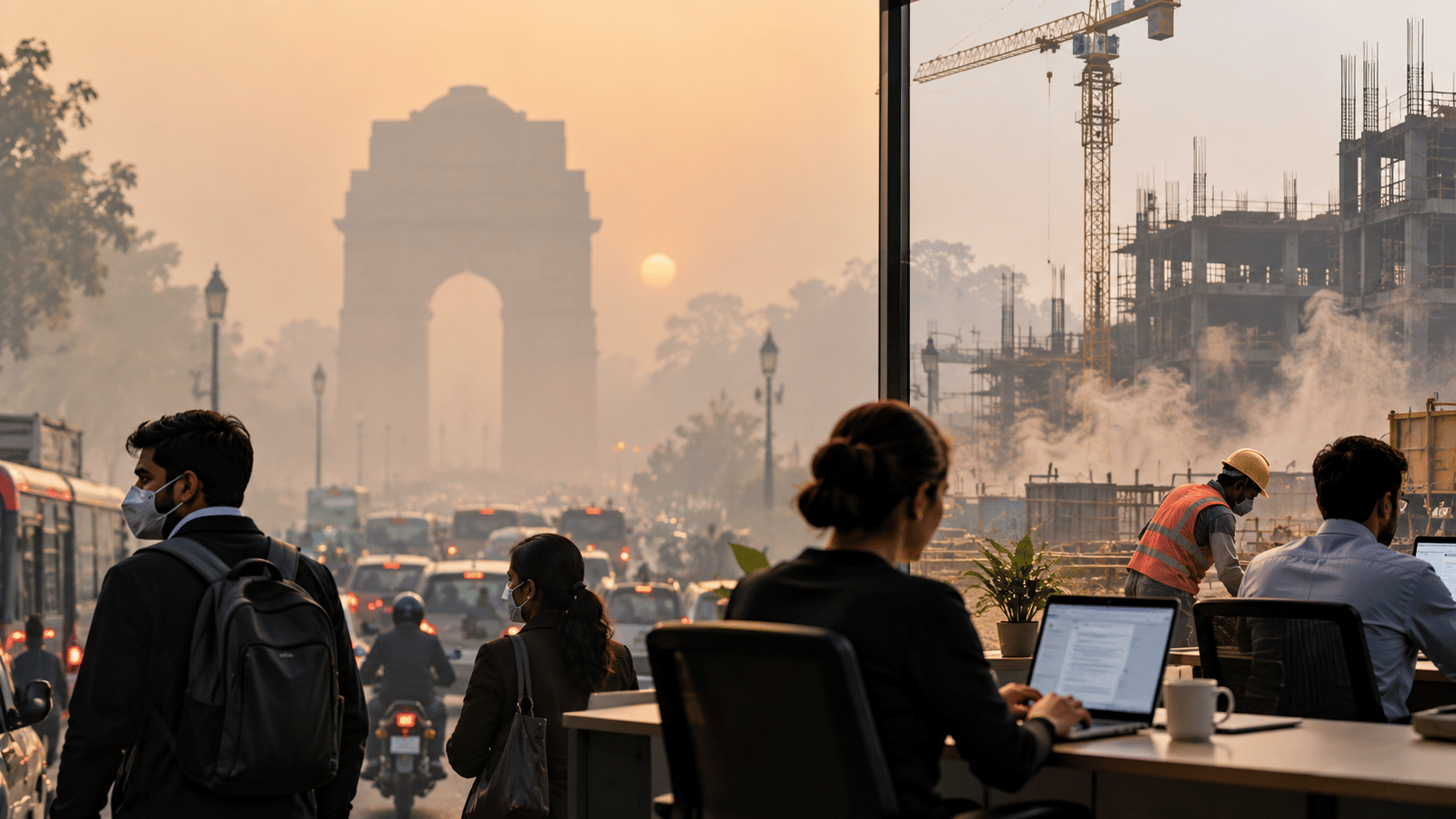
Delhi-NCR has activated Stage 1 of the Graded Response Action Plan (GRAP) as deteriorating air quality brings workplace arrangements and employee commutes into focus.
The restrictions, introduced for the first time this season, follow a sharp rise in Delhi’s Air Quality Index (AQI). According to the Commission for Air Quality Management (CAQM), the capital’s AQI reached 244 at 2 pm on 21 October 2026, entering the ‘Poor’ category.
The development has implications for daily commuting, government office schedules and outdoor work, although private employers face no blanket work-from-home requirement under GRAP 1.
The Delhi government plans to introduce staggered working hours and work-from-home arrangements for government and Municipal Corporation of Delhi offices to reduce vehicular movement.
For employers and employees across the National Capital Region, the immediate question is how pollution-control measures could affect everyday workplace operations.
What is GRAP 1 and why has Delhi-NCR activated it?
The Graded Response Action Plan is a framework of pollution-control measures implemented according to prevailing air-quality conditions across Delhi-NCR.
The CAQM activates different stages as pollution levels increase, with each stage introducing measures intended to control emissions and limit further deterioration.
The four stages are classified according to AQI levels:
GRAP 1, Poor: AQI between 201 and 300.
GRAP 2, Very Poor: AQI between 301 and 400.
GRAP 3, Severe: AQI between 401 and 450.
GRAP 4, Severe Plus: AQI above 450.
Delhi’s AQI increased from 179 on 20 October to 244 on 21 October, prompting the implementation of Stage 1 restrictions.
In its statement, the CAQM said forecasts from the India Meteorological Department (IMD) and the Indian Institute of Tropical Meteorology (IITM) indicated that air quality would remain in the ‘Poor’ category over the coming days.
The forecast suggests pollution-control measures could remain relevant to workplace planning, although the duration of restrictions will depend on subsequent air-quality assessments.
Will GRAP 1 change office hours or work-from-home arrangements?
The most direct workplace development concerns the Delhi government's plans to adjust working arrangements across public offices.
Delhi Environment Minister Manjinder Singh Sirsa announced staggered working hours and work-from-home arrangements for government offices and the Municipal Corporation of Delhi.
The measures are intended to reduce vehicular movement and ease pollution linked to daily travel.
However, GRAP 1 does not automatically mandate work from home for employees across private-sector organisations.
The reported arrangements concern government and municipal offices, and the announcement does not establish equivalent requirements for private companies.
For private employers, any decision to introduce flexible working hours or remote work would therefore require separate organisational consideration.
The distinction is important for employees seeking clarity on whether pollution restrictions will change their reporting schedules or attendance requirements.
How could the restrictions affect employees travelling to work?
Employees who commute by road could encounter changes linked to Delhi's efforts to control vehicular emissions and reduce traffic-related pollution.
According to NDTV, the Delhi government has announced several measures affecting vehicles, parking facilities and public transport.
Key developments include:
Pollution certificates: Vehicles without valid Pollution Under Control (PUC) certificates will not receive fuel under the announced measures.
Parking charges: Parking fees will be doubled across Delhi, excluding Metro parking facilities.
Metro services: The Delhi Metro Rail Corporation (DMRC) plans to increase weekday train trips from 22 October.
Traffic management: Authorities are using an AI-based traffic management system to reduce vehicular emissions.
Government office schedules: Staggered working hours and work-from-home arrangements are planned to reduce commuting-related traffic.
These measures could influence commuting costs, travel choices and the timing of journeys for employees travelling to offices across the capital.
The proposed increase in Metro services could provide additional public transport capacity as authorities seek to limit pollution from road traffic.
However, the report does not specify revised Metro frequencies or provide details about how individual private workplaces will respond.
What does GRAP 1 mean for outdoor workers and construction activities?
The restrictions also extend to construction sites, road maintenance and other activities associated with dust and emissions.
Sirsa said outdoor construction and demolition activities would face restrictions, while open burning would remain prohibited.
The government has deployed 608 anti-smog guns and 1,150 mist-spray units across Delhi to control dust pollution, according to NDTV.
An Integrated Command and Control Centre (ICCC) has also been established to monitor construction-related pollution.
Under GRAP 1, authorities implement measures covering mechanised road sweeping, water sprinkling, construction-site dust control and waste management.
The framework also includes checks on polluting vehicles and emission controls for industries, power plants and brick kilns.
For employers overseeing construction sites or other outdoor operations, the measures make compliance with applicable pollution-control requirements particularly relevant.
However, the report does not establish a general prohibition on outdoor employment or a blanket suspension of construction work under Stage 1.
What should employers and employees understand about the current restrictions?
The activation of GRAP 1 introduces pollution-control measures across Delhi-NCR, but its workplace implications differ between sectors and organisations.
Government employees could see changes to working hours or work-from-home arrangements under the Delhi government's announced plans.
Private-sector employees should not assume that GRAP 1 automatically changes office attendance requirements or creates an entitlement to remote work.
Employers with staff commuting through Delhi may need to consider the practical implications of parking changes, vehicle-compliance checks and public transport arrangements.
Organisations operating construction sites or other activities covered by pollution-control rules must also account for the restrictions applicable to their operations.
The current measures primarily target pollution sources rather than imposing a uniform change to employment arrangements across the region.
What happens if Delhi-NCR’s air quality deteriorates further?
The CAQM's forecast indicates that Delhi's air quality could remain in the ‘Poor’ category over the coming days.
A further deterioration into higher AQI categories could lead authorities to consider additional restrictions under subsequent GRAP stages.
For now, Stage 1 remains the applicable framework, with measures focused on dust suppression, vehicular emissions, waste management and other pollution sources.
The immediate workplace impact will depend on how government agencies implement the announced measures and whether individual employers adjust their operations.
For employees and businesses across Delhi-NCR, official air-quality assessments and subsequent government directions will determine whether further workplace adjustments become necessary.