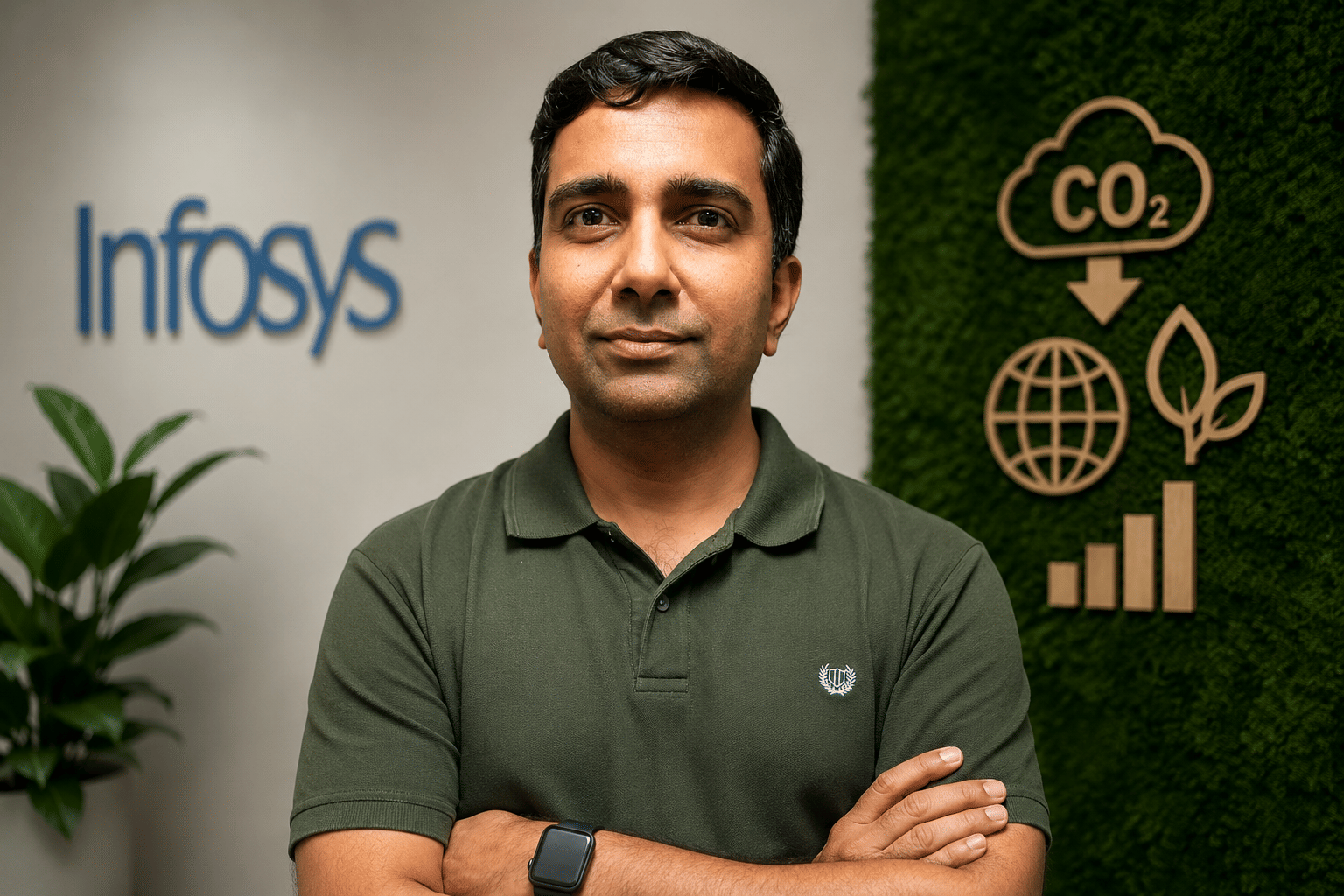
Authored by: Kunal Motwani
I often think back to a conversation I had with a young engineer during a visit to one of our manufacturing facilities. He had graduated from a top engineering college, had stellar grades, and was full of enthusiasm. Yet, when I asked him a simple question, “What excites you most in renewable energy?” he paused for far too long.
Finally, he admitted, almost apologetically, “We never studied anything about solar or renewables in college. I’m trying to learn now.”
That moment stayed with me.
Here was a bright mind, capable, eager, and ready, but shaped by a system that still prepares students for yesterday’s industries.
And this is not an isolated experience. I have met management graduates who can perfectly model a consumer-tech startup but have never been exposed to grid dynamics, green financing, or climate risk. I have met engineers who can code in multiple languages but have never seen a solar module up close.
India is building one of the world’s largest renewable energy ecosystems, but we are doing so with a talent pipeline designed for another era, and that mismatch now demands urgent industry-driven correction.
The Great Paradox: A booming industry, yet a shortage of experts
India’s renewable energy sector is growing at a pace few industries can match. At the same time, we hear of large-scale layoffs in traditional sectors like IT, leaving many talented engineers uncertain about their next step. And yet, by 2030, the renewable energy ecosystem will require nearly one million skilled professionals, project engineers, system designers, storage specialists, recyclers, grid analysts, and green finance experts.
Meanwhile, the technologies transforming our sector – AI-enabled predictive maintenance, digital twins, advanced cell architectures, smart grids, and large-scale storage – are advancing far faster than the system preparing students for them. Frontier solutions demand deeper technical understanding, but professionals trained in these areas remain limited.
This is not a crisis; it is an inflection point. India has the potential, scale, and ambition. With the right focus, we can build a workforce capable of leading the clean-energy revolution already underway.
How Do We Bridge This Gap? A Vision for the Next Decade
The scale of India’s renewable-energy ambitions makes it clear that skilling cannot simply be expanded; it must be reimagined. Encouragingly, the Skill Council for Green Jobs has certified over 5.5 lakh professionals across green sectors, while MNRE–NISE’s Suryamitra programme has trained 57,000 solar technicians. Leading IITs and universities have introduced advanced programmes in renewable engineering, storage, and grid modernisation, supported by over 1,000 new training centres and ITIs.
Yet the need remains vast. India faces a shortfall of 1.2 million skilled professionals, expected to rise as workforce demand grows by 26% through 2027. Meanwhile, the green economy is projected to create 7.29 million jobs by FY28 across manufacturing, project development, storage, grid integration, and services.
Closing this gap requires skilling to become a structural pillar of India’s clean-energy industrialisation. First, we must rapidly scale industry-linked training infrastructure by embedding skilling centres within emerging clean-energy hubs, manufacturing parks, module factories, storage-assembly units, and EPC clusters to train technicians and engineers on real assets, not just classroom simulations. Second, modular, lifelong learning pathways must evolve with technology. Academia and industry should co-create micro-certifications, short-term courses, internships, and upskilling tracks to keep today’s workforce relevant and tomorrow’s future-ready. Third, the industry must treat skilling and retention as strategic investments, offering career pathways, certification-linked wage growth, and on-the-job mentorship.
Beyond employability, skilling must now be viewed as a strategic lever of India’s global competitiveness. As the world seeks diversified clean-energy supply chains, India’s capacity to deliver high-quality manufacturing at scale will ultimately depend on the depth and precision of its engineering and technical talent. Talent, in this context, becomes not just a workforce issue but a geopolitical advantage.
Together, these steps can transform skilling from a reactive necessity into a competitive advantage for India’s renewable-energy transition.
Building More Than Just Infrastructure, Building National Capability
India’s clean-energy revolution will not be defined solely by gigawatts added, factories built, or modules deployed. It will be defined by the people who design, build, operate, and modernise this ecosystem. Beyond technical know-how, the next-generation workforce must also master cognitive skills, critical thinking, problem-solving, and adaptive learning to navigate complex, rapidly evolving clean-energy challenges. Developing these capabilities alongside hands-on expertise will ensure professionals can innovate, anticipate system-level issues, and make strategic decisions on the ground. Without a robust talent pipeline, even the most ambitious targets risk hitting a human-capital ceiling.
The same talent that powers India’s domestic transition will also determine our ability to serve global markets with reliable, high-quality clean-energy solutions.
For India to not only meet but lead the global clean-energy transition, skilling must be treated with the same seriousness as manufacturing, materials, or grid capacity. This is the moment to invest in education, in industry-led training, in continuous learning, and most importantly, in people.
If we do that, India will not just achieve its renewable goals; it will set global benchmarks for how a developing nation builds clean-energy capability from the ground up.
This is not just about green jobs.
This is about securing a resilient, inclusive and self-reliant energy future for India – and positioning the nation as a global anchor of clean-energy manufacturing, talent and trust.
Authored by: Kunal Motwani, Chief Operating Officer, Vikram Solar Limited