








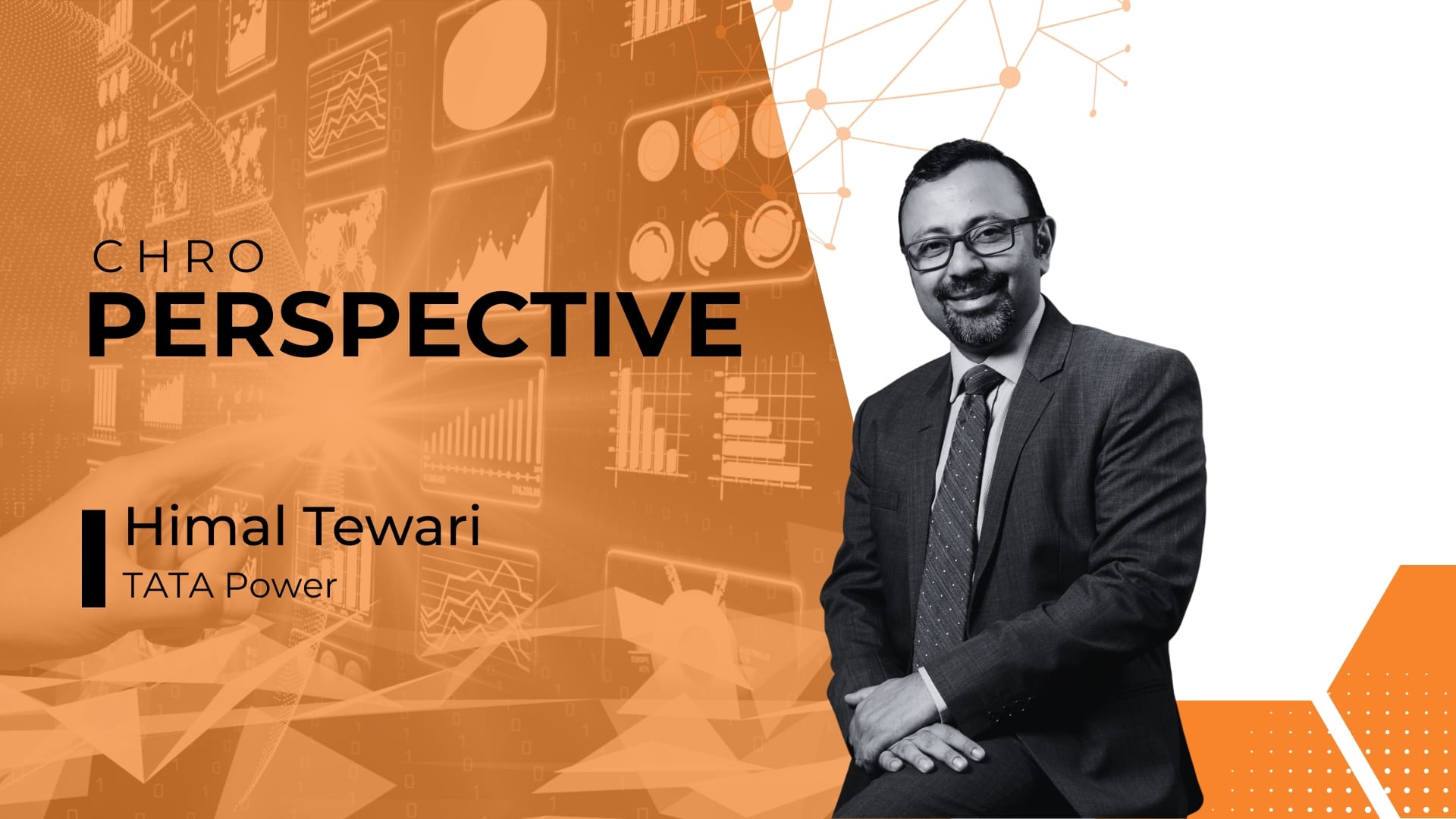
In an era where sustainability often appears as a separate corporate initiative, Tata Power's approach stands as a powerful counter-narrative. When you speak to Himal Tewari, Chief Human Resources Officer (CHRO) and Chief – Sustainability & CSR, Tata Power, what stands out is not just his clarity on the future of work, but the consistency with which he weaves sustainability, equity, and impact into everyday decisions. There's no lofty rhetoric. Instead, every policy, platform, and programme has a purpose — one that serves both the planet and people. "Our Employee Value Proposition (EVP) is built on three pillars — Sustainability, Oneness, and Growth," he says. "We don't treat sustainability as a vertical. It's horizontal. It cuts across everything we do."
In this CHRO Perspective, Tewari shares how Tata Power is building one of India's most forward-thinking, inclusive, and sustainable talent ecosystems — from remote solar fields to urban boardrooms. Through data, structure, and human-centric thinking, the company is making sustainability not just an outcome but an enabler of long-term business value.
Q. Let's start with the big picture. What does sustainability mean to you, personally and professionally?
To me, sustainability is about living with intent and being mindful of the impact of my choices, both personally and professionally. It’s about thinking long-term, beyond immediate gains, and aligning actions with a deeper purpose. This same principle lies at the heart of Tata Power’s legacy. Since our founding in 1906, our core purpose has been to provide “abundant, affordable, and clean power” - a vision rooted in societal progress and environmental responsibility. Today, that commitment continues through our EVP tagline, Purpose.Full. It reflects how we embed sustainability into every decision we make. Whether it’s the electricity we generate, the policies we shape, or the people we bring into the company, the goal is the same: to build a more sustainable and equitable future.
Q. How have you translated that philosophy into HR practices?
Translating that philosophy into HR practices starts with recognising people as whole individuals, not just roles. At Tata Power, this philosophy has been embedded in programmes like, "A Fuller Life", which supports and enhances multiple facets of employee well-being — physical, mental, emotional, and financial. This includes access to fitness and nutrition guides, mental health counselling, financial literacy, and community-building activities that nurture emotional connection and belonging. Importantly, A Fuller Life isn’t just for employees in our corporate offices; it extends to our technicians working at remote renewable plants, frontline staff, and even contractual workers. We've made a conscious effort to design this as an inclusive programme that addresses different life stages, work contexts, and personal circumstances. Every HR practice we design is guided by this belief. It has to be thoughtful, scalable, and inclusive — enabling our people to thrive in the long term.
Q. You mentioned remote sites — how do you ensure inclusion and well-being in those contexts?
Inclusion and well-being can’t be limited by geography and we take that commitment seriously across all our locations, including the most remote ones. Let me share a concrete example from our solar manufacturing facility, where we launched the Iron Women programme for our women operators. During routine assessments, we found a high prevalence of anaemia among the workforce. Instead of treating it as just a statistic, we initiated a structured health profiling and intervention plan. The results have been encouraging, and over 63% of the women workers have shown measurable improvements in their health scores. Going beyond physical health, we have also introduced one-on-one mental health counselling at factory locations. This is something that is often seen as a "corporate" benefit. But even at our plant locations, the response, especially from younger women, to this was overwhelmingly positive. It validated our belief that access and requirement for well-being support shouldn’t be limited by your level or location. Whether you're in a metro office or at a renewable energy site in a remote area, our goal is to ensure every employee is supported, seen, and empowered to thrive at Tata Power.
Q. How do you embed inclusion across cohorts — gender, disability, and generational diversity?
Inclusion has to be systemic. It has to be embedded in our hiring, training, and growth processes for people. At one of our plants, for example, we've hired over 100 Persons with Disabilities (PwDs). We backed this with an inclusive and enabling infrastructure like buzzers, LED safety displays, and more importantly, DEI coaches and peer-led integration. The result? Their performance metrics are consistently on par and often superior. Plant managers now proactively request more PwD hires. On gender, our focus is on mainstreaming women into core technical roles. We're currently at 14–15% women and are working towards reaching 18% over the next two to three years. We also invest in structural skilling, mentorship programmes, and visible career pathways. One of our business cluster presidents, a woman who began her journey in engineering, now serves as a strong role model for the next generation. From a generational lens, with over 40% of our workforce under 30, we’re intentional about creating a culture of collaboration. Younger employees bring agility and a deep climate consciousness; senior professionals bring experience, wisdom, and process maturity. Our role in HR is to build environments where these diverse cohorts don’t just coexist, but actively learn from and elevate one another.
Q. Given the relentless pace at which technology is reshaping every facet of the human experience, how are you strategically navigating this profound shift within HR to ensure it acts as an accelerator, not a disruptor, for your people strategy?
Technology has deeply permeated almost every layer of the human experience, and that is why we cannot discuss or plan the future of HR without keeping technology in the picture. At Tata Power, we see technology as an enabler, and not a replacement. We're leveraging AI, analytics, and integrated dashboards to improve decision-making. But data discipline is a core principle for us because without consistent data, AI insights or integration will be inaccurate and unhelpful. While we use tech to track climate action, we ensure that the data fed to our systems is granular and verifiable individual data. This data hygiene is of immense importance to us in our HR practice. We've clocked 100,000+ hours on LinkedIn sustainability learning modules, which is the highest in the country. We ensure that these hours translate into insights, conversations, and accountability to drive a genuinely meaningful change in our communities.
Q. What's the role of HR in embedding sustainability into the business model?
We've operationalised sustainability through our "Climate Crew" platform. Over 11,500 employees are part of it. They log actions like carpooling, recycling, conserving water, and even volunteering, and each action is linked to UN sustainability dashboards. It's not a campaign — it's a behavioural shift. Our goal is to scale this beyond Tata Power — to our employees' families, to communities, to suppliers. When sustainability becomes personal, it becomes permanent. We've operationalised sustainability through our "Climate Crew" platform. Over 11,500 employees are part of it. They log actions like carpooling, recycling, conserving water, and even volunteering, and each action is linked to UN sustainability dashboards. It's not a campaign — it's a behavioural shift. Our goal is to scale this beyond Tata Power — to our employees' families, to communities, to suppliers. When sustainability becomes personal, it becomes permanent.
Q. How do you hold leadership accountable for ESG goals?
We follow a full cascade model. Tata Group has committed to Aalingana — a set of sustainability goals around carbon neutrality, water conservation, zero waste to landfill, and biodiversity. These goals are broken down into metrics, which are mapped to every division, business leader, and manager. We use a tech platform to track progress across carbon, water, waste, and biodiversity. ESG isn't just a boardroom discussion — it's a daily operating rhythm.
Q. What about talent strategy? How are you preparing for the future of work in energy?
The energy sector is undergoing a tectonic shift from thermal to renewables, centralised to distributed grids, analogue to digital. This demands that the workforce is equipped with skills of the future. Our focus is on internal upskilling to ensure our workforce is ready to lead the transformation of the sector. Many of our current leaders in the renewables space began their careers in more traditional business clusters. Through a ‘just transition’ approach, we redeploy and reskill talent to ensure they stay relevant and empowered, ensuring that no one is left behind as the sector evolves. Beyond our internal efforts, we also run the Tata Power Skill Development Institute — one of India’s largest green skill-building initiatives. Through programmes like ‘Earn as You Learn’, we enable rural youth to pursue B.Voc degrees in renewable energy while gaining hands-on work experience. Our focus is to go beyond creating talent pipelines and democratising access to the energy transition by ensuring that the future of work in energy is inclusive, agile, and sustainable.
Q. In a world of automation and AI, where does empathy fit into HR?
Empathy is the Operating System. Technology helps with speed, scale, and precision. But technology cannot be used to replace human empathy which remains indispensable at a time when people may be struggling with burnout or navigating a career transition. Empathy creates a system of trust and support. That's why we train HR teams and people managers in "moments that matter" to listen, nudge, and support. AI can suggest a leave policy but for now only a human can sense that someone needs to be asked, "Are you okay?"
Q. What should the CHRO of tomorrow be doing differently today?
A few things. First, become tech fluent. Understand not just tools, but how they impact roles, performance, and experience. Second, embed sustainability as a horizontal — not a vertical. It must be embedded in job descriptions, leadership assessments, vendor engagements, and even down to how offices & plants are designed. Third, build deep integration with society. Our workforce must reflect the diversity of the communities we serve. Inclusion isn't a favour — it's an efficiency driver. Lastly, stay close to the business. Learn to speak the language of ROI, EBITDA, and enterprise risk. HR should be business-centric.
Q. And what about collaboration with the C-suite?
C-suite collaboration is essential because strategy is no longer a business charter but a people charter. At Tata Power, every business transformation from new energy ventures to ESG compliance requires HR to be part of the conversation from the very beginning. We've worked closely with our CEO and leadership to ensure people's strategy flows upstream, thereby influencing how we grow, diversify, and stay relevant
Q. One final question. What gives you hope that we're collectively moving towards a more positive and sustainable human-centric outcome?
The clarity and courage of young professionals. They ask difficult questions about purpose, climate, inclusion, and equity. They want to work at places that reflect their values. When I see the Climate Crew volunteers organising events, or when I see operators from marginalised backgrounds becoming role models - I know we're on the right path. Sustainability isn't an initiative for them but an expectation. And that's exactly as it should be.
This story is part of CHRO Perspective. A People Matters series featuring bold ideas and real-world insights from India’s top CHROs. Stay with us for more perspectives that power the future of work.