








Everyone wants a greener India. Few people are talking about the workforce needed to build it.
Solar parks do not build themselves. Neither do wastewater treatment plants, climate-resilient cities or smart water networks.
Behind every sustainability target is an engineer, technician, hydrologist, data scientist or plant operator. India is investing heavily in greener infrastructure, but the workforce required to deliver those ambitions is struggling to keep pace.
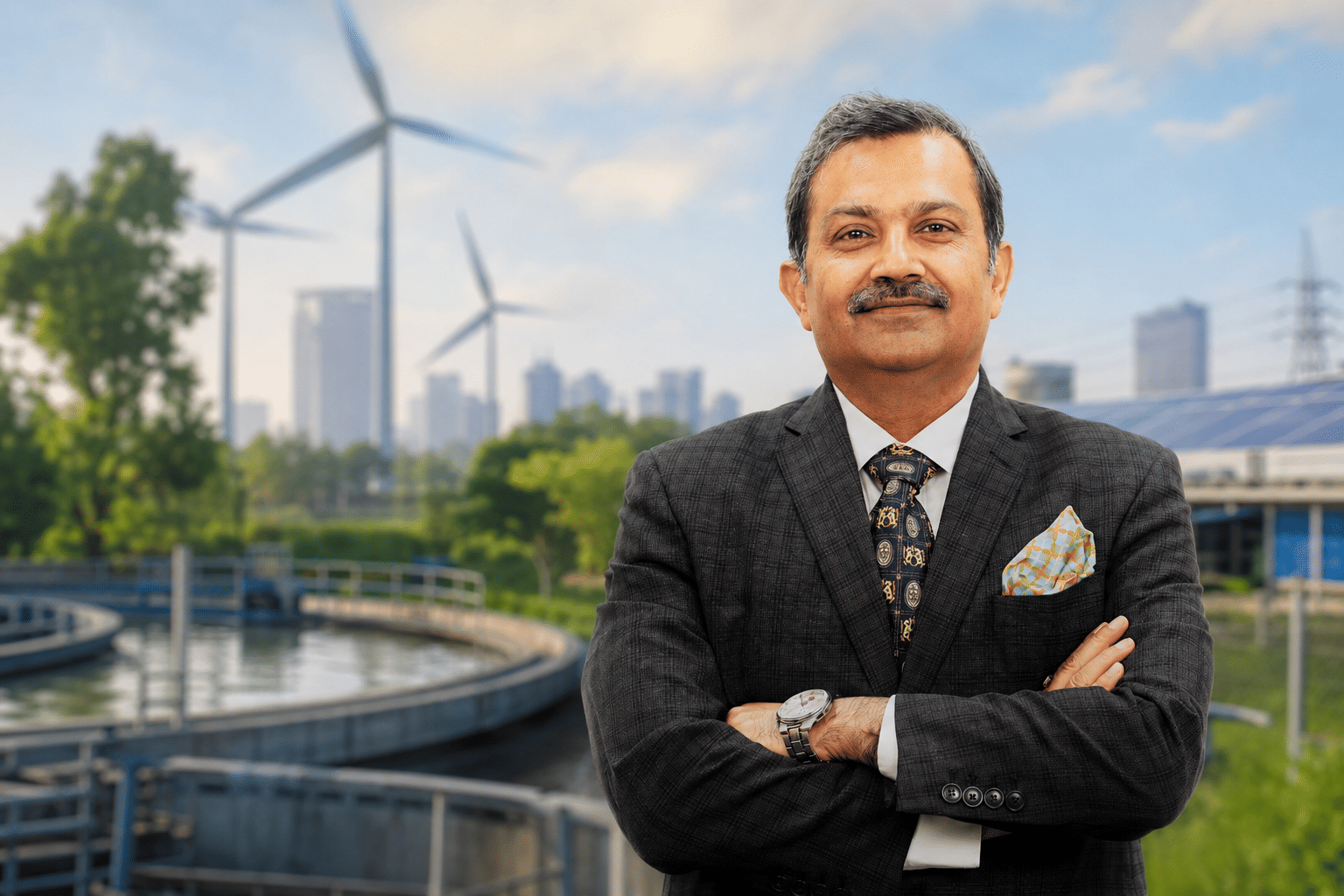
For Rajesh Jain, Group Chief People Officer at Vishvaraj Environment, India's green transition is as much a workforce story as it is an infrastructure story.
Speaking to People Matters, Jain says employers are no longer dealing with a conventional hiring challenge. Instead, they are confronting a workforce problem unfolding on multiple fronts.
The pressure is building across every layer of the workforce. Entry-level hiring is becoming harder. Experienced professionals are increasingly difficult to retain. Technical roles are evolving faster than universities can prepare graduates.
The scale of the challenge becomes clear in the data.
India's 18.5 million green workforce will need to "nearly double in two decades," while renewable energy alone is already short by 1.2 million workers, a figure projected to reach 1.7 million by 2027. Water and wastewater infrastructure is facing "the same squeeze."
Hiring, however, is only one part of the story.
Jain points to "frontline attrition of around 30% in contractual renewable energy roles," driven by demand outstripping supply.
At the same time, employers are finding themselves caught between increasingly sophisticated operations and graduates who often arrive with only one area of expertise. Modern facilities rely on SCADA, IoT, predictive maintenance and ESG, yet, as Jain puts it, the pipeline continues producing "single-skilled engineers."
Climate is popular. Green careers are not.
Perhaps the biggest contradiction sits elsewhere.
Young Indians consistently rank climate change among the issues they care about most. Purpose increasingly shapes career conversations. Sustainability has become part of employer branding across industries.
Yet environmental infrastructure still struggles to attract graduates.
Jain calls it "a visibility paradox."
Drawing on Deloitte's 2025 findings, he notes young Indians care deeply about climate. But according to CAG, only 35% of urban youth can identify what a green job actually is.
The problem is not interest. It is imagination.
As Jain puts it, "'Sustainability' defaults to an ESG analyst in a Mumbai high-rise," not "a process engineer at a wastewater plant or a hydrologist in a Tier-2 city."
He identifies "career imagination, sector storytelling, and geography" as the biggest barriers. Remote, short-cycle infrastructure projects remain particularly difficult to staff because many graduates never picture themselves building careers there.
The jobs exist. The career aspiration often does not.
Jain says Vishvaraj is designing its employee value proposition around "Pride in Sustainability" to begin closing this imagination gap.
Purpose gets people through the door. Learning keeps them there.
Purpose has become one of the defining themes in conversations around younger workers.
Jain agrees, but with an important caveat.
According to Deloitte 2025, "90% of Gen Zs cite purpose" while "70% rank sustainability in employer choice." Yet, in his words, "day-to-day behaviour lags."
Purpose may attract candidates. It rarely retains them on its own.
Instead, organisations need to "tell a genuine impact story inside the employee experience (not just on the website)," offer "learning velocity, not tenure-based progression," and "design site-anchored and hybrid-enabled tracks honestly."
Ultimately, Jain says retention depends on respect and whether "the role kept its promise on learning, exposure and impact in the first 18 months."
Culture is becoming a bigger differentiator than salary
Compensation remains important, but Jain believes workplace culture is becoming an even stronger differentiator for younger talent.
He describes its influence as "decisive arguably more than compensation."
According to Deloitte 2025, 25% of Gen Zs research a company's environmental policies before accepting a job. Environmental infrastructure should naturally benefit from this shift.
Instead, Jain believes many employers are still playing by outdated rules.
He says organisations continue to recruit using "2005-era job descriptions" while benchmarking workplace culture against utility companies rather than technology and consumer businesses.
For him, "the honest impact narrative and culture parity with modern employers are our two biggest levers."
Within Vishvaraj, "manager capability and frontline dignity are measured KPIs, not aspirations."
AI is quietly rewriting green jobs
Technology is changing environmental infrastructure far faster than many people realise.
Modern water and wastewater assets increasingly depend on SCADA, IoT, digital twins, predictive maintenance and AI-assisted anomaly detection.
Jain says this transformation is creating three immediate workforce requirements.
The first is "hybrid talent (engineering + digital + commercial)." The second is "mobile-first frontline tools," because "no young technician will accept paper logbooks in 2030." The third is the emergence of entirely new jobs, including "asset analytics leads, ESG data scientists, digital-twin engineers," roles which, as Jain notes, "did not exist in our org charts five years ago."
Building these capabilities requires both hiring and reskilling.
Jain says Vishvaraj is following a "build-and-buy mix," recruiting specialist AI and data professionals externally while "30–40% of mid-career engineers" are being reskilled internally.
Building a green workforce will take more than recruitment
No organisation can solve the talent shortage alone.
Jain outlines what he describes as "five practical levers, all of them under-glamorous." They include:
- Campus and ITI partnerships, including ongoing discussions with SCGJ, which has trained more than 100,000 workers.
- Internal academies capable of reducing a fresh engineer's learning curve from 18 months to under 12.
- Rotation-based leadership pipelines blending technical and commercial experience over a six to eight-year period.
- Targeted investments in women entering green careers, noting only 10% of women globally possess a green skill compared with 17% of men.
- Codified green-skill premiums built into career frameworks instead of relying on ad hoc retention bonuses.
India's green transition needs a workforce plan
Looking ahead, Jain believes India's climate ambitions will require structural changes extending well beyond corporate hiring.
He outlines "four structural moves, working in concert." These include:
- A "demand-visible National Green Workforce Plan" supported by rolling 10-year sector and district-level forecasts.
- Curriculum reforms embedding digital instrumentation, ESG, climate risk and circular economy into mainstream education, supported by UGC and AICTE recognition for micro-credentials.
- A stronger Tier-2 and Tier-3 skilling backbone, co-located with infrastructure clusters, similar to India's automotive manufacturing hubs.
- An "employer compact to professionalise the frontline" through dignity, safety, fair wages and certification portability.
Jain also says Vishvaraj is talking to IITs about joint research on sustainable designs and plans to increase industry-academia collaboration.
His final observation captures both the urgency and the opportunity.
"The window is open," he says, and "the next five years will decide whether climate-resilient industries become an aspirational career destination or remain a hidden corner of the economy."
India's green transition is often measured in investments, renewable capacity and infrastructure projects.
Its long-term success may ultimately depend on something much simpler. Whether enough people choose to build the future they already say they believe in.