The BFSI industry has never been short of transformation narratives. Every few years, a new wave arrives—digitisation, mobile banking, fintech disruption, regulatory shifts, platform businesses, AI. Yet despite unprecedented investment in technology and workforce development, many organisations continue to grapple with the same question: why does transformation still feel slower than expected?
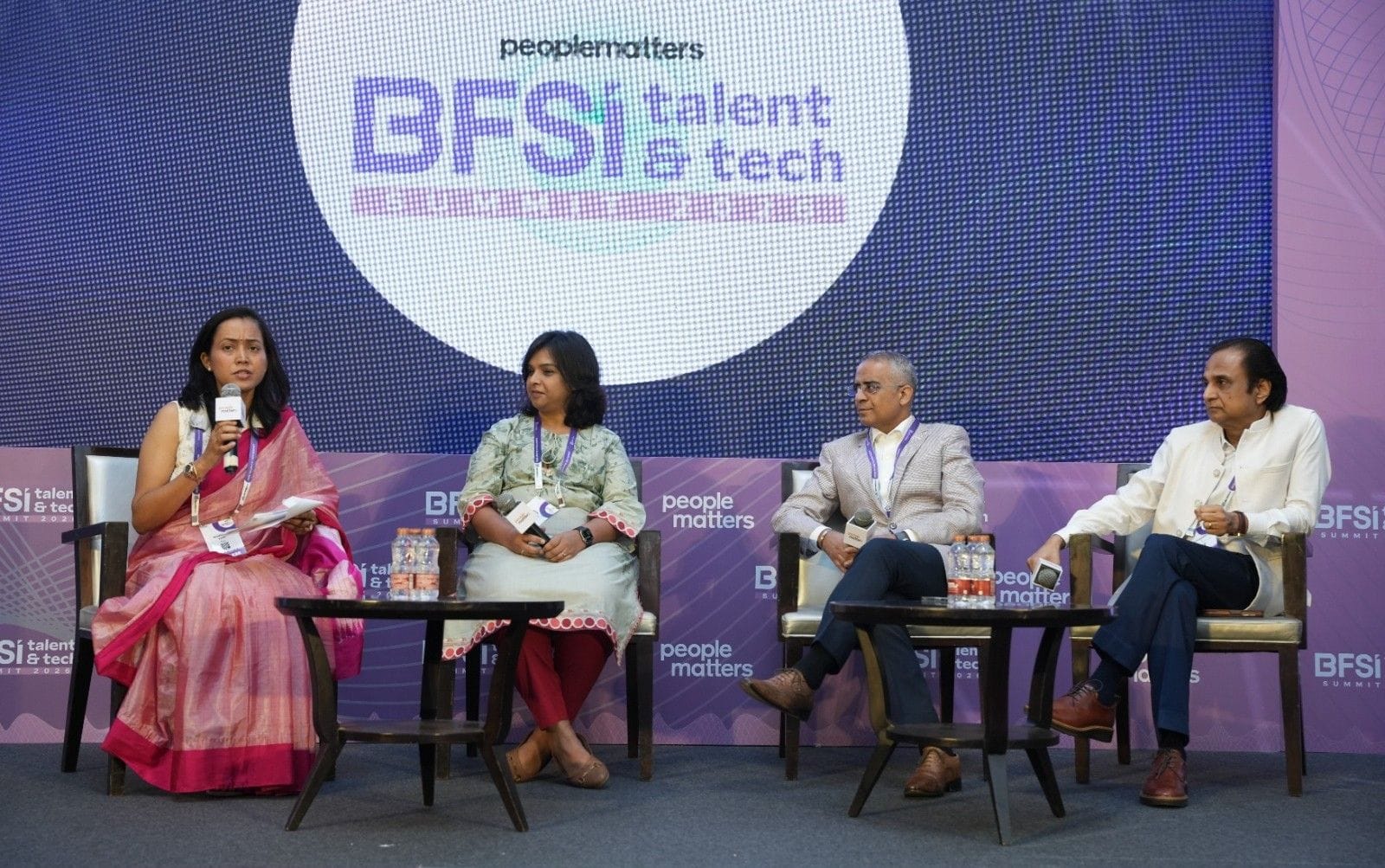
The discussion opened on why, despite large investments in skilling and technology, organisations still struggle to see transformation translate into lived change. The issue, as the discussion revealed, is not simply the availability of skills. It is whether organisations are willing to rethink control, ownership, culture and capability from the inside.
The old BFSI talent playbook is being rewritten
The first shift is in what BFSI organisations hire for. Deep financial services expertise still matters, especially in a regulated industry where trust, risk, compliance and customer protection remain foundational. But the idea that domain depth alone can carry a career is beginning to weaken. The future BFSI workforce will require professionals who can combine functional expertise with learning agility, digital fluency, problem-solving, collaboration and ownership. As the panel reflected, the assumptions that once governed hiring are changing because the work itself is changing.
For Shivshanker SV, BFSI’s transformation must be understood within the realities of regulation and trust. A bank cannot operate with unrestricted freedom because the customer’s relationship with the institution is built on the belief that their money is safe. But he argued that guardrails do not prevent innovation; they can, in fact, force organisations to think more creatively within boundaries.
Speaking from Standard Chartered’s experience, he placed mindset and co-creation at the centre of transformation. In one example, he recalled a process simplification exercise that reduced nearly 1,300 processes to about 400 without waiting for automation to do the work. The lesson was clear: before leaders ask what technology can fix, they must ask what teams can simplify, standardise, stop doing or do differently.
That insight is especially important for BFSI because transformation often gets positioned as a technology-led agenda, when it is equally a mindset-led one. Shivshanker was direct when asked whether capability or mindset worries him more. His answer was mindset, because many leaders and employees are committed to the idea of change but not always to the actions and behaviours required to make it real. Transformation, in his framing, requires people to internalise change rather than participate in it temporarily.
From control to ownership
If traditional BFSI has often been associated with hierarchy, structure and controlled decision-making, fintech has brought a sharper focus on speed, customer-backward thinking and distributed ownership.
Zacharias captured this shift with one of the strongest observations from the session. “The future of BFSI is not going to be owned by the companies that have the biggest balance sheets, it’s going to be owned by the companies that work customer-backward, that bring high velocity in learning, in ownership and in execution,” she said.
At PayU, this philosophy is being translated into how work is structured. Zacharias explained that the organisation has broken its short-term strategy into strategic key result areas and distributed them deep across the organisation. Decision-making and ownership are pushed closer to the point of execution, with cross-functional teams built around strategic priorities rather than traditional pyramids.
Rewards, too, are being aligned to recognise contribution towards those strategic outcomes rather than only individual performance. The broader argument is that strategy and execution cannot remain the preserve of the CEO or the top leadership team if organisations want speed, innovation and accountability to travel through the system.
Zacharias also warned that the talent of tomorrow will not respond to the old language of control, structure and hierarchy. “Talent tomorrow is not going to respond to the traditional lens of control and structure and hierarchy; talent of tomorrow is going to respond to the lens of context, the why we do what we do, and the lens of ownership and agency,” she said.
In a sector where regulation and risk discipline will remain critical, this does not mean abandoning structure. It means redesigning structures so that employees have enough context to make better decisions and enough agency to act on them.
Culture cannot be outsourced to HR
For organisations with distributed workforces, the talent rewire becomes even more complex. Tilak spoke from the reality of Piramal Finance, which operates with thousands of employees spread across hundreds of branches and multiple states. In such an environment, the challenge is not simply designing culture at the centre, but ensuring that employees at the last mile understand and experience it consistently.
Tilak was clear that culture cannot be treated as an HR-owned campaign. At Piramal Finance, he said, leaders fully own the culture, purpose and values agenda rather than outsourcing it to the HR function. The organisation has focused on codifying behaviours, communicating them in simple language, reinforcing them through leadership-led roadshows, recognising culture champions and creating listening mechanisms that help leaders understand lived experiences on the ground. His point was practical rather than rhetorical: in a distributed workforce, culture travels only when leaders repeatedly make it visible, understandable and relevant.
Zacharias added a sharper lens to the culture debate by arguing that culture is ultimately defined by what organisations allow. “You can talk about culture in the sexiest language that you want to. You can have the best posters up there, but at the end of the day, the behaviour that you tolerate, the behaviour that you allow in the organisation is the culture that you’re setting,” she said. When asked later on whether culture should be about enablement and free will rather than tolerance, she clarified that it is not an “or” but an “and”.
Organisations can articulate culture beautifully, run training programmes and embed values into processes, but if they let unacceptable behaviour pass without consequence, that behaviour becomes part of the silent culture.
This was one of the most important takeaways from the discussion because it moved culture away from abstraction. Culture is not only what organisations declare. It is what they reinforce, what they reward, what they ignore and what they are willing to confront.
Capability building must become leader-led
The panel also challenged the way organisations think about capability building. Shivshanker spoke about Standard Chartered’s Talent Marketplace, designed to democratise opportunities by allowing employees to build skills, choose projects and prepare themselves for future roles. He shared that the business case for internal upskilling was clear because hiring externally for future skills can be significantly more expensive than building them internally.
The larger point was that skilling cannot remain a centralised programme that employees consume passively. It must become a system where people can discover opportunities, apply themselves to real projects and build relevance continuously.
Tilak made a similar point from the culture and capability lens. Just as culture cannot be outsourced to HR, capability building cannot be left to HR alone. Leaders must own it because they understand the business context in which skills will be applied. This matters particularly in BFSI, where a workforce may be spread across branches, functions and customer segments, and where capability must be built close to business reality rather than only through standardised classroom interventions.
The audience discussion brought this into sharper focus when the question of educational institutions and skill gaps came up. Shivshanker argued that the curriculum has to evolve with industry needs and that collaboration between academia and industry must improve.
Zacharias added that as AI democratises coding and access to technical tools, the differentiator will increasingly be the ability to ask better questions, understand problems and build problem-solving muscle. Her view was that traditional teaching methodology must shift from simply teaching students to making them think, solve and practise agency in real time.
Adaptability is overtaking experience and expertise
The rapid-fire round brought the discussion back to what the future BFSI workforce will value most. When asked what would matter more — experience, expertise or adaptability — the answer that emerged was adaptability. This did not mean experience and expertise are losing relevance. In a sector like BFSI, they remain essential. But their value increasingly depends on whether they can evolve with new technologies, customer expectations, risk models and business realities.
The same theme appeared in answers on workforce expectations. Purpose, resilience, flexibility and demonstrated skills were identified as important markers of the future workforce. The panel also suggested that qualifications alone may carry less weight over time as demonstrated skills and experiences become stronger signals of readiness. This is an important shift for BFSI because the sector has historically relied heavily on credentials, tenure and domain experience. The emerging question is whether those markers are enough in a world where job categories, customer journeys and business models are being redrawn.
On change fatigue, the panellists offered a grounded response. The answer is not to deny fatigue, but to anchor change in purpose, learning agility and visible leadership behaviour.
Zacharias said that leading with a sense of purpose helps employees understand why change is happening. Tilak pointed to learning agility as a cultural capability that helps people absorb new concepts and try new things. Shivshanker added that leaders must embrace change in the language they speak and the spirit they demonstrate, so that change feels less like a forced initiative and more like a journey people can experience and engage with.
The real talent rewire
By the end of the session, one conclusion was difficult to miss: BFSI’s transformation is not a single shift from legacy to digital. It is a continuous re-architecture of work, leadership and culture. The sector must preserve trust while encouraging innovation, retain rigour while enabling speed, and build capabilities for jobs that are still evolving. That requires more than reskilling programmes or technology investments. It requires leaders who are willing to redraw job architectures, redistribute ownership, build cultures of accountability and make learning part of how work gets done.
Concluding the discussion with a powerful metaphor, Kaur said changing direction is easy when a ship is docked at the shore, but far harder when it is in the middle of the sea, carrying passengers, navigating harsh weather and operating within regulatory constraints. BFSI is in that moment now. The ship cannot stop moving while leaders redesign it. That is why the real task for HR and business leaders is not to manage change from the sidelines, but to own it from within.
The talent rewire, then, is not just about preparing employees for new technology. It is about building organisations where people have the mindset to adapt, the context to decide, the agency to act and the culture to sustain change when transformation becomes a permanent condition.