For decades, workforce planning in financial services was built around stability.
Business leaders forecast growth, estimated hiring needs and created three-to-five-year talent plans to support expansion.
According to a panel of BFSI leaders at the People Matters BFSI Talent & Tech Summit 2026, the very notion is losing relevance.
"Three to five years in today's scenario is a very big cycle right now. I would say three to five months is a much better approach with AI and disruption coming in," said Dr Harpreet Singh Anand, CHRO, Protean eGov Technologies Ltd.
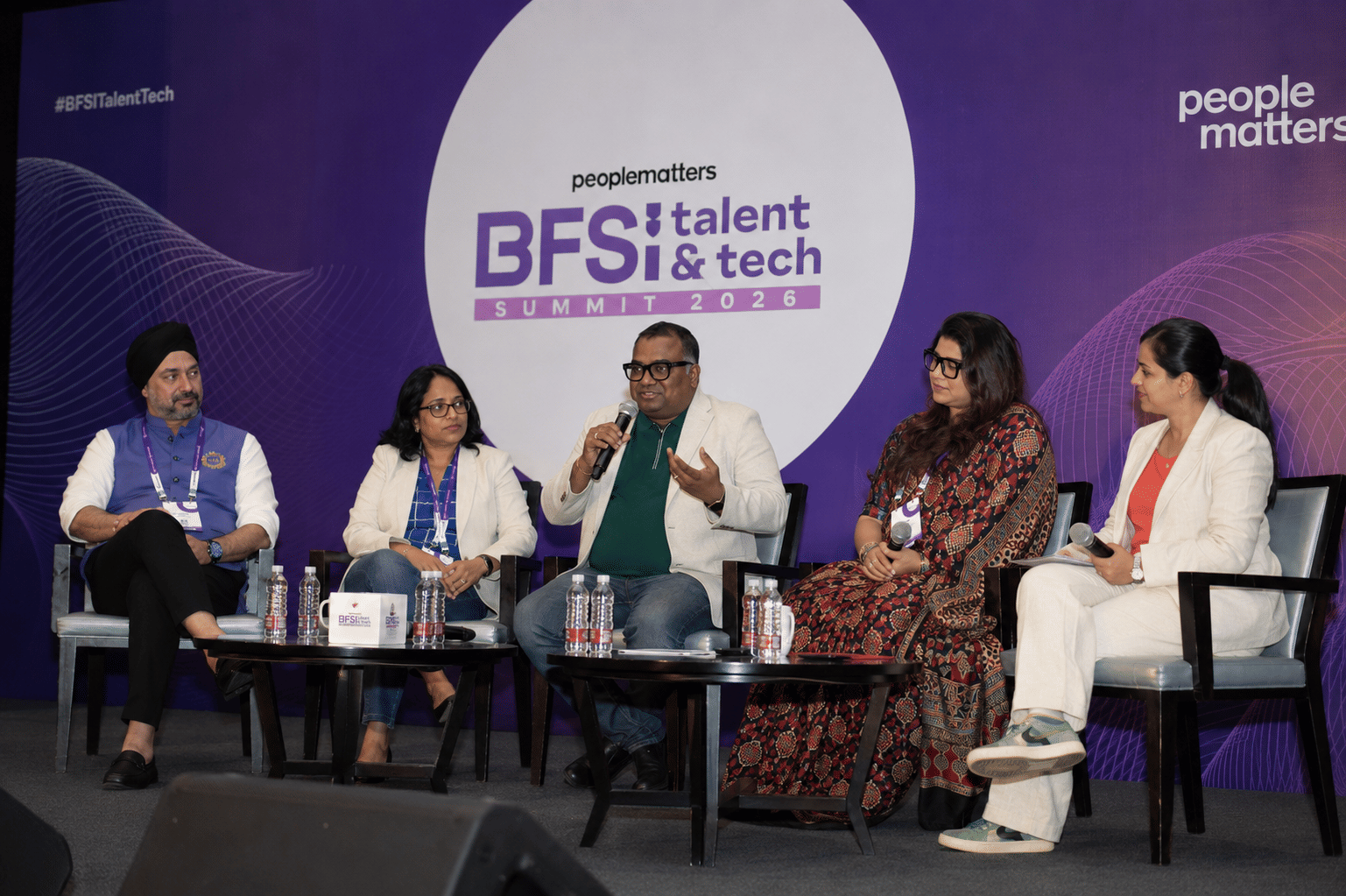
The remark captured the mood of the discussion during the session, "Skills Intelligence: How BFSI Should Rebuild Talent Architecture", where leaders explored how artificial intelligence, changing workforce expectations and evolving business models are pushing organisations away from traditional manpower planning and towards capability-based workforce strategies.
The session brought together Beena More, Former SVP & CHRO, Bank of India IM; Nisha Rodi, Head - HR, NPCI BHIM; Suresh Kumar Sivaraj, CHRO, Muthoot Fincorp Ltd.; and Dr Harpreet Singh Anand, moderated by Cheshta Dora, Head of Research & Content, People Matters.
Planning for skills, not positions
One of the strongest themes to emerge from the conversation was the growing disconnect between traditional workforce planning models and the pace of technological change.
Anand said organisations are no longer focused on forecasting how many employees they need at different levels of the hierarchy.
Instead, the conversation has shifted towards identifying the capabilities required to execute business strategy.
"We are not actually doing the manpower planning the whole way that we are getting the headcount planning done. The planning is more on the skill. What is the skill that you require in this financial year or the next financial year?" highlighted Dr Anand.
The focus, he explained, increasingly centres on questions around AI capability, engineering talent and supporting skills needed to enable transformation programmes.
Beena More, Former SVP & CHRO, Bank of India IM, agreed that capability requirements have changed dramatically over the past few years.
"The pattern of capabilities across the skills that we are looking into has changed."
More noted that organisations have moved from navigating post-pandemic digital acceleration to managing the impact of generative and agentic AI.
As a result, workforce planning horizons have narrowed considerably.
"We have come from the traditional manpower planning of three years or so, truncated to about three months or six months."
AI agents enter the organisation chart
While discussions about AI often remain theoretical, Anand shared examples of how the technology is already altering work structures.
He described how Protean deployed AI agents within its pre-sales function to identify opportunities, analyse RFPs, generate summaries and support bid-related decision-making.
"We have created eight AI agents which now end-to-end manage the entire RFP pre-sales business."
The development has already produced measurable organisational changes.
"As of now, in my organisation, there are 14 roles which have already been taken over by AI agents."
For HR leaders, the implications extend beyond automation.
The emergence of AI agents is changing how organisations think about workforce composition, budgeting and organisational design.
"Today you have on-roll employees, off-roll employees and AI agents."
Talent scarcity remains a stubborn reality
Despite the excitement around AI, Suresh Kumar Sivaraj, CHRO, Muthoot Fincorp Ltd., brought the discussion back to a challenge many BFSI organisations continue to face every day: finding enough skilled people.
"This BFSI industry is struggling with lack of manpower. Whatever skill we require, do we have? We don't have."
Sivaraj said many organisations are forced to balance ideal skill requirements with the realities of the labour market.
Waiting for perfectly qualified candidates is often not an option.
Instead, organisations need mechanisms to identify potential and develop capability internally. "The first stage is that we just look for certain trainability."
At Muthoot Fincorp, this has resulted in greater emphasis on role-specific development programmes and learning pathways designed to accelerate employee effectiveness.
"We have gone away from the general orientation programme to role-specific orientation programme."
Why NPCI is hiring for capability over credentials
The conversation around skills intelligence also raised questions about how organisations evaluate talent.
For Nisha Rodi, Head - HR, NPCI BHIM, traditional hiring practices no longer provide a reliable picture of future performance.
"We do not hire for pedigree or experience. We hire for skills."
NPCI has moved towards assessing candidates through real-world problem-solving scenarios rather than relying primarily on conventional interviews.
"What we are assessing is their ability to think and solve."
The organisation has applied a similar philosophy internally.
Over the past few years, NPCI has assessed employee capabilities through structured challenges designed to identify existing strengths and emerging skill gaps.
"Today we very clearly know what are the skills every employee possesses and what are the gaps that the organisation has."
The visibility enables more targeted learning interventions while helping the organisation prepare for future capability requirements.
Skills intelligence starts with strong foundations
While many organisations are eager to embrace skills intelligence, More cautioned against viewing it as a technology solution alone.
Before organisations can build sophisticated skills ecosystems, they need basic talent foundations in place.
"Do we have the skill metrics? Do we have competency metrics? Did we do job evaluation? Do we have proper training roadmaps?"
More questioned whether organisations have genuinely become skills-based or are simply adding skills terminology to existing structures.
"Are organisations fully equipped, skill-based today as we speak? Not really." She also challenged assumptions around workforce adaptability.
"There is no age for unlearning, reskilling or doing this." According to More, capability building must be embedded into performance systems and business outcomes if organisations want meaningful transformation rather than symbolic change.
The rise of the techno-functional professional
As AI becomes embedded across business functions, the panel agreed that traditional role definitions are beginning to blur.
Sivaraj argued that technical fluency can no longer remain confined to technology teams. "Nobody can call themselves functional. They have to call themselves techno-functional."
The expectation applies across functions, including HR, sales, operations and compliance. "I cannot call myself an HR expert. I need to say I'm a techno-functional guy who understands how to deploy AI in my function."
Anand echoed the sentiment, suggesting that while many jobs will continue to exist, the capability threshold required to perform them successfully will rise.
"Roles will still be there, but the proficiency level expected from a human is at an L3. L1 and L2 proficiency-level skills will no longer work."
A future built on adaptability
The panel revealed no consensus on exactly how AI will reshape the future workforce.
What emerged instead was a shared recognition that workforce planning, hiring and capability development can no longer operate on assumptions that held true even a few years ago.
Some organisations are deploying AI agents into core workflows. Others are rebuilding hiring systems around demonstrated skills. Many are still grappling with talent shortages and capability gaps.
Across those perspectives, one message remained consistent: in an environment where technology, business needs and employee expectations are changing simultaneously, adaptability is becoming one of the most valuable organisational capabilities of all.