









According to a 2015 Association of Talent Development study, 62% percent of HR managers believe that they are not meeting each individual’s learning needs. At the same time another study highlights that ineffective training techniques could cost a company up to $13.5 million a year per 1,000 employees. Is localization the right solution? Why localizing training courses is important across levels, scale of businesses and modes of training? What are the trending language technologies for localizing training content?
Gourmet meals, spa sessions, flexi timings, paid paternity leaves, diversity—sounds like heaven for employees?

Well, these are some of the parameters on which Fortune adjudged “Best companies to work for in 2017”. Another important parameter these organizations are rated on is “Training”, and most of the companies who featured in this list take their credo to training very seriously.
Average number of training hours at these organizations is around 60 hours per employee.
As per Brandon Hall Data report, training expenditures have doubled in the US, from $13.3 billion in 2014 to $28.7 billion in 2017.
In today’s global economy, the need for training spans across collars/levels, geographies and company size. It is no longer just the big corporations who need to speak to their clients and employees in multiple languages, it is a strategic imperative for small and mid-sized businesses as well to cater to their global stakeholders (clients, employees, investors et al).
A quick glance at some of the important reasons to localize training courses:
So why is it important to localize the training content in local languages?
Besides the obvious need to make it understandable, here are a few underlying reasons quoted by Mayflower’s e-learning clients:
- It helps the message to stick – training messages, especially by leaders, tend to stick better when imparted in the local language.
- Ensures no misinterpretation and promotes workplace safety – Misinterpretation of training content can lead to serious hazards on the shop floor and can lead to accidents.
- Helps focus on the subject matter – Learners can focus on the topic rather than trying to translate and interpret the English content in their minds.
Blue collar or white collar or Leadership?
Which type of training content needs to be translated?
Is it just the compliance training courses or is it important for the managers or leadership also to receive training in their native language? Apparently, yes!!
Leaders need to convey important messages about change management or inspiring anecdotes to their teams. One of the best ways for such messages to have an impact is via storytelling, and stories are most relatable when they are culture and language specific.
Kinds of trainings for which clients turn to Mayflower to localize these or to add voiceovers and subtitles:
- Leadership training
- Product training
- Compliance training
- ERP/Application training
- Safety training
- Policies training
- Sales training
- Process training
We have a success case about implementation of training programs for a popular MNC restaurant chain. These were via our client who developed the original content and Mayflower helped with the localization process. The programs included different levels of learners spanning leadership, mid-management and shop floor employees. Content was diverse and learning requirements were different. And the media strategy was diverse too with usage of Storyline, After Effects, PPT (of course !), InDesign!
French, Arabic, Chinese, Spanish and Russian were the languages chosen by this MNC to speak to their global teams. These languages were in line with their market strategy and these are often the 5 most popular languages that companies chose to localize as Wave 1. These are followed by other popular languages such as Portuguese, Japanese, Korean and Hindi.
It showed the commitment of the food giant to implement localized training for all levels of employees. This evidently improved their customer service and amplified employee productivity in these 5 markets.
Language technologies and training – a match made in heaven?
There is a lot of buzz around the words Machine Translation (MT), Post-edited Machine Translation (PEMT) which simply put, means automating the translation process by using reliable Statistical Machine Translation engines, with or without human intervention. Then there is Translation Memory (TM), which is creating a repository of your existing human translated data and using it for the next version of translating content. Repetitions and fuzzy matches are the number of “exact repeated segments” within a document.
“Can the training content use MT or TM technology for localization?”, is the question often asked by Mayflower’s clients. Our answer is yes, and no. A lot of English training content aspires not to be monotonous and is written to bring unpredictable assessments or creative interactivity, so surely this content should not be left to the machines to be translated. We can, however, leverage “repeated segments” within large sized documents to take advantage of the tools and technologies. This is typically true for ERP trainings, where a lot of content gets repeated to explain processes and sub-processes.
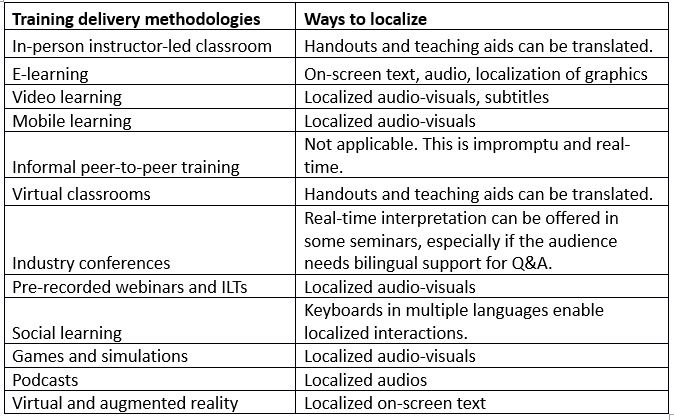
Let’s look at some of the training delivery methods and ways to make them multilingual:
Nifty and Thrifty solutions
L&D teams and HR leaders are finding innovative ways to unleash the potential of their culturally diverse resources. At the same time, with scrimped training budgets, the need to come up with thrifty solutions is immense. This further extends to localization spends, and there are creative ways to do it within the budgets. Clients do want to improve the reach and effectiveness of training programs and are more aware of ways to measure training ROIs. So, they do want good quality, impactful audio-visual elements. Great quality outputs while doing it on a dime is not always possible.
Some tips for cost-saving:
- Dubbing or subbing? Our e-learning clients tend to compare these 2 options and while dubbing is more impactful and quicker, subbing is cost-effective. But, localization is most effective when all the elements audio, on-screen text and subtitles are localized.
- Instructional design (ID) teams need to carefully draft the icons and graphics taking accurate locale-specific colors, currencies, date formats and culturally sensitive images at the storyboarding stage rather than as an afterthought.
- Keeping the on-screen text minimal is always a good idea.
- Adding captions below the images instead of text on the images always helps save image localization costs.
- For European languages, text expands by around 20-30%, so the boxes need to have this extra space.
- Arabic and Hebrew projects are probably the toughest for localization as the text is aligned right-To-Left (RTL) and all images become mirror images if the source course is in English. It requires ActionScript tweaks than a simple copy-paste of text effort. Hence, it makes sense to have slightly more budget and time for integration in these languages.
- Minimum abbreviations and use of colloquial phrases – ID methodologies tend to create short forms and abbreviate points as a summation and retention method. But these go against localization ease, for example, ADDIE expands as (Analyze, Design, Development, Implementation, and Evaluation), and it is quite difficult to find word equivalents in say, Chinese. Ditto with colloquial phrases, which might not find a local equivalent.
- Showing alternating visuals – if the rollouts are planned in 2 countries, and if it is fine by the client, alternating currencies or on-screen text in bilingual format could also be proposed. More suited for short video learning projects.
- For product training videos, it's best to add both voice and subtitles so that complex words can be caught well.
The world today is closer than one would think and yet there is a need to strike a chord with your learners by adding personalized touches in the visuals, speech, and words. As rightly said,"Give a man a fish and you feed him for a day. Train a man to fish and you feed him for a lifetime".