









Many of us once faced envious comments while working from home, the pandemic has changed this outlook. Unabated official commitments and juggling between personal commitments with lack of support mechanisms has given work from home a newer meaning. Suddenly people who always felt work from home is a boon, have started finding it to be a difficult proposition.
Many organizations have already shared their future plans for remote working. While this offers benefits - work life flexibility, low carbon foot prints etc. the reality is, this too has its dark side. The question that now arises is - Are we aware of this dark side? And how do we mitigate?
The problems with remote working
For many, remote working would have brought a shocking lack of social interaction and complicated work-life dynamics, causing deterioration to mental health. Let’s take a look at what some of the reasons might be:
- Isolation: As social animals, human beings are used to a certain level of interactions. Lack of such connect can lead to a feeling of loneliness, and that throws a big risk at employers, not only in terms of work productivity but also emotional well-being of staff.
- Disconnected with mental health services: Mental health support volunteers in office find it difficult to diagnose risks for staff remotely, and hence on-time support becomes difficult.
- E- Presenteeism: E- Presenteeism refers to being available for co-workers online, beyond expected hours of work. Many face difficulties in switching off from work because of such culture and expectations.
- Burnout: Remote workers have always complained of working beyond hours, either because more work gets allocated or because parallel working with colleagues is not possible causing more time allocation to each piece of work. Sometimes, also because remote workers wish to do more to please line managers or justify remote working.
All of these pose a high risk of burnout for remote workers, leading to something similar to what the Japanese call ‘Karoshi’ (death caused by overworking, often due to stress).
Psychological Capital
As you see, the psychic costs of remote working may be much higher than we imagined, which leads me to Psychological Capital (Psycap). A concept of Positive psychology, coined by Fred Luthans and other colleagues, he also refers to them as the ‘HERO within’.
Psychological capital refers to positive emotions, engagement, promoting collaboration, and is said to have an impact on attitudes, behaviors, performance, and employee well-being. Currently a lot of us must be facing a considerably low Psycap. The good news is that we can build on these HEROS that are linked to employee well-being. Let’s explore how:
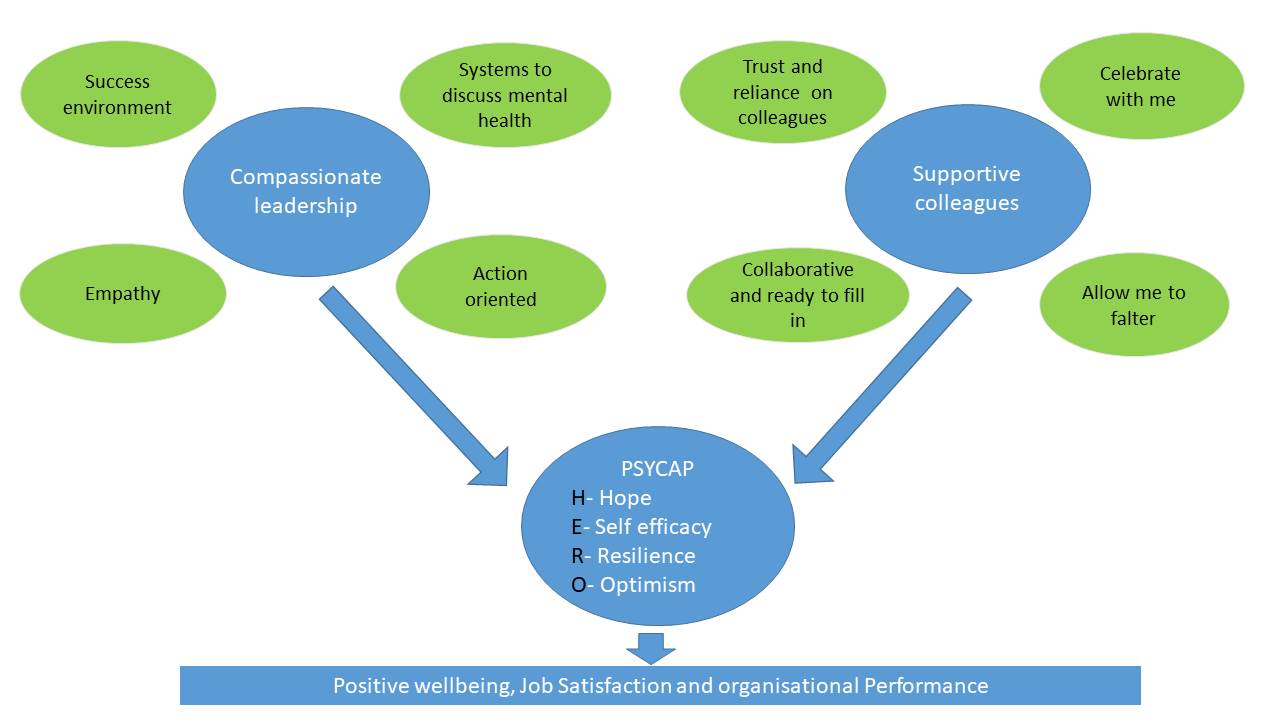
How Leaders can impact Psycap?
Leaders have a crucial role to play as they endevor to build on the psychologicla capital of their workforce. Here is how they can lead and contribute:
- Role model acceptance of vulnerability: Most leaders set the tone for their teams, and if you can role model taking resilience breaks, it passes a message that it’s okay to be vulnerable.
Allow breaks when someone does not feel upto the mark.
Not limiting well-being to physical wellness and recognizing emotional health will go a long way to build trust and resilience.
- Well-being action plan: Engage with your team to have a well-being action plan (WAP) for themselves. This should be owned by them and they should consult you when needed. The WAP should allow them to think about - what stresses them, what motivates them, when are they most productive and what support will help them during periods of poor mental health.
- Identify the vulnerable: There will always be people who will be more vulnerable towards depletion of Psycap or who may need specific support to build on their HEROS more eg; single parents, people who lack family support, people living alone, people with poor tech support due to geographical reasons. Identify them and work with them.
- Informal systems: It's important that you allow informal communication around the subject of mental well-being, either by way of setting up peer-to-peer groups or by setting-up support mechanisms for times when someone does not feel okay. This allows conversations and builds better acceptance and openness towards the concept of mental well-being.
- Realistic vs. ambitious goals: As mentioned earlier, most remote workers are prone to over-committing, falling prey to the ‘always-on’ attitude. It’s important that leaders watch out for these and set corrections positively by helping teams set realistic goals.
- Be mindful: Most leaders have adapted to frequent communication sometimes leading people to feel overwhelmed.
It is considered good to resort to over-communication when in doubt, but given remote working will remain for longer, there is a need to revisit such communication strategy.
- Environment to succeed: Appreciation plays an important role, but it isn’t limited to recognizing efforts. It's about helping the person see what helped him/her/them excel and allow a recreation of that environment. Reiteration of past success and taking a note of what helped the individual succeed, helps boost confidence, efficacy and hope for more success.
Can we as individuals participate in building Psycap?
Organizational culture is made up of how people treat each other; individuals have a larger responsibility to shape this culture. Here are my recommendations to help you build your and your colleagues Psycap through these 5 pillars:
- Connect: Most of us are going to miss those face to face connections, so make it a point to socialize virtually. If possible have a routine to connect with at least two / three of your colleagues once a week and talk about off-work things. It enhances the feeling of belongingness.
- Take notice: When talking to your colleagues, practice active listening. Pick up on clues. If you feel that your colleague needs support, start a conversation around what’s disturbing them, offer support. Small empathetic conversations are helpful in building strong bonds.
- Don’t judge: Most of us are currently going through micro tragedies.
So if your colleagues are not themselves at times, don’t judge. Look for an appropriate time and try to speak to your colleague about their behaviour or the situation when they were not being themselves.
- Self-compassion: It is said that an empty cup can’t pour. First be kind to yourself, know your well-being, and be open to reaching out to your friends, colleagues when you need them.
- Celebrate: Ensure you journal small achievements, and not limit your writings to your to-dos. This will give you a larger sense of achievement and motivation.
COVID-19 has probably been the first, and many pray for it to be the only pandemic in their lifetimes. However, many researchers have pointed out that the next upcoming pandemic, a mental health crisis, is around the corner. While a considerable amount of our life is spent on work and associated social circles, this responsibility cannot be shouldered only by organizations. Each one of us has a role to play. Building on Psycap will be a journey, on which we hopefully begin today.