Advanced technology is rapidly transforming the way businesses used to work. In this competitive environment, where organizations are striving hard to be a preferred choice, adopting digital transformation to automate, streamline and make the informed data-driven decision is imperative. With the availability of huge data and sources to store and process data, it is now possible to use data insights for multiple applications. Artificial Intelligence has acted as a lever to catapult the use of Big Data by helping organizations in predicting future outcomes. AI emphasizes building smart machines which nearly exhibit human-level intelligence while making a decision. Machine Learning is a subset of AI which collects, uses, and analyzes data to identify the patterns through learning algorithms on similar data sets and derive insights that can be used to take actions.ML does not take action itself, when its data insights are used to make decisions without human intervention, is when AI comes into the picture. “AI in Human Resources” - the phrase may sound like a paradox that may be self-contradictory but is turning out to be a truth considering the way technology is revolutionizing how organizations run the business now. AI has proven to have multiple use cases in HR if backed by correct data. It can definitely be a facilitator to transform HR to a strategic partner by advocating data-driven decisions instead of good old gut feeling ones. People Analytics coupled with AI and human interventions as and when required can be the best combination in providing solutions to unsolved problems.
How AI can transform HR -
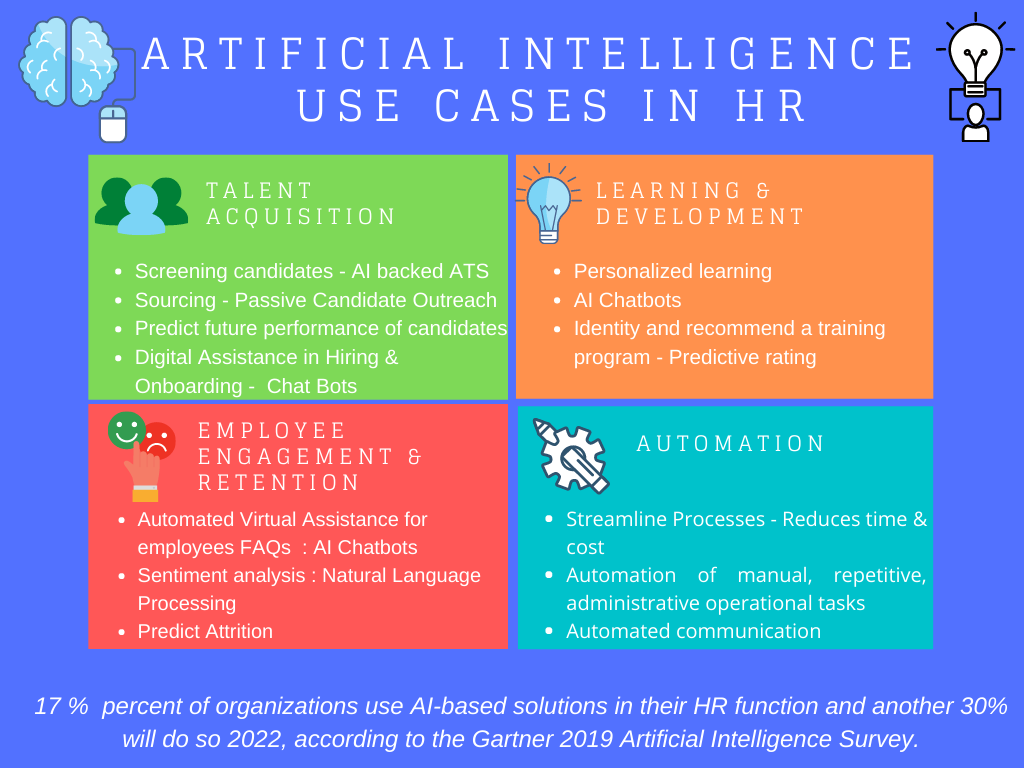
In addition to data-driven insights and predictive analysis for decision making, AI can enhance the candidate and employee experience by automating repetitive tasks and streamlining the processes. It can free up HR from mundane administrative tasks, complicated excel sheets, and paperwork. The saved time can be used in more productive activities of building relationships with clients, employees, candidates and focus on strategies. In fact, to deal with times like COVID -19, organizations have become open to adopting AI-backed HR Tech solutions to improve the productivity and performance of the function. Here are some of the use cases of AI in HR-
Talent Acquisition
According to the 2019 Artificial Intelligence in the Recruiting Industry benchmark report of CEIPAL, SaaS provider of staffing companies - two-thirds of all staffing firms will adopt AI-driven ATS by the end of 2020, while 79 % of enterprise staffing firms (firms with more than 100 recruiters) will have done the same.
- AI can automate the screening efforts of recruiters and find the best match from a pool of hundreds of candidate’s applications received through the one-click Apply button. It can rank qualified candidates on top based on a matching algorithm for resume with data points from the job description or pre-screening questionnaire scores. Applicant Tracking System (ATS) backed with AI, ranks the potential candidates with high match scores for the recruiter’s manual reviews and saves on time by disqualifying irrelevant applications. Data Scientists suggest that ML models like Latent semantic analysis can be used to discover the similarity between two documents i.e. resume and job description through keyword match/similarity scores.
- AI can help to identify passive candidates who may show interest if reached out by the analysis of social media and online data related to prospective candidates which may include data points like education, social media post, experience, skillset, recommendations, etc. The response of a candidate can be predicted by data scientists using artificial neural networks and Regression i.e. probability between 0 to 1.The best source/channel of applications for open requisition can also be identified.
- While hiring, it may be possible to predict the future performance of candidates as an employee through AI by using past credentials and interview assessment/performance scores. The input data will be past credentials and performance scores which can be used to predict the future. Again simple artificial neural networks may work for this.
- AI can enhance candidate engagement and experience of the recruitment process through digital assistance in the form of automated processes and chatbots. Assistance provided in the form of cognitive and rule base chatbots for application, pre-screening, scheduling interviews, conducting video interviews, or answers to common questions can improve a recruiter's as well as a candidate’s experience.
Learning & Development
With the new normal post COVID-19, L&D has become the top most priority of organizations for upskilling, reskilling, cross functional skilling and continuous learning of its employees to make them relevant in the uncertain future ahead. It is revolving around being a Personal, Precise, and Proactive approach for employees.
- AI in combination with an effective LMS can help to create personalized learning tracks for employees based on their skill set needs.
- AI chatbots can be integrated into LMS which can answer questions 24x7 and provide real times automated assistance during a training program. It can also list out training courses based on employee’s interests, skill gaps or queries to create an enhanced learning experience.
- AI can also facilitate identifying and recommending a training program for an employee by analyzing ratings provided by similar kinds of employees to different training programs and select the programs that a specific employee may like. Data scientists recommend the User item recommendation technique of ML using deep learning and word embedding for desired outcomes. It works on the same concept as in E-commerce/Netflix by generating recommendations of products/services to customers/viewers using ML. Training course recommendation is based on the highest predicted ratings that employees may give to each of the courses not taken.
Employee Engagement & Retention
Employee engagement is considered an important factor that drives employee productivity and retention.
- This can be enhanced through automated virtual assistance for self- service of employees. Whenever employees have any questions around policies and procedure for benefits, insurance, leaves, reimbursements etc. they don’t need to write or ask HR but can refer the chatbots /virtual assistant instantly for human-like communication.AI backed chatbots have the ability to comprehend the natural language questions from employees and map them to document/guide of that respective topic in form of direct links or short answers. This too may work on the similarity score concept of the Latent Semantic Analysis technique of ML. This can prove extremely beneficial in case of repetitive questions or FAQs and save time of employees as well as HR.
- AI can also help HR practitioners in tracking the pulse of employees through sentiment analysis via communication platforms like employee engagement survey feedback, chatbots or internal post on any of the topics related to work. The text used can be an indicator to assess whether content of the message is positive, negative or neutral. It can act as an alert in case of low levels of employee engagement or motivation which might cause attrition and needs to be immediately addressed. It’s just like a natural language processing technique.
- AI models can be used to predict Attrition considering data points/attributes like tenure in the company, performance ratings, number of promotions/promotion duration or compensation which may push employees to take a decision to leave.HR can be proactive by fixing the problems of employees and prevent employee turnover costs.
Automation
- The streamlining and automation of the workflows help to reduce the time and cost. The repetitive and high volume administrative tasks can be performed by AI tools leaving HR to concentrate on building meaningful engagement and relationships with employees and candidates. It also enables HR to enhance its role as a strategic business partner than just transactional activities.
- AI-enabled automated communication can help to disseminate required info like policy changes, internal announcements etc. among employees in no time.
- ATS backed by AI can help to generate automated messages based on the status of candidates and communicate the same to candidates and hiring managers thereby reducing the workload of recruiters. It can also automate the scheduling of interviews, send feedback or status of candidature in the recruitment process.
Conclusion
Whether AI will replace humans from human resources function - will be too big a statement to make as AI is a facilitator, not a complete solution. It can help to give data-driven insights which coupled with human interventions can provide optimal solutions. The huge amount of input data used for AI should be properly stored and managed as it has sensitive employee personal data which is generally kept private and confidential. If HR is able to identify precisely what questions they want to get answered or what problem you are trying to solve, what are the benefits, what data inputs into the algorithm will be useful, AI can do wonders. There may be initial challenges around lack of skills, quality of data or understanding use cases of AI. But if HR, technology teams, and data scientists work in tandem, AI can re-imagine the way HR function works. The automation, operational analysis, and predictive analysis provided by AI techniques can definitely help to increase productivity and performance of HR function, and contribute to enhancing its role as a strategic partner in an organization.