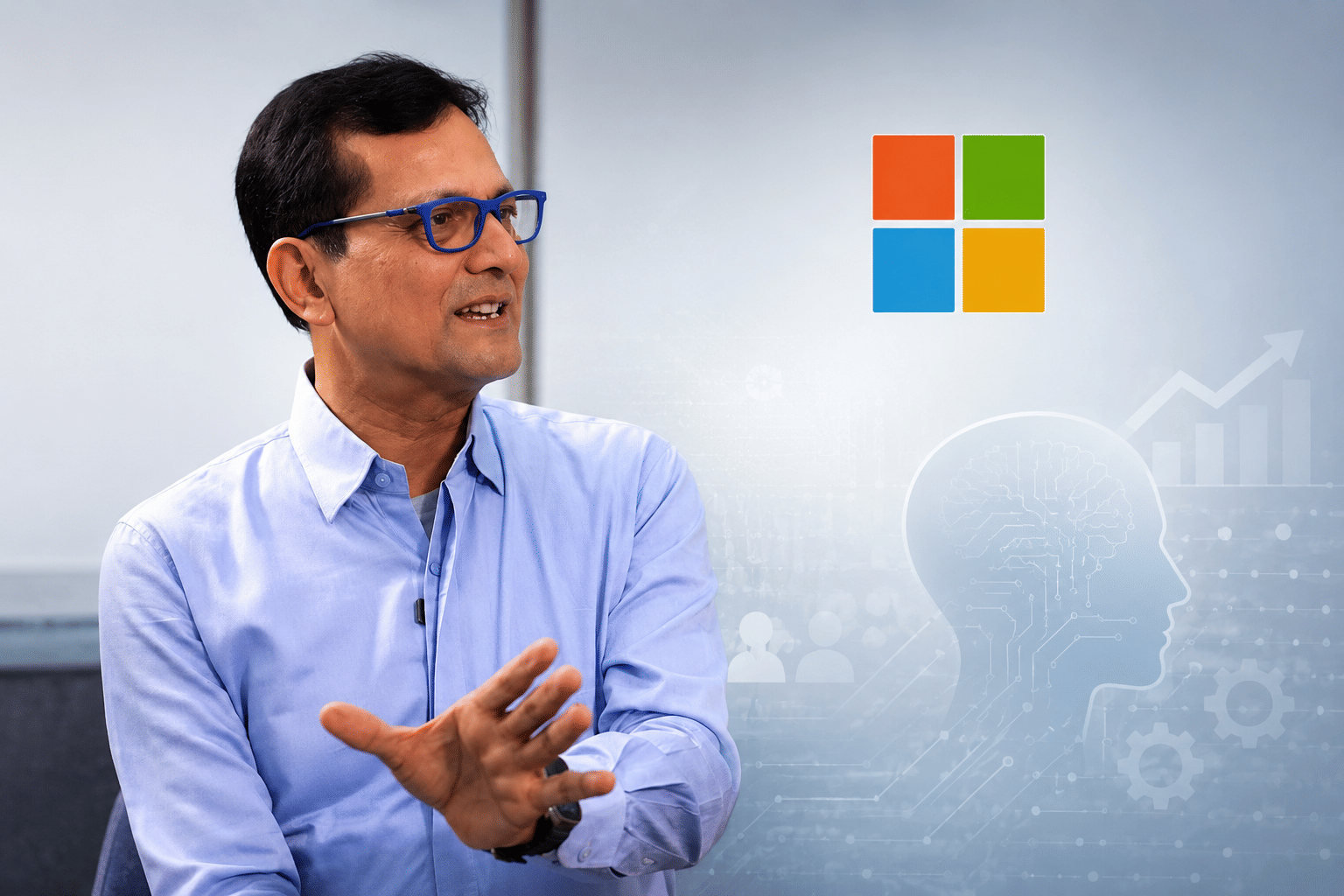
Artificial intelligence is enabling workers to perform tasks that would have been beyond their capabilities just a year ago, according to Rajiv Kumar, Managing Director and President of Microsoft India Development Center (IDC), who says the technology is reshaping careers around collaboration rather than replacement.
Writing in a Microsoft commentary published on 11 June, Kumar pointed to findings from Microsoft's latest Work Trend Index 2026 report, which found that 58% of AI users globally say they are producing work they could not have done a year earlier, while 66% report spending more time on higher-value activities as AI takes on routine execution.
The comments come as concerns over AI-driven job displacement continue to dominate discussions around the future of work. Kumar said the conversation among young engineers is already shifting from fears of replacement towards understanding how to work alongside AI effectively.
“The question has shifted from ‘Will AI replace me?’ to ‘How do I collaborate with AI?’”, he wrote.
Skills disruption accelerates across industries
Kumar linked the growing importance of AI collaboration to broader shifts taking place across the labour market.
Citing the World Economic Forum's Future of Jobs Report 2025, he noted that 39% of core job skills are expected to change by 2030, highlighting the pace at which technological advances are reshaping workforce requirements.
For India, the challenge is particularly significant.
According to the report, 63% of the country's workforce will require substantial upskilling or reskilling by 2030, creating pressure on both employers and workers to adapt quickly to changing job demands.
Key workforce trends highlighted by Kumar include:
• 39% of core job skills expected to change globally by 2030
• 63% of India's workforce projected to need reskilling or upskilling by 2030
• 30% of Indian employers have adopted skills-based hiring practices, compared with a global average of 19%
• More than 85% of organisations globally are prioritising upskilling and reskilling in response to AI-driven change
Kumar said these figures demonstrate why adaptability and continuous learning are becoming increasingly valuable in career development.
Employers focus on learning potential
The Microsoft executive said hiring practices are evolving alongside technological change.
Rather than assessing candidates solely on their current knowledge, organisations are increasingly evaluating their ability to learn and acquire new skills.
According to the World Economic Forum data cited by Kumar, 30% of Indian employers have already adopted skills-based hiring, significantly above the global average.
He suggested that this trend reflects growing recognition that career success in the AI era will depend less on static qualifications and more on the capacity to adapt as technologies and business needs evolve.
Kumar also referenced the book Open to Work: How to Get Ahead in the Age of AI by Ryan Roslansky and Aneesh Raman, noting that modern careers are increasingly defined by continuous experimentation, skills development and learning rather than rigid career plans.
AI moves beyond automation into cognitive work
Beyond productivity gains, Kumar said AI is increasingly serving as a cognitive partner rather than simply an automation tool.
According to Microsoft's Work Trend Index 2026 findings cited in the article, nearly half of interactions with AI copilots support higher-order cognitive activities, including:
• Analysing information
• Solving problems
• Creative thinking
• Idea development
Kumar described this shift as a movement from command-based interactions towards collaboration, where AI augments human decision-making rather than simply executing instructions.
"As AI takes on more execution, human agency is expanding," he wrote.
New expectations for engineers
Kumar argued that the changing nature of technology work requires engineers to focus on capabilities that remain difficult to automate.
He identified three areas that will become increasingly important:
• Strong technical fundamentals, including systems thinking, algorithms and architecture
• Continuous learning and experimentation with emerging tools and technologies
• Judgement and decision-making, particularly around determining priorities, understanding customer needs and evaluating outcomes
While AI can generate outputs and assist with coding, Kumar said human judgement remains critical in deciding what problems are worth solving and what success should look like.
India positions itself for an AI-led future
Kumar also highlighted India's strategic position in the global AI landscape, citing the country's large engineering talent base and growing digital ambitions.
He noted that Microsoft's India Development Center in Hyderabad, which has operated for 27 years and remains the company's largest research and development hub outside the United States, is contributing directly to global product development and innovation.
For early-career professionals, Kumar suggested that traditional linear career paths are being replaced by more flexible progression models built around new projects, lateral moves and continuous skills development.
The broader message, he said, is that AI should be viewed as a tool for expanding human capability rather than limiting opportunity.
As organisations accelerate AI adoption and workforce requirements continue to evolve, the ability to learn, adapt and collaborate with intelligent systems is likely to become one of the defining career advantages of the decade.