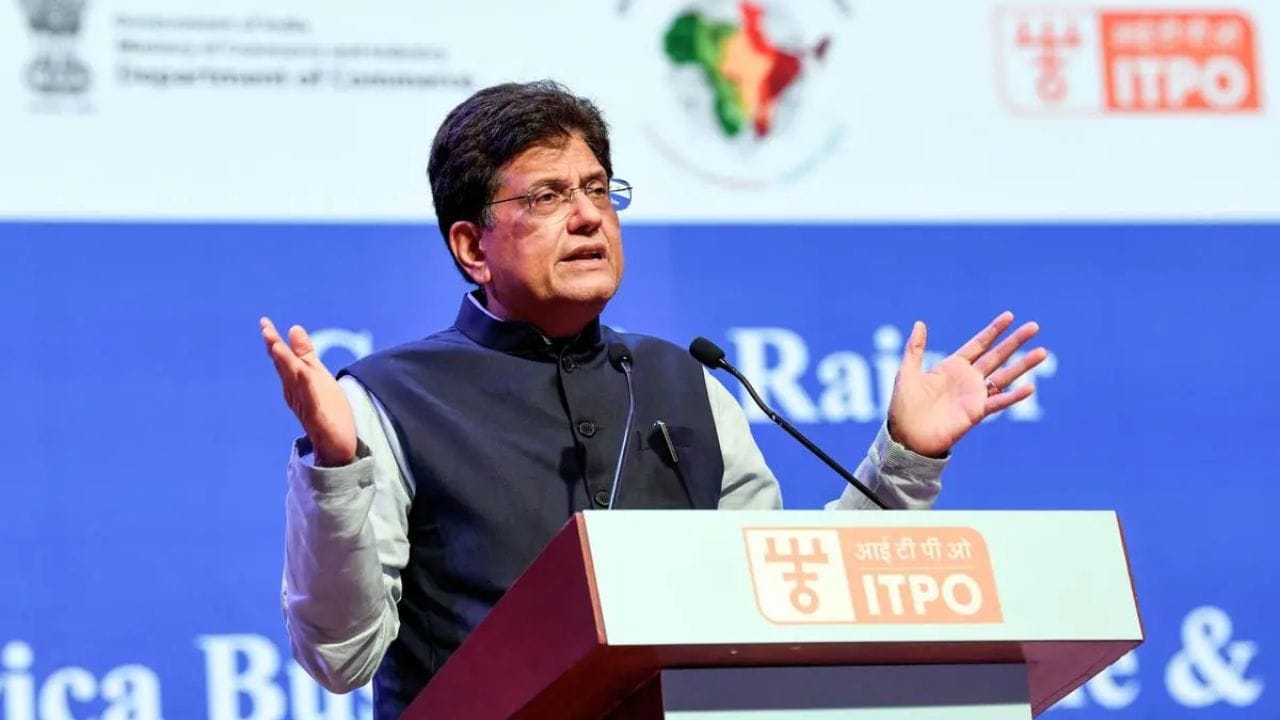
India has set an ambitious target of achieving $1 trillion in exports this year and doubling it to $2 trillion within the next five years, with Union Commerce and Industry Minister Piyush Goyal describing the goal as the true hallmark of an Atmanirbhar Bharat.
Addressing the launch ceremony of the Bharatiya Vyapar Mahotsav in New Delhi, Goyal said the target was not just a government ambition but a national mission requiring participation from businesses, industries and citizens alike.
“Exports this year have reached 863 billion dollars, nearly 5% higher than the previous year, despite global challenges,” he said, adding that both goods and services exports had registered growth in a difficult global environment.
FTA strategy
The minister said India’s push for Free Trade Agreements with nearly 38 developed countries over the last three-and-a-half years would open doors for Indian exporters through lower import duties and improved market access.
He noted that the Oman Free Trade Agreement could come into force from 1 June, while other completed agreements awaiting procedural clearances would also become operational gradually.
According to Goyal, these trade agreements would allow Indian products to compete more effectively in global markets and strengthen the country’s export ecosystem over the coming years.
Import warning
At the same time, the minister warned that India’s rapidly rising consumption could become a challenge if domestic industries failed to keep pace.
He urged businesses to closely monitor import trends using the Commerce Ministry’s trade portal and identify areas where India could reduce dependence on foreign products through domestic manufacturing.
“Import substitution and exports represent two key sides of growth,” Goyal said, stressing that Indian industries must seize opportunities emerging from products currently being imported into the country.
He specifically called upon industrial hubs such as Rajkot, Jalandhar, Ludhiana, Batala and Pune to strengthen domestic production capacities, particularly in capital goods where India continues to rely heavily on imports.
Swadeshi focus
The minister also made a strong pitch for promoting Indian-made products and strengthening the spirit of Swadeshi.
He cautioned that even small preferences for imported goods could weaken domestic industry and increase dependence on foreign suppliers.
“As consumption grows with the expansion of the middle class, it is essential for India to meet its own requirements, otherwise imports will fill the gap,” he said.
Goyal urged businesses and consumers to support each other by becoming suppliers and customers within the country, adding that initiatives such as the Bharatiya Swadeshi Mela could evolve into a nationwide movement supporting Made in India products.
Quality drive
Highlighting the importance of competitiveness, the minister said India must improve product quality, packaging and productivity if it wants to dominate global markets.
He said Prime Minister Narendra Modi had consistently emphasised higher quality standards and productivity growth across sectors.
“Without better quality and packaging, India would not be able to capture global markets,” the minister said.
He added that an export-oriented approach naturally pushes industries towards better standards and stronger competitiveness.
Agriculture potential
Goyal also highlighted the untapped potential in agriculture and fisheries, noting that agricultural exports had already crossed nearly Rs5 lakh crore.
However, he said value addition in these sectors remained limited and called on young entrepreneurs to establish food processing and manufacturing units at small, medium and large scales.
Greater participation from startups and youth could unlock significant opportunities in value-added manufacturing and import substitution.
MSME expansion
The minister reiterated the government’s support for MSMEs, saying the revised definition now includes enterprises with turnover of up to Rs500 crore.
The government wanted businesses to scale up and compete globally rather than remain small.
India’s growing middle class and rising domestic demand gives away enormous opportunities for traders, manufacturers and MSMEs both within the country and overseas.
Digital push
Goyal also proposed greater use of India’s digital payment ecosystem during the Bharatiya Swadeshi Mela.
He suggested involving the National Payments Corporation of India and promoting wider adoption of RuPay cards and UPI through dedicated kiosks at the venue.
The Bharatiya Vyapar Mahotsav is scheduled to be held at Bharat Mandapam from 12 August to 15 August 2026.