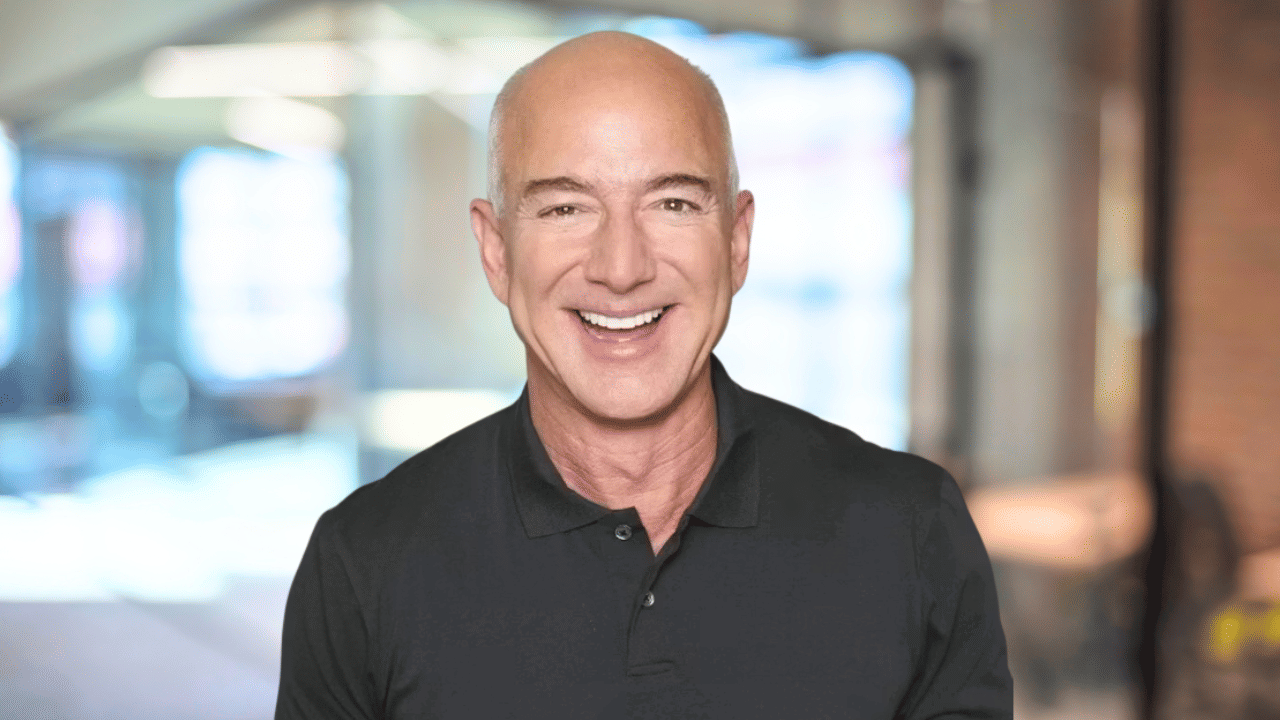
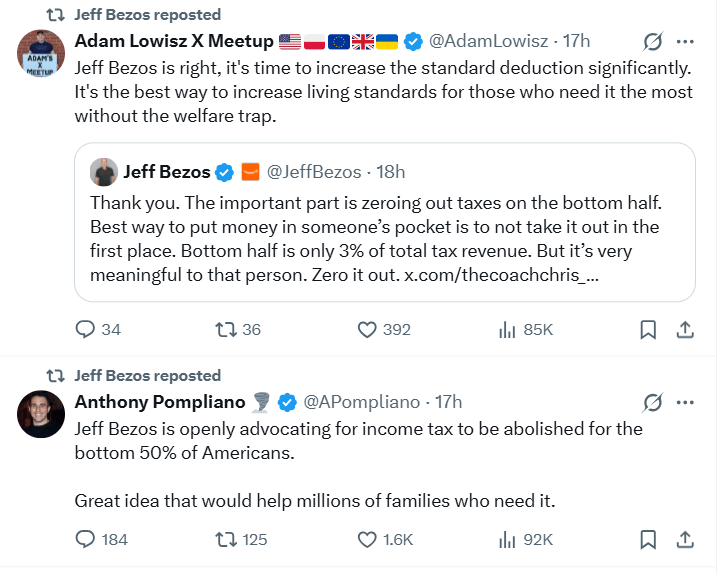
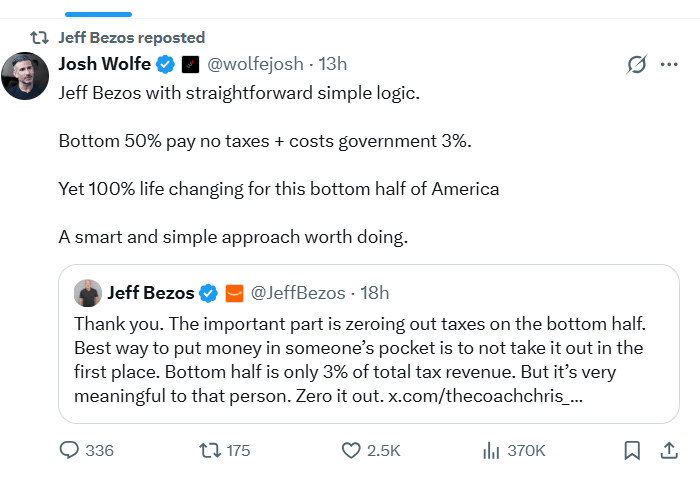
Jeff Bezos has reignited debate around taxation, inequality, and the future economic impact of artificial intelligence after calling for the bottom half of income earners in the United States to pay zero federal income tax, a stance that quickly drew reactions from prominent business and technology leaders, including Elon Musk.
Speaking to CNBC’s Squawk Box from Merritt Island, Bezos argued that the tax contribution from lower-income Americans is relatively small for the government but can make a meaningful difference to households struggling with inflation and rising living costs.
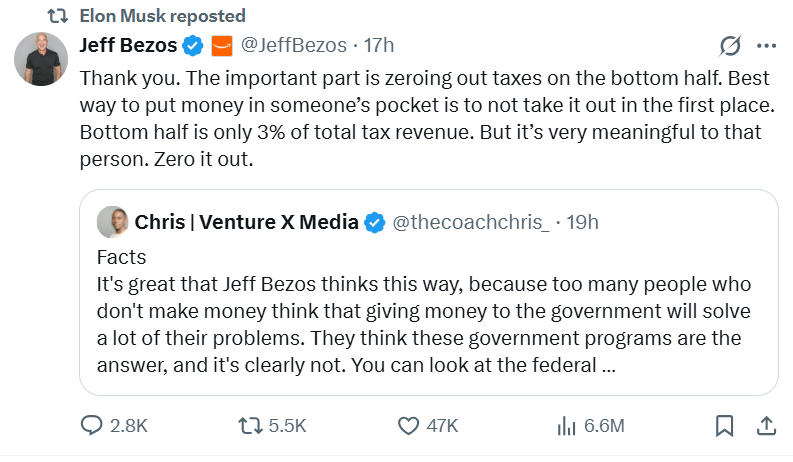
“The top 1 per cent of taxpayers pay about 40 per cent of all tax revenue, and the bottom half pay 3 per cent,” Bezos said. “I don’t think it should be 3 per cent. I think it should be zero.”
Using the example of a healthcare worker earning $75,000 annually, Bezos questioned why working-class Americans should continue paying federal income taxes amid mounting affordability pressures.
“We shouldn't be asking this nurse in Queens to send money to Washington,” he said. “They should be sending her an apology.”
The comments come at a time when economic inequality, inflation, and the widening gap between higher- and lower-income households remain central political and business concerns in the United States.
According to data cited from the Tax Foundation, the bottom half of taxpayers accounted for just 3 per cent of federal income taxes in 2023, despite representing more than 76 million households. Meanwhile, the top 1 per cent contributed nearly 38 per cent of total income tax revenue.
Bezos’ remarks also aligned with broader conversations emerging among policymakers. Cory Booker recently proposed the “Keep Your Pay Act,” which seeks to make the first $75,000 of household income tax-free for qualifying families.
“No income tax on the first $75,000 families earn would be a game changer for working people,” Booker said while introducing the proposal earlier this year.
Beyond taxation, Bezos used the interview to defend the role of large corporations and for-profit businesses in driving societal progress. He argued that entrepreneurs and billionaires often create more value through building companies than through traditional philanthropy alone.
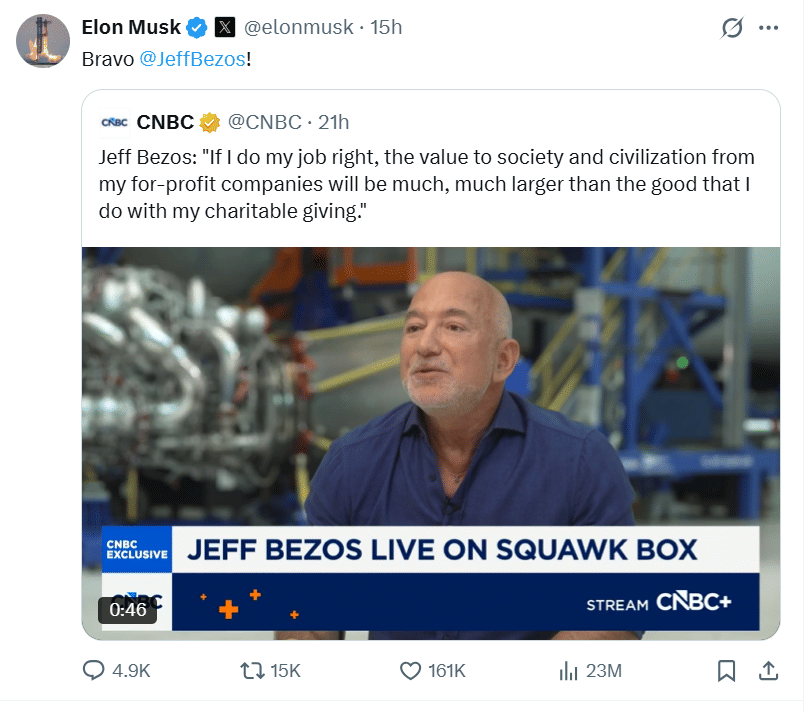
“If I do my job right, the value to society and civilization from my for-profit companies will be much, much larger than the good that I do with my charitable giving,” Bezos said.
He pointed to Amazon as an example of a business that has generated employment, infrastructure, lower consumer prices, and large-scale convenience for millions of people.
The comments unexpectedly drew praise from Musk, who publicly responded online with, “Bravo Jeff Bezos!”
The endorsement attracted attention because Musk has recently been involved in a high-profile legal dispute involving OpenAI, where he criticised the organisation’s evolution from a non-profit structure into a commercial entity.
Musk had previously described the OpenAI dispute as “a textbook tale of altruism versus greed” and argued in court filings that it was “not OK to loot a charity.”
Against that backdrop, Musk’s agreement with Bezos on the value of for-profit companies marked a rare public alignment between two of the technology industry’s most influential and competitive figures.
Bezos also addressed growing fears surrounding artificial intelligence and job displacement, particularly within software engineering and knowledge-based professions.
Rejecting predictions that AI will replace engineers, Bezos described the technology as a productivity accelerator that enhances human capability rather than eliminating it.
“These people are wrong,” Bezos said, referring to concerns that software engineering roles could disappear because AI systems can generate code.
Comparing AI to giving a bulldozer to someone digging with a shovel, Bezos argued that the technology would unlock major productivity gains across industries, enabling workers to produce more with less effort.
He suggested that these efficiency improvements could eventually reduce the cost of everyday goods and services, potentially reshaping inflation trends altogether.
“Because of the productivity gains, you're going to be able to afford things,” Bezos said. “Your food will get cheaper.”
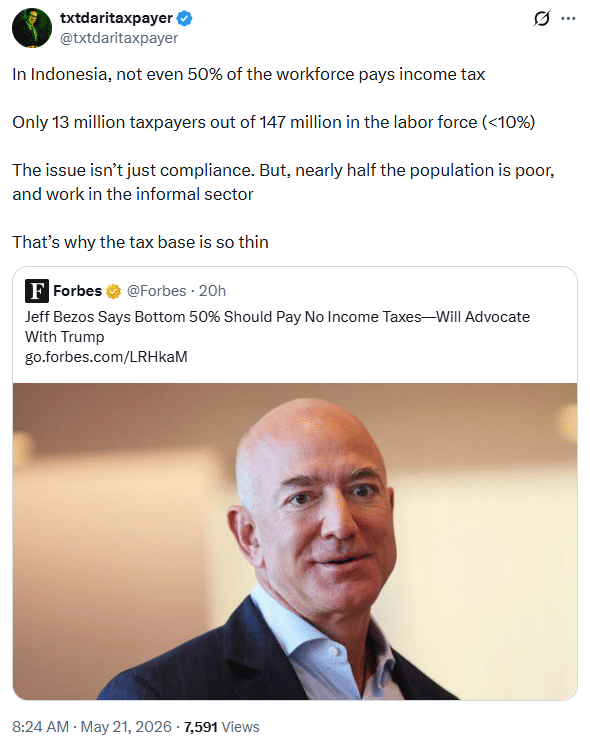
A X user added an Indonesian perspective to Bezos’s remarks, noting that fewer than 13 million people pay income tax out of a workforce of 147 million, largely because a significant portion of the population works in the informal sector or remains low-income, leaving the country with a much thinner tax base.
The remarks reflect a growing view among business leaders that AI could dramatically reduce operational costs across sectors such as logistics, retail, manufacturing, healthcare, and software development, while simultaneously redefining productivity and economic growth.