








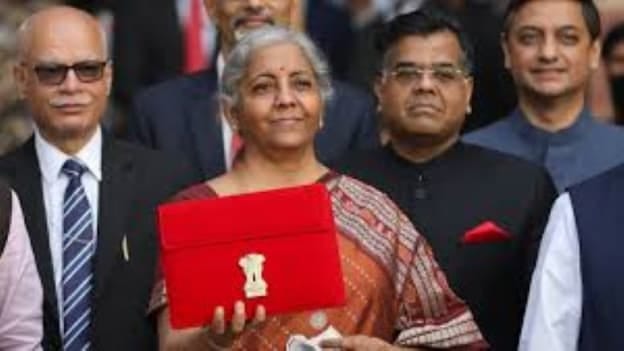
Finance Minister Nirmala Sitharaman announced the Union Budget for 2023-24 on Wednesday, February 1. The government's last full-year Budget before the Lok Sabha elections in 2024 focused on the country's infrastructure sector — including a record outlay for the railways — and tax benefits for the salaried middle class, sending waves of cheer on Dalal Street.
Here are some key highlights of the government's last full-year budget ahead of the 2024 general elections:
Infrastructure
Record capital outlay of Rs 2.4 lakh crore for Railways
Enhanced capex of Rs 10 lakh crore for infra development, 3.3 per cent of GDP
PM Awas affordable housing scheme outlay hiked 66 per cent to Rs 79,000 crore
50 new airports and heliports to be made
Increased capital outlay for infra to crowd in private investment
Rs 10,000 crore for urban infra fund every year
Rs 75,000 crore for 100 transport infra projects
Agriculture
An Agri accelerator fund will be set up to encourage agri startups in rural regions
Agriculture credit target raised to Rs 20 lakh crore
One crore farmers to be facilitated to adopt natural farming
Defence
Rs 5.94 lakh crore allocated to defence ministry vs previous year's Rs 5.25 lakh crore
Rs 1.62 lakh crore set aside for capex towards areas such as purchase of new weapons, aircraft, warships, other military hardware
What becomes cheaper & what gets costlier
Mobiles, camera lenses to become cheaper
Gold, silver, diamonds, cigarettes, imported rubber to get more expensive
Fully imported luxury cars and EVs to cost more; custom duty raised by 1,000 bps to 70 per cent
Concessional basic customs duty of 2.5 per cent to continue on copper scrap
Others
Three AI centres of excellence are to be set up
KYC procedure to be simplified further; PAN to be made a common business identifier
Revamped MSME credit guarantee scheme with an infusion of Rs 9,000 crore, to be rolled out on April 1
Savings
The Monthly Income Scheme limit doubled to Rs 9 lakh, Rs 15 lakh for joint accounts
One-time new small saving scheme Mahila Samman Savings Certificate to be made available for two years up to 2025; scheme to allow maximum deposit of up to Rs 2 lakh, yield 7.5 per cent interest
Taxes
Tax exemption on capital goods and lithium batteries
Higher TDS limit of Rs 3 crore for cooperatives
Rebate limit increased to Rs 7 lakh in new income tax regime; No. of slabs reduced from seven to five
Only five per cent tax on individuals with an annual income of Rs 9 lakh to only pay Rs 45,000 in tax
Salaried class and pensioner standard deduction increased to Rs 52,000
The highest tax rate 42.74 per cent brought down
Presenting the budget, Sitharaman outlined the government’s emphasis on a technology-driven and knowledge-based economy, with strong public finances and a robust financial sector.
She said the Indian economy is on the right track, and heading towards a bright future. The Indian economy has increased in size from being 10th to 5th largest in the last nine years.
"The world has recognized India as a bright star, our growth for the current year is estimated at 7%, which is the highest among all major economies, in spite of the massive global slowdown caused by the pandemic and the war. In these times of global challenges, India’s G20 presidency gives us a unique opportunity to strengthen India’s role in the world economic order," said Sitharaman.
In addition, the government will launch Pradhan Mantri Kaushal Vikas Yojana 4.0. To upskill the youth for international opportunities, 30 Skill India International Centres will be set up across different states.
According to Sitharaman, the budget follows seven priorities such as inclusive development, inclusive development, reaching the last mile, infra & investment, unleashing the potential, green growth and youth and financial sector.