
A job advertisement seeking a “non-Kannada/Marathi speaking” candidate for a senior human resources role has sparked a linguistic controversy in Bengaluru, drawing criticism over alleged discrimination and exclusionary hiring practices.
The listing was posted by a private firm, Skill Sonics, and circulated widely on social media after users shared screenshots of the requirement. The role was for an HR head position, and the company cited “diversity” as the rationale for excluding speakers of Kannada and Marathi.
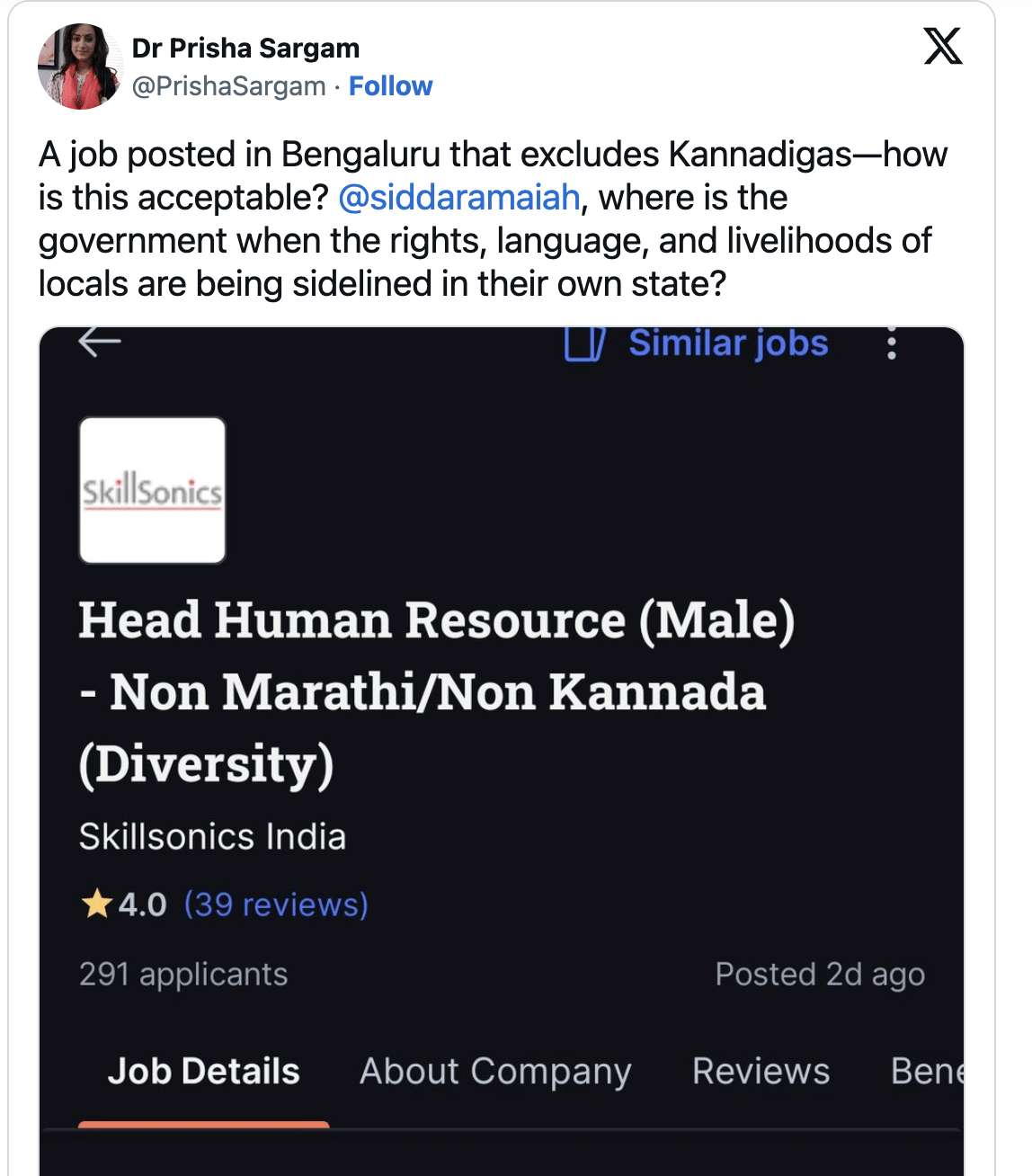
The post prompted strong reactions online, particularly from users in Karnataka and Maharashtra, many of whom questioned why proficiency in Kannada—the official language of Karnataka—was being treated as a disqualifier for a role based in Bengaluru.
Backlash and public response
Social media users described the requirement as offensive and discriminatory, arguing that it marginalised local talent. Several posts called on authorities to examine whether such hiring criteria violate employment norms or state language sensitivities.
One widely shared comment questioned how excluding Kannada speakers could be justified in a city where the language is integral to daily life and workplace interaction. Others argued that diversity initiatives should broaden inclusion rather than restrict it on linguistic grounds.
Some users defended the company’s stated intent, suggesting the move may have been aimed at balancing linguistic representation within the organisation. However, that view failed to quell criticism, with detractors saying diversity could not be achieved by explicitly barring local language speakers from leadership roles.
Skill Sonics has not issued an official statement responding to the criticism or clarifying the intent behind the job requirement. The absence of a response has further fuelled online debate.
Language and employment have long been sensitive issues in Bengaluru, a city that attracts professionals from across India while also grappling with concerns around the preservation and respect of local language and culture. In recent years, debates over signage, public communication and workplace language norms have periodically surfaced in Karnataka.
As the controversy continues to unfold online, the episode has reopened broader questions around diversity hiring, language inclusion and corporate responsibility in multicultural urban centres. Whether the backlash prompts regulatory scrutiny or a clarification from the company remains to be seen.