








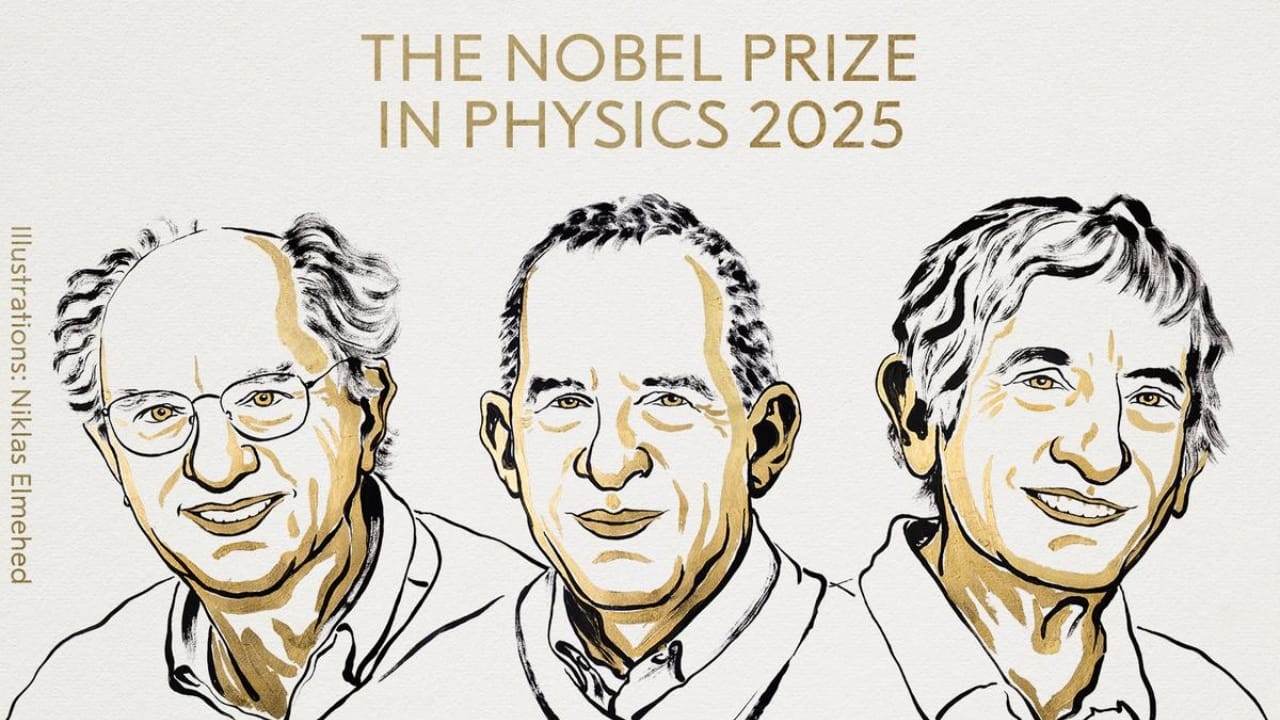
The 2025 Nobel Prize in Physics has been awarded to John Clarke, Michel H. Devoret and John M. Martinis “for the discovery of macroscopic quantum mechanical tunnelling and energy quantisation in an electric circuit,” the Royal Swedish Academy of Sciences announced in Stockholm on Tuesday, 7 October.
Olle Eriksson, Chair of the Nobel Committee for Physics, said: “It is wonderful to be able to celebrate the way that century-old quantum mechanics continually offers new surprises. It is also enormously useful, as quantum mechanics is the foundation of all digital technology.”
The Academy stated that the discoveries provided opportunities for developing the next generation of quantum technology, including quantum cryptography, quantum computers and quantum sensors.
Last year’s Nobel Prize in Physics went to John J. Hopfield and Geoffrey Hinton “for foundational discoveries and inventions that enable machine learning with artificial neural networks,” according to the Royal Swedish Academy of Sciences.
The Nobel Prize in Physiology or Medicine was announced on Monday, 6 October, by the Nobel Assembly at the Karolinska Institute. The award went to Mary E. Brunkow, Fred Ramsdell and Shimon Sakaguchi“for their discoveries concerning peripheral immune tolerance.”
The Karolinska Institute said the three scientists had identified the immune system’s regulatory T cells, which prevent the body from attacking its own tissues.
Thomas Perlmann, Secretary-General of the Nobel Assembly, said at the press briefing that he had reached only Sakaguchi by telephone at the time of the announcement.
Marie Wahren-Herlenius of the Karolinska Institute said that until the 1980s, it was believed harmful T-cells were eliminated only in the thymus gland. Sakaguchi later demonstrated that mature T-cells expressing the protein CD25 could suppress harmful T-cells, identifying what became known as regulatory T-cells.
Brunkow and Ramsdell discovered that mice with a severe autoimmune disorder had a mutation in the FOXP3 gene, and that mutations in the same gene in humans caused a rare autoimmune condition called IPEX syndrome. Sakaguchi showed that FOXP3 controlled the development of regulatory T-cells.
Adrian Liston of the University of Cambridge said regulatory T-cells acted as “the brakes of the immune system.” Danny Altmann of Imperial College London described the discovery as one of the most significant advances in immunology in the past three decades, the Guardian reported.
The Nobel Foundation confirmed that each prize carries a cash award of 11 million Swedish kronor (about £871,400). The awards will be formally presented in Stockholm on 10 December, the anniversary of Alfred Nobel’s death.
Nobel week continues with Chemistry on 8 October, Literature on 9 October, the Peace Prize on 10 October, and the Sveriges Riksbank Prize in Economic Sciences on 13 October.
Alfred Nobel, the Swedish chemist and inventor of dynamite, established the prizes in his will, stipulating they be given to those who “during the preceding year, have conferred the greatest benefit to humankind.”