








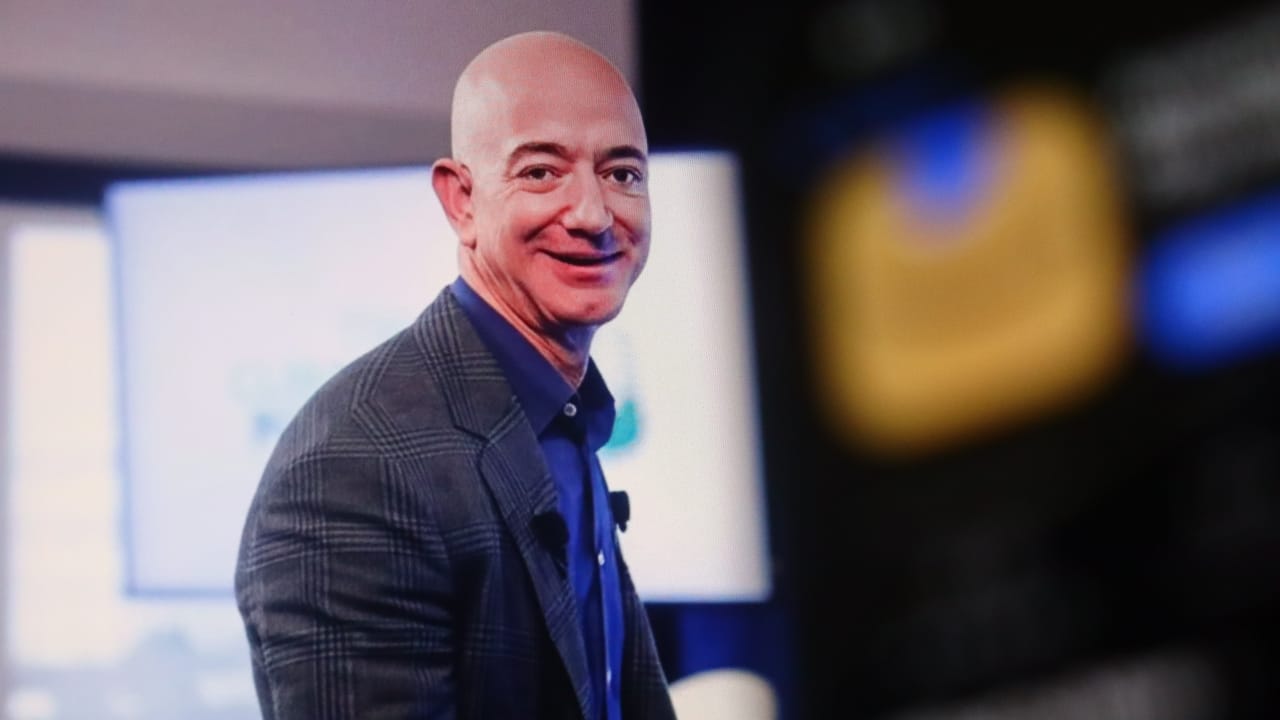
Jeff Bezos has said he is proud of drawing a modest salary during his time as Amazon’s chief executive, arguing that his wealth was already tied to the company’s success and that taking more pay would have felt inappropriate.
Speaking at the 2024 New York Times DealBook Summit, Bezos disclosed that he had asked Amazon’s board not to award him stock grants or bonuses, despite leading one of the world’s most valuable companies. “I already owned a significant amount of the company, and I just didn’t feel good about taking more. I just felt how could I possibly need more incentive?” he said.
Bezos earned an annual salary of about $80,000 throughout his tenure as CEO, a figure that stood in stark contrast to the multimillion-dollar packages commanded by many of his peers. “I just would have felt icky about it. And I’m actually very proud of that decision,” he added.
Bezos, who remains Amazon’s largest shareholder with a stake worth hundreds of billions of dollars, described his stance as consistent with many founder-operators, who rely on equity holdings rather than executive pay as their main source of wealth. He emphasised that his interests were naturally aligned with long-term shareholder value, making additional compensation redundant.
The Amazon founder, now executive chair, argued that the best measure of success for a corporate leader was how much value they created for others. “Somebody needs to make a list where they rank people by how much wealth they’ve created for other people,” he said. Bezos pointed to Amazon’s current market capitalisation of $2.3 trillion, estimating that he had helped generate $2.1 trillion of wealth for shareholders.
Bezos’s approach reflects a broader pattern in Silicon Valley where high-profile leaders have adopted symbolic or minimal salaries. Meta chief executive Mark Zuckerberg has drawn $1 annually since 2013, following the precedent of Apple co-founder Steve Jobs. Warren Buffett, chairman of Berkshire Hathaway, has long limited his pay to $100,000 a year without stock-based bonuses.
Such decisions are often presented as a statement of principle, signalling a focus on long-term company performance rather than personal enrichment. They also serve to reinforce the narrative of founders who see themselves as stewards of shareholder value, measured by market capitalisation and wealth creation.
Bezos founded Amazon in 1994 and turned it from an online bookseller into a global technology and logistics powerhouse spanning cloud computing, e-commerce, and digital media. Under his leadership, Amazon became one of only a handful of companies to exceed $2 trillion in market value, placing him among the world’s richest individuals.
Yet Bezos’s remarks at DealBook underscored his preference to frame his legacy not in terms of personal net worth but in the wealth generated for others. “Amazon’s market cap is $2.3 trillion today. I’ve created something like $2.1 trillion of wealth for other people,” he said.