Jeff Bezos is returning to day-to-day leadership as co-chief executive of a new artificial intelligence venture valued at $6.2bn, marking his most significant operational role since leaving Amazon’s top job in 2021. The New York Times reported that Bezos will lead Project Prometheus alongside co-founder Vik Bajaj.
The Times, citing people familiar with the company, said Project Prometheus has raised billions in funding, including capital from Bezos himself. The startup remains in stealth mode, offering few public details about its founding, headquarters or personnel. What is emerging, however, is a focus on using artificial intelligence to accelerate engineering and manufacturing across sectors such as computing, aerospace and automotive technology.
Bajaj, whose profile identifies him as co-CEO, is a former director at GoogleX, the innovation lab behind moonshot projects including the self-driving car initiative that evolved into Waymo. His track record in experimental engineering suggests Project Prometheus aims to operate at the frontier of applied AI rather than consumer-facing products.
The company’s name, drawn from Greek mythology, hints at its ambitions. Prometheus, the Titan who delivered fire to humanity, symbolises both transformative potential and inherent risk — themes that have dominated global AI debates. Bezos has been vocal about AI’s capacity to reshape industry, even as he acknowledges signs of speculative excess.
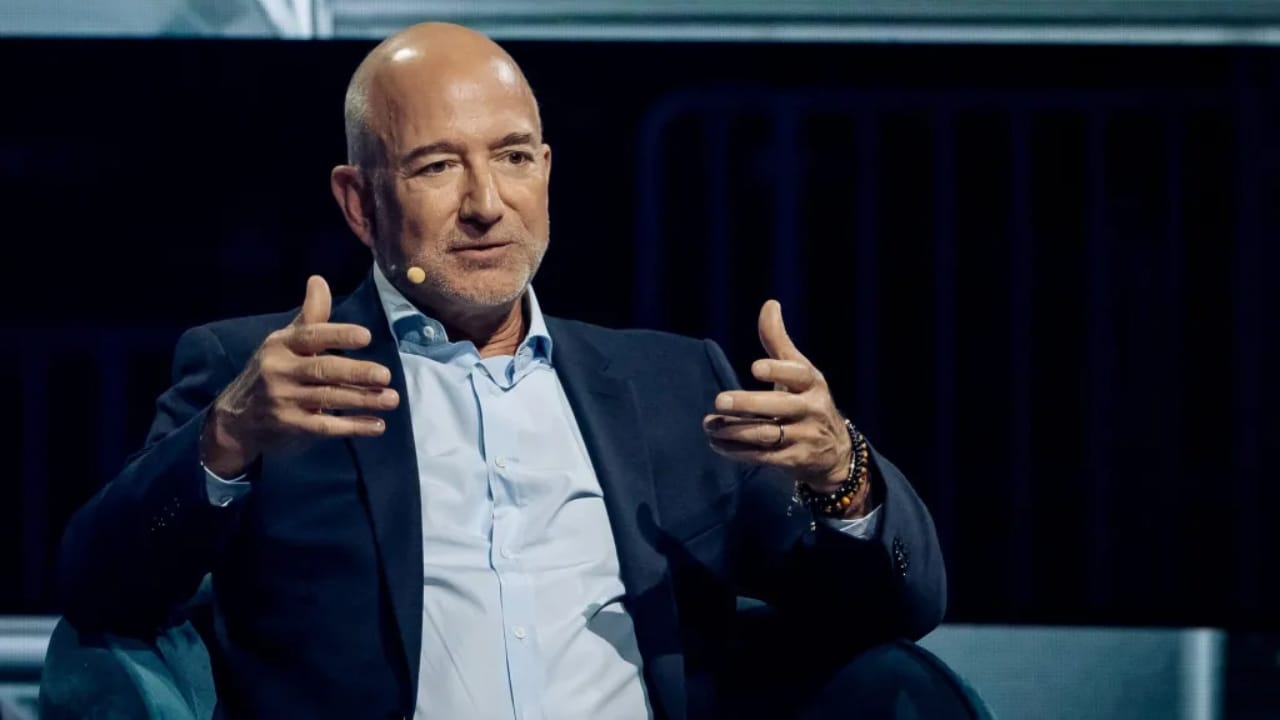
Speaking at Italian Tech Week earlier this year, Bezos said that while “there is an AI bubble,” it resembles what he called an “industrial bubble,” similar to the biotechnology surge of the 1990s. He argued that such cycles ultimately generate breakthroughs despite early failures. “This is real, the benefits to society from AI are going to be gigantic,” he said, adding that indiscriminate funding phases make it difficult to distinguish strong ideas from weak ones.
Bezos also used the event to outline his broader technological vision. He predicted that millions of people could be living in space within a few decades, enabled by advanced robotics and AI. “If you need to do some work on the surface of the moon or anywhere else, we will be able to send robots to do that work,” he told the audience in Turin. His comments align closely with Blue Origin’s long-term goals, suggesting Project Prometheus could become a strategic partner in space-focused engineering.
The billionaire’s optimism contrasts with more cautious voices in the financial sector. At the same conference, Goldman Sachs chief executive David Solomon warned that substantial AI investment may fail to deliver returns, echoing broader concerns about overheated valuations. “There will be a lot of capital that was deployed that didn’t deliver returns,” Solomon said.
Despite such scepticism, Bezos appears confident in the trajectory of the sector and his ability to shape it. With Project Prometheus positioned at the intersection of industrial AI and next-generation manufacturing, his return to an executive role signals a renewed appetite for hands-on innovation.
As the company emerges from stealth, investors and competitors will be watching whether Bezos’s latest venture can deliver the technological advances he envisions — on Earth and, potentially, far beyond it.