
Flipkart has emerged as the most preferred Indian homegrown employer among professionals surveyed by workplace community platform Blind, ranking significantly ahead of traditional IT giants such as TCS, Infosys and HCL.
The survey of 1,205 India-based professionals found that nearly half of respondents would actively consider joining an Indian company if they lost their current jobs. However, workplace culture concerns continue to overshadow compensation and career growth considerations.
According to Blind, 48% of respondents said they would either actively look at or seriously consider joining an Indian homegrown company if laid off tomorrow.
Yet the findings also revealed deep concerns around work culture across India’s technology and startup ecosystem.
Flipkart leads preference rankings
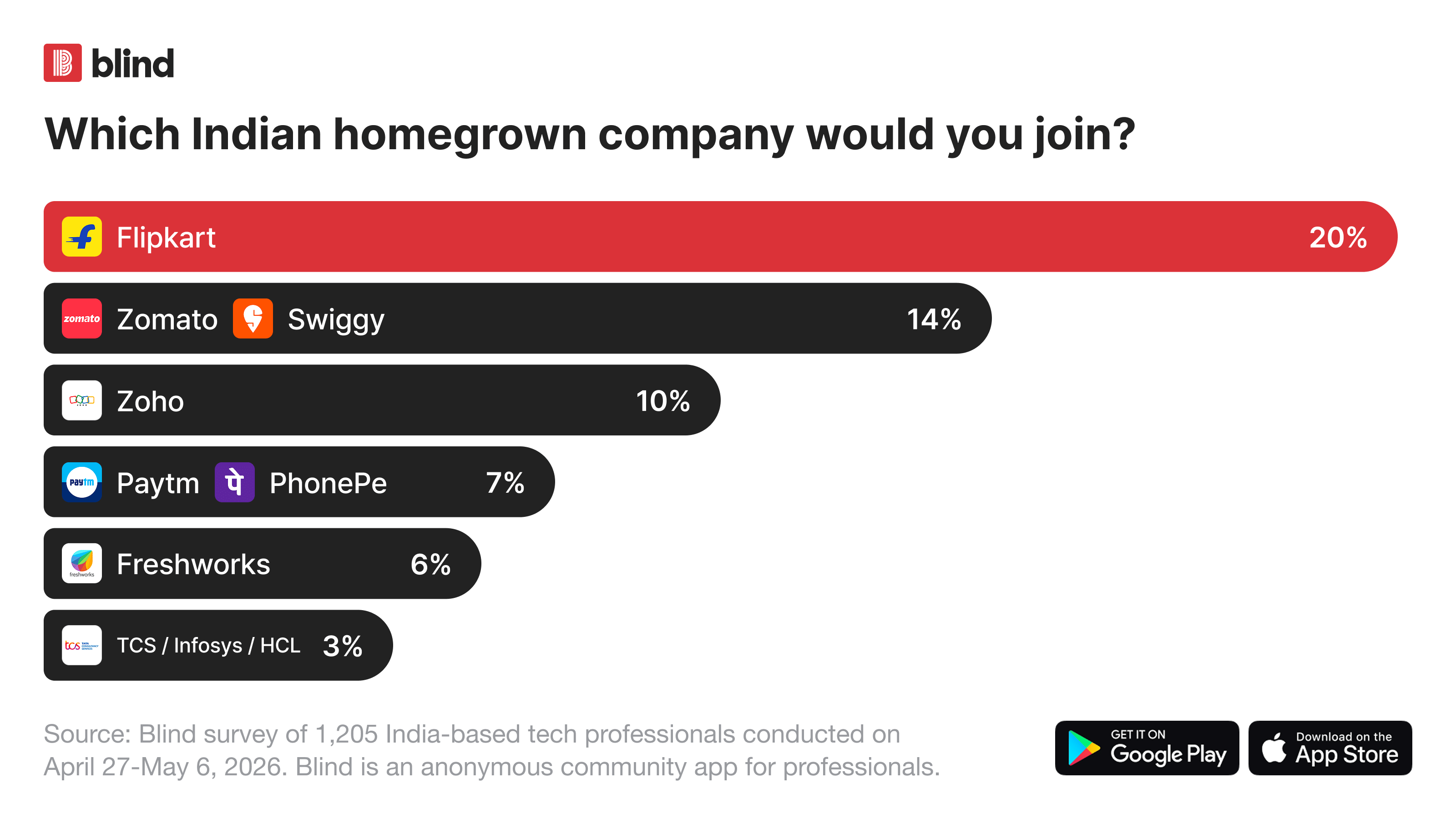
When respondents were asked which Indian homegrown company they would most likely join, Flipkart ranked first with 20% support.
Other preferred employers included:
- Zomato and Swiggy at 14%
- Zoho at 10%
- Paytm and PhonePe at 7%
- Freshworks at 6%
In contrast, traditional IT services firms including TCS, Infosys and HCL collectively attracted only 3% of responses despite remaining among India’s largest technology employers.
Perhaps most notably, 40% of respondents selected “none of the above”, suggesting a large share of professionals remain unconvinced that Indian employers currently offer the workplace standards they seek.
The findings indicate a shift in how professionals perceive India’s technology landscape, with internet-first and product-led firms appearing to attract stronger employer appeal than legacy outsourcing companies.
Workplace culture outweighs salary concerns
Blind’s survey found that workplace environment concerns significantly outweighed financial considerations.
Among respondents:
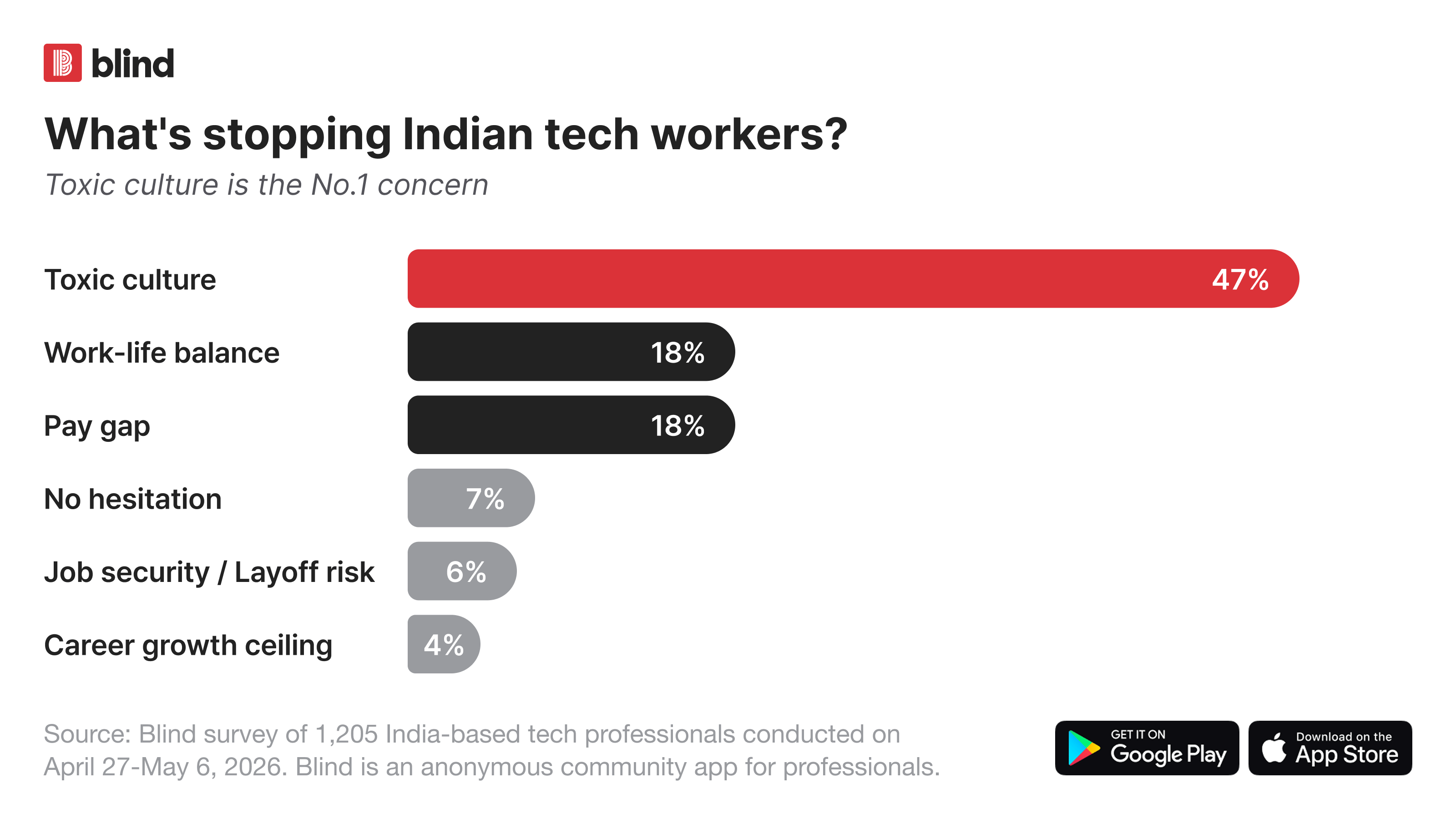
- 47% cited toxic workplace culture as their biggest hesitation
- 18% pointed to work-life balance concerns
- 18% identified pay gaps as the primary issue
- 6% worried about job security or layoffs
- 4% cited limited career growth
Combined, culture and work-life concerns accounted for 65% of responses, reinforcing the idea that professionals increasingly prioritise quality of work environments over compensation alone.
Blind said the findings suggest workplace culture has become the biggest obstacle for Indian companies competing for top-tier talent.
The platform also referenced earlier internal research showing that 83% of Indian IT professionals experience burnout, while 25% reported working more than 70 hours per week.
Employees continue to scrutinise top firms
The survey also highlighted that even highly ranked employers continue to face criticism from workers regarding long hours and workplace expectations.
Blind, which allows verified employees to anonymously discuss workplace experiences, cited posts from workers across major Indian firms.
One Flipkart employee reportedly wrote: “You will feel at home if you have no life outside of work.”
A Zoho employee cited concerns including limited remote work flexibility, lack of overtime compensation and weekend work pressures.
The comments reflect broader industry debates around burnout, employee wellbeing and workplace sustainability across India’s fast-growing technology sector.
Over the past several years, India’s startup and technology ecosystem has faced increasing scrutiny over work intensity, leadership styles and expectations around extended working hours.
Global tech employees show growing interest in Indian firms
Despite those concerns, the survey suggests Indian companies may still have an opportunity to attract talent from global technology firms.
Blind said respondents open to joining Indian companies included employees currently working at:
- Microsoft
- Amazon
- Oracle
Microsoft employees accounted for 7.6% of respondents considering Indian firms, followed by Amazon at 6.8%, Oracle at 4.1% and Google at 3.2%.
Blind also said its internal AI systems, which analyse search behaviour and engagement trends, found that Flipkart, PhonePe and Infosys were the most searched Indian companies among employees at Microsoft and Amazon between February 2025 and May 2026.
The data indicates that interest in India’s domestic technology ecosystem extends beyond local professionals and increasingly includes talent already employed at major global technology corporations.
Indian firms face culture and talent crossroads
The survey arrives at a time when India’s technology and startup ecosystem is attempting to mature beyond rapid growth-focused operating models.
As companies compete globally for engineering and product talent, workplace culture is becoming a critical differentiator alongside compensation and career progression.
Blind suggested that Indian firms could significantly strengthen their employer appeal if they improve workplace practices and employee wellbeing standards.
The report also highlighted growing calls from professionals for healthier workplace expectations and stronger mental health support systems.
In one discussion cited by Blind, a verified Microsoft employee wrote: “We need to find a way to pivot mindset and boost mental health.”
The findings suggest that while Indian companies are increasingly attracting attention from highly skilled professionals, long-term success in the talent market may depend less on brand recognition and more on whether organisations can build sustainable, employee-focused workplace cultures.