








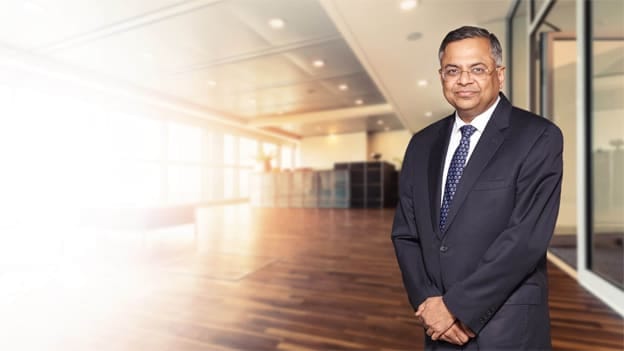
In an interview with a news publication, N. Chandrasekaran outlined his vision for Tata Sons. We look at some of the highlights of the same.
What has N. Chandrasekaran been in the news recently?
Being the head of one of the biggest conglomerates in the country means news coverage will be aplenty. Appointed as the chairman of Tata Sons in Februrary of this year, in an interview published in ET recently, he laid out his vision for the future of the group. He touched upon a number of topics, and the highlights of the interview are as follows:
- Tata Sons will ‘simplify’ its business. He says in the report, “I will be the first to admit that we are very complex. We need to be simplified. I would like to see ourselves as 5, 6, 7 groups as opposed to 110 companies.”
- His priority will be fixing the balance sheets of various companies and reduce the $25.5 billion debt that the empire has accrued. He won’t be hesitant to take ‘tough decisions’.
- He talked about different Tata companies candidly, sharing his plan: Tata Steel will separate the Indian and European operations to simplify operations and growth, Tata Power will bring down its debt by selling non-core assets or realigning its geographical footprint, Tata Motors will explore partnerships, and investing in Tata Teleservices will mean “throwing good money after bad.” He also hinted a change in the aviation portfolio.
- He steered clear of the controversy that dogged Tata Sons for most of the second half of 2016, saying, “I don't want to criticise decisions that were taken in the past as every decision makes sense in a context. In hindsight, we can question that. We are now in a new context and in that let us take a transformative view, let us rationalise what is required and go forward...”
- He also mentioned the importance of the right talent and team in achieving his vision and said that it is his job to ensure that the team is integrated.
Why was this interview important?
This is the first public interview by the head of Tata Sons since he took up the job, claims the report. Experts might quickly pitch this plan against Cyrus Mistry’s Vision 2025 that hogged the limelight two years back when Mistry was at the helm of affairs. One can notice the similarity of overarching goals, even if the means to achieve them might be dissimilar. Furthermore, Chandrasekaran’s emphasis on the non-confrontational approach and the talk of creating the right team and taking everyone along has not gone unnoticed. The task at hand is, no doubt, challenging, considering the strong culture at the group; it remains to be seen how Chandrasekaran will assert his authority and keep all stakeholders happy.
What does the future look like?
This not the first time a big multi-national business has decided to simplify itself. Some might argue that ‘portfolio pruning’, the process of losing or restructuring assets that are not giving desired returns, is a necessary and periodic course-correction intervention needed to stay agile and focussed. And the fact is that it portfolio pruning is done by organizations more frequently than one would assume; the biggest international names have done it in the past – Time Inc. Diageo , Nestle, P&G, Unilever and Nokia – publically or not. As a matter of fact there are systematic strategies and tools in place to help companies to help them identify the need to drop laggard brands and implement such decisions with ease.
Depending on the reason for the pruning, a company might simply kill a brand or go for re-branding. The motivation behind the same is essential for it decides the future of employees, possible merger and acquisition, and customer behaviour. For example, Tata Teleservices, on the brink of closure, is reportedly working on an exit plan for its employees. If Tata Sons decides to shut more non-performing assets, more job cuts might be in the offing or the industry could witness some mergers. One thing is for sure, change is coming soon to the almost 150-years old empire and is, in all probability, to be led by the second ever head who is not from the Tata family.