









A routine sick leave request turned tragic when a 40-year-old employee died of cardiac arrest just ten minutes after sending a message to his manager, according to an account that has since gone viral on X.
The final message
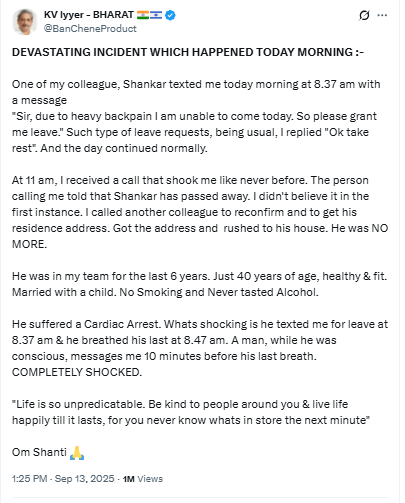
The man, identified only as Shankar, had worked for six years under manager KV Iyyer. On the morning of his death, he texted Iyyer at 8:37 am, writing: “Sir, due to severe back pain I am unable to come today. Please grant me leave.”
“I replied, ‘Ok, take rest.’ Such messages are routine, and I thought nothing more of it,” Iyyer later wrote in his post. But at 11 am he received a call that left him stunned: Shankar had collapsed and died.
“What is unbelievable is that he sent the leave message at 8:37 am and passed away at 8:47 am,” Iyyer said. “A man, fully conscious, messaged me just 10 minutes before his last breath. I am completely shocked.”
Colleague and family man
Iyyer described Shankar as “healthy and fit, married with a child, never smoked or drank.” He was remembered as a steady colleague and a dependable member of the team.
“He was part of my team for six years,” Iyyer wrote. “Life is unpredictable. Be kind to those around you and live happily, because you never know what the next minute holds.”
The post quickly spread across social media, with thousands of users offering condolences and reflecting on the fragility of life. Many echoed Iyyer’s call for compassion in workplaces and beyond.
A growing health concern
Though the account did not include medical details, health experts note that cardiac arrest among seemingly healthy adults is not uncommon. Studies by the Indian Heart Association show that cardiovascular disease is increasingly striking younger age groups, often linked to high stress, sedentary lifestyles and undetected conditions.
“Sudden cardiac arrest can occur without warning and in people who look perfectly well,” said one Mumbai-based cardiologist. “This is why regular check-ups and awareness of early warning signs — chest discomfort, unexplained fatigue, severe back or shoulder pain — are vital.”
The doctor added that companies can play an important role by encouraging preventive care, offering wellness screenings and reducing stigma around taking time off for health.
Workplace implications
For corporate leaders, the story has reinforced the importance of prioritising employee wellbeing alongside performance targets. HR specialists argue that flexible sick leave policies, health awareness workshops and access to counselling are becoming essential parts of modern workforce management.
“This is not just about one tragic case,” said a senior HR consultant in Bengaluru. “It’s about recognising that employees bring their full selves to work, and that includes health vulnerabilities. Organisations must go beyond compliance to foster cultures where health is openly discussed and supported.”
The emotional weight of Shankar’s death has resonated well outside his company. On X, responses to Iyyer’s post mixed shock with personal anecdotes. One user wrote: “We plan our lives for decades, yet it can all change in minutes. Be kinder, be present.”
The incident, stark in its timing and detail, has become a public reminder of both life’s uncertainty and the need for stronger systems of care. For Shankar’s family and colleagues, it is a sudden loss. For the wider community that has read his last message, it is a moment to pause and reflect.