









Shaadi.com founder Anupam Mittal has announced one work-from-home day every week for employees, positioning the move as a practical response to Prime Minister Narendra Modi’s recent appeal to reduce fuel consumption and limit unnecessary imports.
Mittal shared the announcement on LinkedIn shortly after Modi urged citizens and businesses to adopt measures that could help reduce pressure on India’s fuel imports and foreign exchange reserves amid rising geopolitical uncertainty and oil price concerns.
“Yesterday, the PM asked India to import less & consume less imports. Fair ask,” Mittal wrote in his post. “So at Shaadi.com, we’re starting with one simple move. One day remote work every week.”
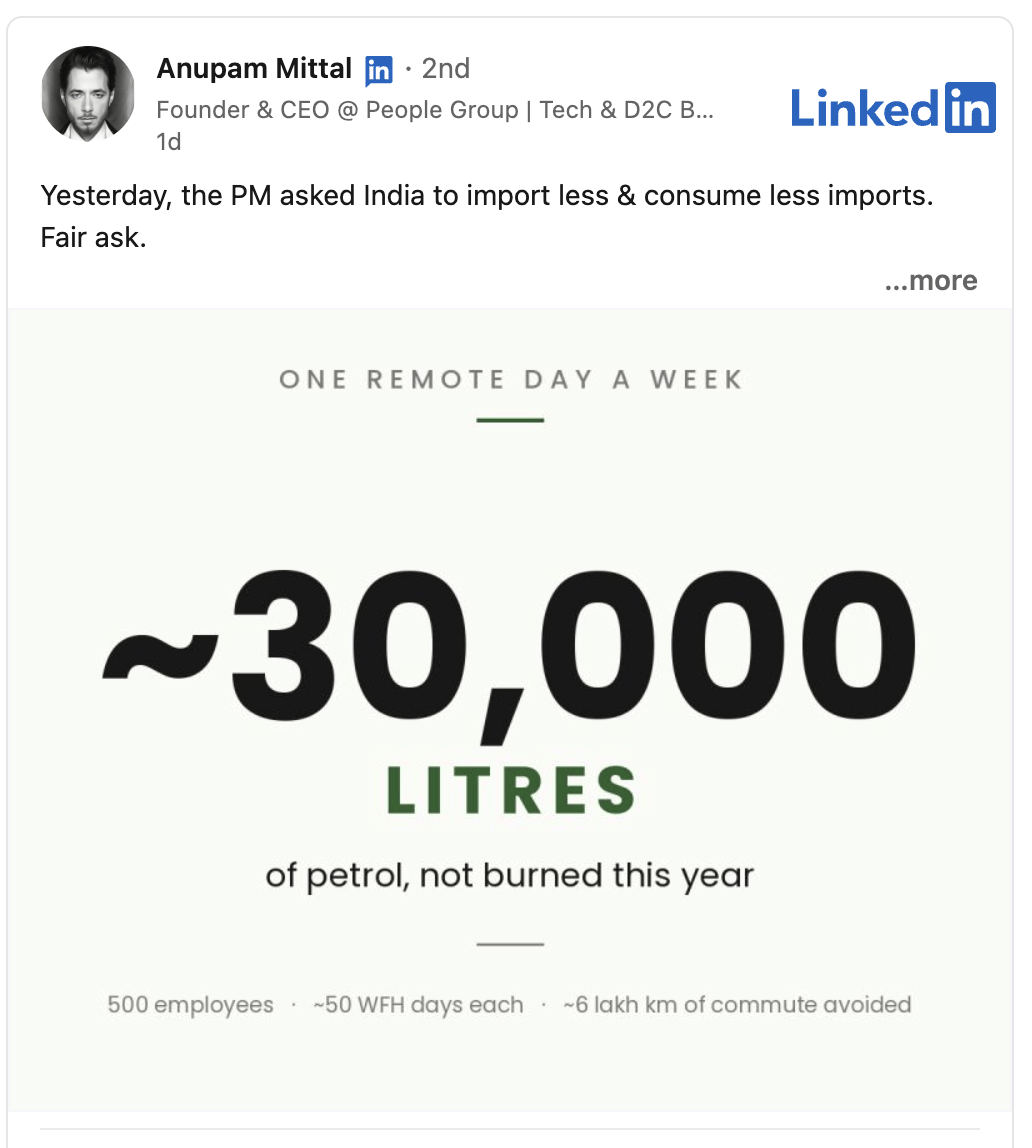
Shaadi.com frames remote work as a fuel-saving measure
Mittal described the policy as a modest but measurable attempt to reduce commuting-related fuel consumption.
“For our teams, that could mean roughly 20% less office commute fuel,” he wrote. “Not a revolution. But not nothing either.”
The post included an internal estimate suggesting the company could avoid burning approximately 30,000 litres of petrol annually through one remote work day each week.
According to the graphic shared by Mittal:
- Around 500 employees would participate
- Employees would collectively work remotely for roughly 50 days annually
- Approximately six lakh kilometres of commuting could be avoided each year
Mittal framed the initiative less as a workplace perk and more as a broader civic contribution.
“Nation-building is not always a grand sacrifice,” he wrote. “Sometimes it is just fewer cars on the road on a weekday.”
He described the move as a “Small move. Real intent.”
PM’s comments have revived the WFH conversation
The announcement follows Modi’s recent remarks encouraging citizens and businesses to reduce unnecessary fuel consumption in response to global energy pressures linked to geopolitical tensions in the Middle East.
As part of that appeal, the Prime Minister encouraged the revival of several Covid-era practices, including:
- Work-from-home arrangements
- Virtual meetings
- Online conferences
- Car-pooling
- Greater public transport usage
The broader message focused on reducing pressure on imported petroleum consumption and protecting India’s economic stability amid rising global oil prices.
Mittal’s announcement is among the first visible responses from a well-known startup founder directly linking workplace policy to the Prime Minister’s appeal.
Online reactions reveal divided views on remote work
The LinkedIn post quickly gained traction online, reportedly attracting more than 16,000 likes and over 600 comments.
Reactions reflected broader divisions around the future of work and the role of remote employment in corporate India.
Some users praised the initiative as a practical and realistic step.
Others questioned why the company limited remote work to one day a week rather than adopting broader flexibility.
One commenter wrote, “If your team can WFH one day, why not all days and amplify the support and lead the industry by example.”
Another argued that remote work could create wider business savings beyond fuel reduction, including lower real estate and operational expenses alongside reduced attrition.
Some users also criticised the move as symbolic rather than transformational.
“Why the token gesture?” one comment read, questioning why full remote work arrangements were not being considered if fuel conservation was the primary objective.
Corporate India’s remote work debate is shifting again
The Shaadi.com announcement arrives at a time when many companies have been tightening return-to-office mandates after years of pandemic-driven flexibility.
Across India’s corporate sector, employers have increasingly argued that physical office presence improves:
- Collaboration
- Team culture
- Innovation
- Mentorship
- Employee engagement
At the same time, employees and worker groups continue pushing for more flexible work arrangements, particularly for digitally deliverable roles.
The latest fuel conservation discussion is adding a new economic layer to that debate.
Remote work is now being discussed not only as a flexibility or productivity issue, but also as a potential tool for:
- Reducing fuel consumption
- Lowering urban congestion
- Cutting commuting costs
- Supporting broader economic resilience
Whether more companies adopt similar measures remains uncertain.
But Mittal’s announcement signals that the work-from-home conversation in India may be entering a new phase, shaped as much by energy economics and national policy messaging as by employee expectations.