Organisations globally invest billions in advanced employee recognition frameworks, state-of-the-art platforms and structured reward systems. Yet, a striking paradox remains at the heart of the modern workplace. According to O.C. Tanner’s State of Employee Recognition Report, a mere 21% of organisations have successfully integrated recognition in a manner that is frequent, highly visible and deeply embedded into daily corporate operations.
This stark disparity highlights a critical truth: the primary barrier to effective appreciation is not a lack of organisational intent, but a systemic failure in operational execution. When employee appreciation is restricted to sporadic annual ceremonies or automated, transactional notifications, its psychological and cultural value rapidly deteriorates.
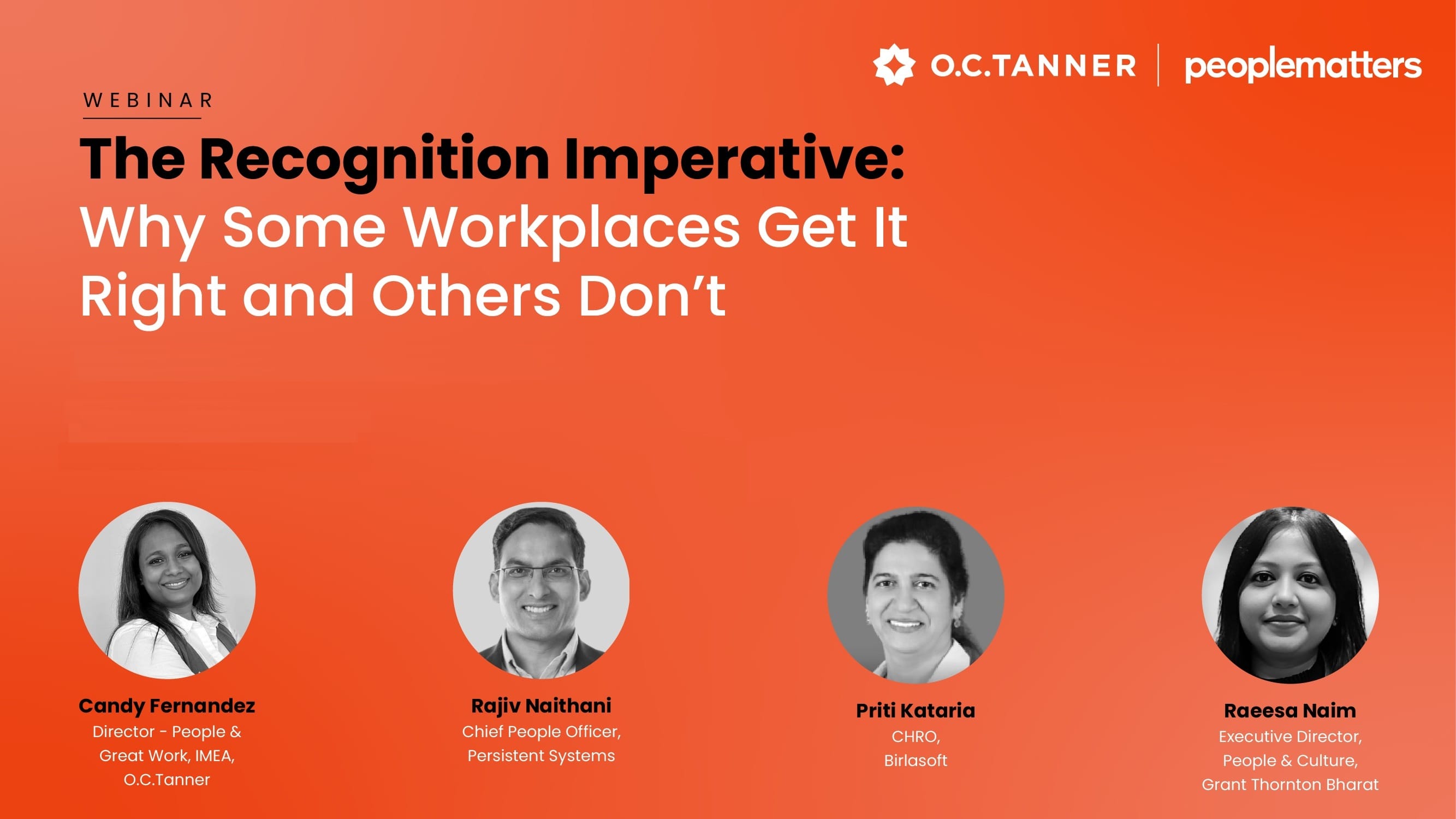
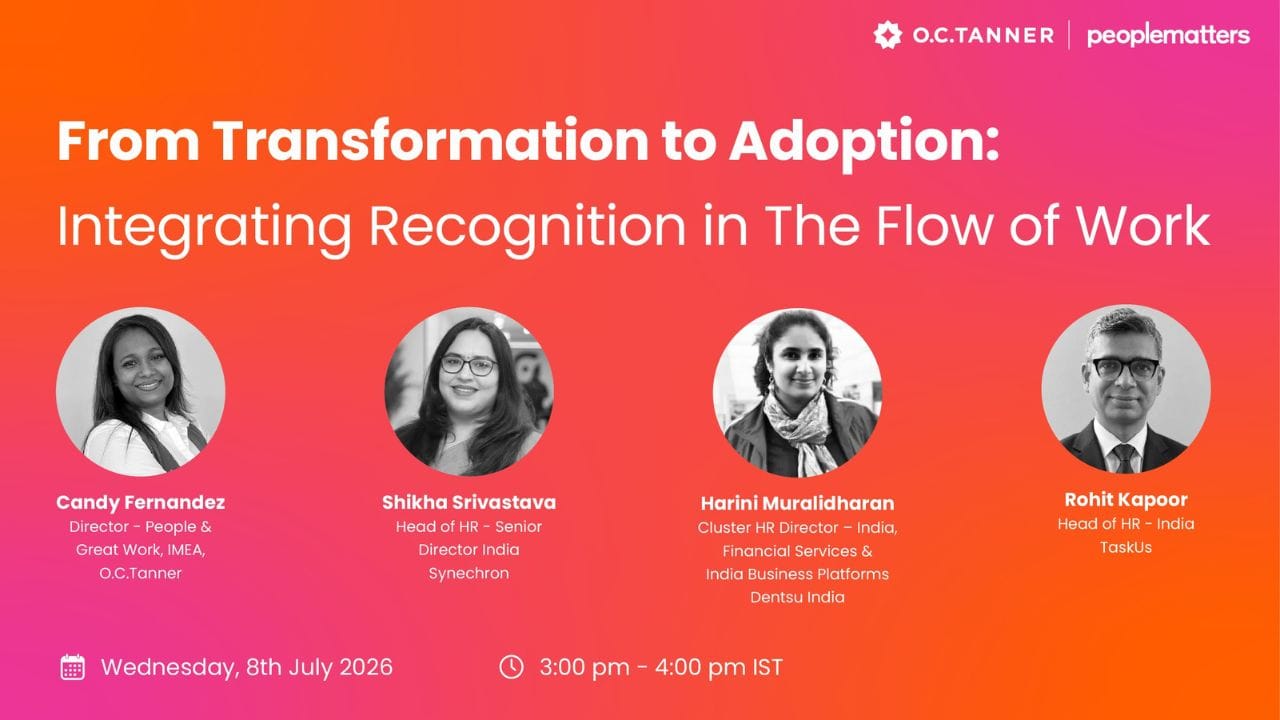
To demystify how organisations can successfully bridge this gap and move away from isolated human resources (HR) initiatives to establish recognition as a consistent, everyday operating discipline, People Matters and O.C. Tanner organised a webinar with Shikha Srivastava, Head of HR - Senior Director India, Synechron , Harini Muralidharan, Cluster HR Director – India, Financial Services & India Business Platforms, Dentsu India, Rohit Kapoor, Head of HR - India, TaskUs and Candy Fernandez, Director – People & Great Work, Middle East, Africa, South Asia, O.C. Tanner. Moderated by Cheshta from People Matters, the conversation gave an insight into making recognition an indispensable part of the workplace.
The execution gap: From platform to habit
Many modern enterprises mistakenly equate the deployment of a recognition platform with the creation of an appreciative culture. While digital tools act as vital scalable enablers, they cannot serve as a substitute for genuine human connection. When recognition functions merely as a transactional checklist, employees perceive the insincerity, which inadvertently accelerates disengagement.
The fundamental issue is that organisations frequently over-index on macro-experiences, such as formal onboarding milestones, major project completions or lengthy service anniversaries, while completely neglecting the vital power of daily micro-experiences. True operational integration requires acknowledging small wins, daily collaborations and the consistent exhibition of cultural values.
Moreover, an over-reliance on technology tools often skews appreciation toward high-profile, vocal individuals, leaving quiet contributors unnoticed. To build systemic trust, recognition must be highly inclusive, structured and equitable across all tiers of the workforce. Shikha points out the risk of viewing appreciation strictly through a technological lens: "Rather than thinking of recognition as a platform, making it a habit is what matters." In other words, when appreciation becomes a foundational cultural habit rather than an automated software function, it fundamentally shifts how employees experience their workplace environment.
Leadership behaviours: The core engine of authenticity
Culture is explicitly cascaded from the top down. The long-term sustainability of any appreciation strategy depends heavily on the visible, active modelling of leadership teams, observes Harini. If leaders explicitly define organisational norms, executives who treat recognition as an administrative burden, middle management and frontline supervisors will inevitably follow suit.
To bridge the execution gap, progressive leadership teams are shifting their focus from purely outcome-driven metrics to behaviour-driven reinforcement. Celebrating outcomes is simple, but reinforcing the behaviours that lead to those outcomes, such as resilience, collaboration and uncompromised integrity, is what truly shapes corporate culture.
Practical leadership interventions include establishing structural corporate rituals, such as opening strategic business updates and team operational meetings with culture value nominations before discussing commercial targets. This structural priority forces managers to consistently scan their environments for meaningful employee contributions. Furthermore, authentication requires immediacy. Delayed appreciation tied exclusively to formal quarterly or annual performance reviews completely loses its psychological impact. Harini says, "It boils down to speed, specificity, and more than anything, just a simple acknowledgement, and that's the mindset which organisations have to drive."
Operationalising recognition in the hybrid and AI era
As enterprises navigate the complexities of hybrid work models, distributed teams and rapid artificial intelligence (AI) integration, maintaining organisational cohesion has become exceptionally challenging. In a fragmented work environment, traditional informal interactions like casual office conversations or spontaneous expressions of gratitude are lost. Consequently, the intentional design of recognition pathways must be heavily prioritised to maintain psychological safety and employee belonging.
To build a resilient strategy, HR professionals must establish a continuous equilibrium between scalable digital systems and deep, personal human connections. While data indicates that modern technology is critically significant to the logistical rollout of an appreciation framework, employees fundamentally crave authentic, personalised validation. Organisations can cultivate this environment by empowering peer-to-peer appreciation channels that allow colleagues to share distinct, narrative-driven experiences. When horizontal recognition is democratised across the workforce, it ceases to be a top-down mandate and matures into a self-sustaining cultural ecosystem, Candy says.
Furthermore, an effective appreciation framework must remain highly dynamic. Human resource practitioners must routinely re-evaluate their programmes to ensure they scale seamlessly alongside evolving commercial objectives and shifting employee needs. Candy notes the essential requirement of evolving beyond rigid, programmatic structures: "We need to move focus from creating more recognition programs to creating more recognition moments because your employee may forget the platform, but they’ll always remember how and how often he felt seen or valued and appreciated."
Driving performance through strategic alignment
When recognition is successfully woven into the everyday flow of work, it ceases to be a soft HR metric and transforms into a powerful lever for sustaining corporate performance, reducing talent attrition and unlocking discretionary effort. The ultimate measure of a programme’s success does not lie in activity metrics like the volume of badges issued or points redeemed. Instead, it is found in tangible business outcomes: enhanced innovation, stronger cross-departmental collaboration and heightened employee retention.
To maximise this strategic impact, organisations must ensure that appreciation is explicitly tied to values that advance business objectives, says Rohit. When an employee is recognised for specific corporate values, it provides a clear blueprint for the entire team, signalling exactly what behaviours are required to succeed. This alignment creates a highly transparent and predictable environment, removing the cynicism often associated with arbitrary reward systems. Rohit summarises the comprehensive impact of this integrated cultural approach: "If embedded rightly into the leadership behaviour and daily interactions, it becomes a powerful lever for shaping culture, reinforcing priorities, and sustaining performance."
Ultimately, the businesses that thrive in the future of work will be those that view appreciation not as an episodic reward, but as an essential element of their daily operational framework. By moving from structural transformation to genuine behavioural adoption, modern enterprises can successfully build high-performing cultures where individuals feel deeply seen, genuinely valued and inspired to bring their authentic selves to work every day.