In today’s learning landscape, access to content is no longer the primary challenge. Organisations are investing heavily in upskilling, while digital platforms offer vast libraries of courses and learning resources. Yet many L&D teams continue to grapple with participation gaps, unclear learning impact, and ensuring employees treat learning as an ongoing responsibility rather than an occasional activity.
At Sify Technologies, these realities have shaped a practical approach to learning transformation - one that focuses on learner ownership, business alignment, and the effective use of digital learning platforms.
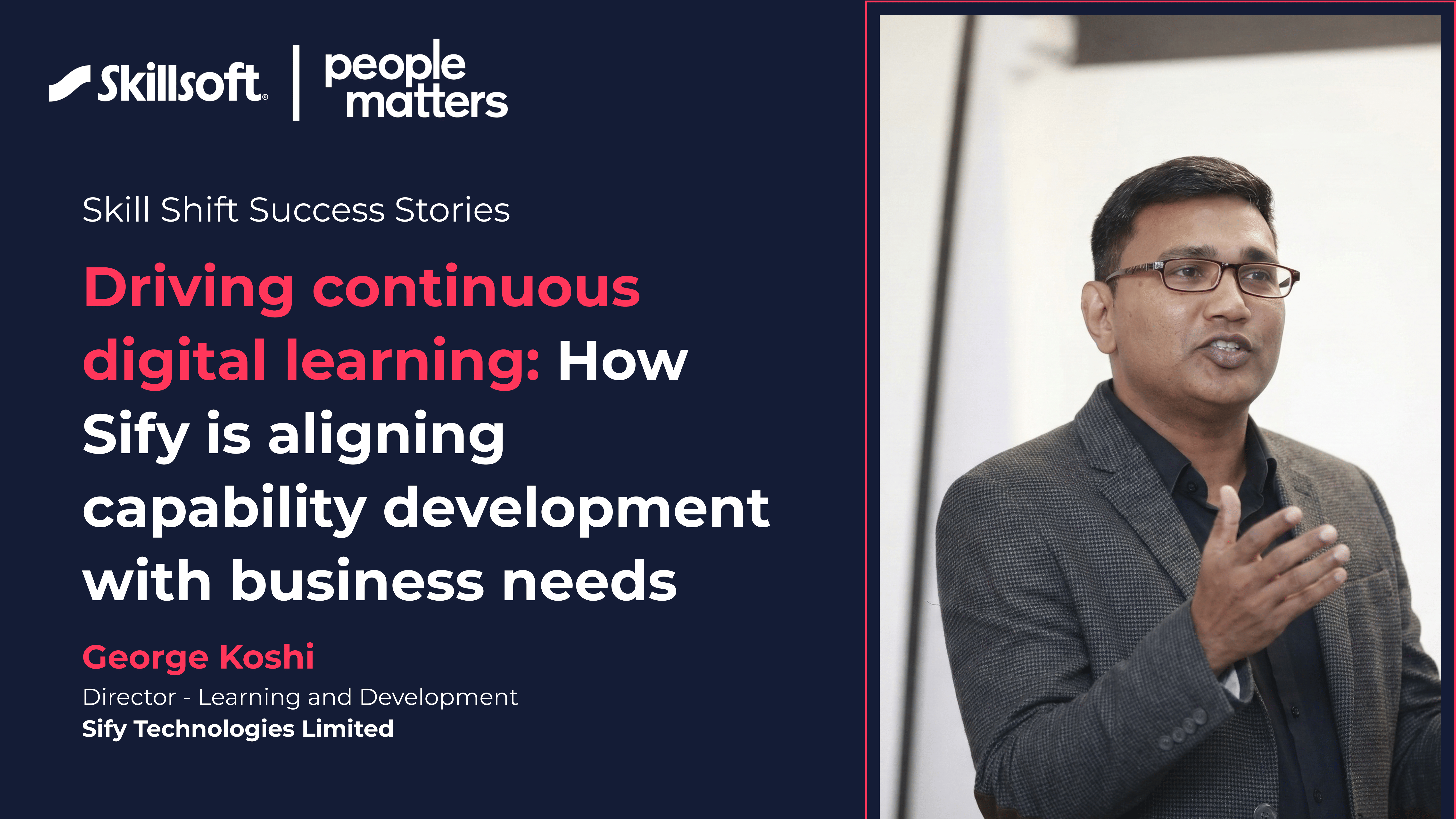
As part of the Skill Shift Success Story Series by Skillsoft × People Matters, George Koshy, Head, Learning and Development at Sify Technologies, shared how the organisation is addressing common L&D challenges while strengthening a culture of continuous learning.
Addressing the core challenges in learning and development
According to George, the challenges faced by L&D teams are remarkably consistent across organisations.
The first challenge is participation. Encouraging employees to actively engage in learning programmes remains difficult, particularly when learning is voluntary rather than mandated. While induction programmes typically see strong participation, role-based or optional learning initiatives often struggle to attract consistent engagement.
“Bringing people into learning has always been a challenge. Only when programmes are mandated, like induction, does participation become easier,” George explains.
The second challenge lies in measuring the impact of learning. Business leaders increasingly expect training programmes to demonstrate tangible outcomes. Yet measuring learning effectiveness, particularly in areas such as leadership development, remains complex.
The third challenge is content relevance. In today’s information-rich environment, organisations have access to vast libraries of courses. However, identifying and curating the right content for the right employee at the right time requires careful alignment with role requirements and business priorities.
Together, the three challenges, that of engagement, measurement, and relevance, form the foundation of Sify’s learning strategy.
Co-creating learning with business stakeholders
To address these challenges, Sify has adopted a collaborative approach to learning design. Rather than building programmes in isolation, the L&D team works closely with business leaders and subject matter experts. These stakeholders understand the operational realities of the organisation and help shape learning initiatives that align with business priorities.
For example, while designing initiatives around strengthening information security culture, the L&D team partnered closely with senior management to define the programme’s content, delivery approach, and assessment mechanisms.
This collaborative model ensures that learning initiatives remain closely connected to organisational needs and operational priorities.
Leveraging digital learning platforms
Digital learning platforms play a central role in Sify’s learning ecosystem. The organisation has partnered with Skillsoft for more than five years and relies extensively on its Percipio learning library as a primary source of curated digital learning content. When new learning requirements emerge, the L&D team first evaluates courses available on the platform before exploring external options.
This extensive repository allows the organisation to quickly identify relevant content across a wide range of competencies, including technical, behavioural, functional, and leadership development areas.
At the same time, George notes that certain specialised industry topics may still require external resources, particularly when niche technical skills are involved.
Sustaining engagement through structured learning frameworks
To maintain learning momentum, Sify has implemented a structured framework across the organisation.
Learning partners are assigned to specific business units, from sales to marketing, and work closely with managers to identify evolving skill requirements. These insights are then translated into curated learning pathways and course enrolments for employees.
The organisation also mandates a minimum of eight hours of learning every quarter, resulting in 32 hours of annual learning for every employee. Learning progress is tracked regularly, with reminders and nudges sent to help employees stay on track.
Weekly communication initiatives further support engagement. Learning partners regularly share curated course recommendations through internal mailers, highlighting relevant content employees can explore.
Measuring learning outcomes
While measuring learning impact remains challenging, Sify has adopted a multi-layered approach to evaluation.
For instructor-led programmes, whether classroom-based or virtual, the organisation uses pre- and post-assessments to measure knowledge improvement. These assessments help identify the learning delta achieved through training programmes.
In addition, the organisation gathers feedback from managers to understand how training initiatives influence employee performance in their roles. Although collecting such feedback can sometimes be difficult, it provides valuable insights into how learning translates into workplace application.
These metrics are complemented by platform-level insights, including adoption and engagement analytics. Currently, learning adoption through the digital platform ranges between 60% and 70%, which George notes is comparatively strong across the industry.
The growing importance of digital learning
Reflecting on the broader evolution of learning, George highlights the increasing role of digital learning tools in enabling continuous skill development. Digital learning allows employees to access content anytime and from anywhere, making it easier to integrate learning into everyday work routines, particularly in hybrid and remote work environments. “Digital assets would be the most convenient way of learning because content is available anytime, anywhere,” George says.
Advances in technology are also expanding possibilities for learning design, with innovations such as virtual reality, augmented reality, and AI-powered simulations creating new opportunities for immersive learning experiences.
While classroom training continues to play a role in certain areas, digital learning assets are increasingly becoming the primary channel for skill development.
A learner-driven future
For Sify, the long-term vision for learning remains centred on learner ownership.
“The ownership of learning lies with the learner. We believe in democratic learning where learners choose what they want to learn and when they want to learn,” George explains.
Organisations can provide platforms, resources, and encouragement, but employees ultimately play the most critical role in driving their own development.
Leadership reinforcement is also important in sustaining this mindset. At Sify, the importance of continuous learning is frequently emphasised in internal forums and leadership communications.
In a rapidly evolving technology landscape, this focus on learner ownership helps reinforce a simple but powerful message that continuous learning is an option but a necessity.
This article is part of The Skill Shift Series, where Skillsoft and People Matters explore how organisations are redefining learning to build capability, bridge skills gaps, and drive measurable business impact.
Learn how Skillsoft Percipio can transform your organisation’s learning journey today.