








For organisations, investing in AI alone does not guarantee transformation. The real differentiator lies in people readiness - from mindset, capability, and the ability to translate learning into business outcomes.
At Konica Minolta India Private Limited, this realisation has shaped a deliberate shift in learning strategy. Anchored in business realities, the organisation is focused on building a future-ready, skill-first culture capable of continuous technological adoption.
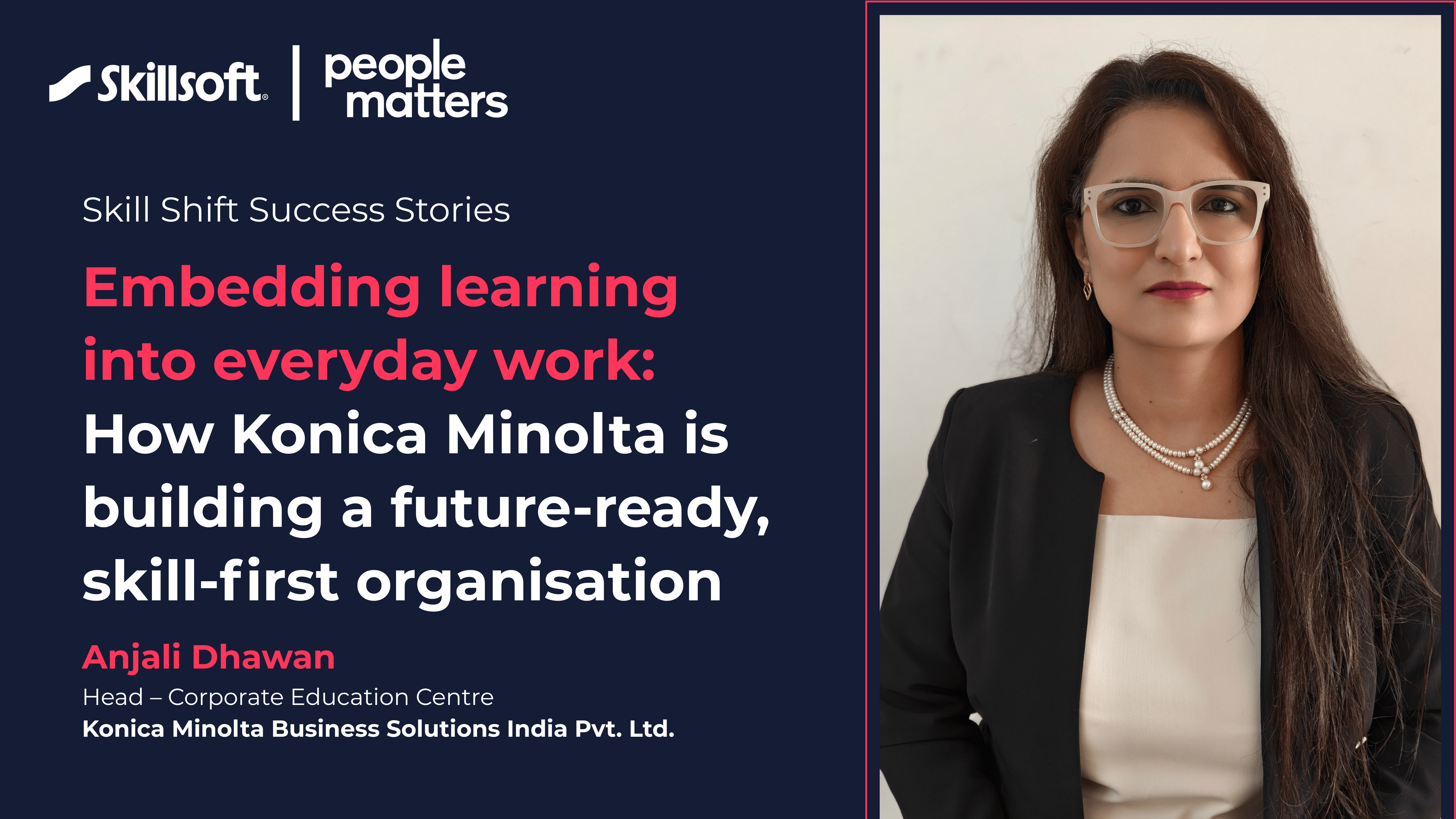
“Our learning transformation was anchored in business realities, not in modernising learning for its own sake,” says Anjali Dhawan, Head – Corporate Education Centre, Konica Minolta India Private Limited. “We focused on solving interconnected business challenges while ensuring learning became embedded into everyday work.” This perspective reflects more than a learning strategy, signalling a broader shift towards creating an organisation that continuously adapts alongside technological change.
For Season 2 of the Skill Shift Success Story Series by Skillsoft and People Matters, we explore how Konica Minolta aligned learning transformation with enterprise priorities by embedding digital, AI and leadership capability into the flow of work by building an ecosystem designed around application, ownership and long-term business impact.
Anchoring learning in business challenges
Konica Minolta’s transformation was designed to solve three interconnected business challenges, Anjali shared. They were as follows:
1. Building a consistent, future-ready learning culture
With a geographically dispersed and functionally diverse workforce, the organisation needed to move away from fragmented, event-based training. They wanted to nurture a continuous and accessible learning culture. This was because rapid advances in AI, automation and data-driven decision-making were also reshaping roles across functions. The challenge was not only to preserve deep institutional knowledge while intentionally building future-ready skills. Learning had to shift from occasional interventions to an embedded, everyday practice aligned with evolving role expectations.
2. Enabling a growth-oriented digital mindset
While the organisation was investing in intelligent automation, analytics and AI-enabled solutions, technology adoption alone did not translate into business impact. “The real gap was not the tools or the platform, but people-readiness,” Anjali explained. “Many employees viewed new digital and AI technologies with hesitation, seeing them as complex, disruptive or relevant only to certain roles.”
The learning objective, thus, evolved from awareness-building to mindset transformation and practical application. Employees needed to feel confident experimenting, adapting, and applying AI tools to enhance productivity, decision-making and customer outcomes.
3. Translating learning into business impact
Participation metrics were not enough. “We wanted learning efforts to result in measurable capability and performance improvement, rather than high participation with limited on-the-job application,” she said.
Employees needed clarity on what to learn, why it mattered, and how it connected to their roles. Learning had to move from consumption to application that aligned with business priorities.
An enterprise-wide, inclusive learning strategy
The learning strategy was enterprise-wide and inclusive by design. “I believe everybody is a target learner because everybody has a right to learning and future-ready skills,” Anjali said. Every employee, whether an individual contributor, a people manager, a member of the leadership pipeline, a new joiner, or an experienced professional, was considered a target learner. This ensured consistency in mindset, capability and ways of working across levels and functions.
However, intent to learn wasn’t the issue. “Despite strong intent to learn, we identified barriers around time constraints, an event-driven approach to learning and content overwhelm,” Anjali shared. As Anjali pinpointed, time constraints and competing business priorities, an event-driven perception of learning rather than a habit-driven approach, and overwhelm from abundant content were the main barriers, and addressing them became central to learning design and delivery.
The power of partnership and co-design
Strong internal and external partnerships drove transformation. “Without business buy-in and alignment, we cannot do anything,” Anjali noted. Internally, business leadership, HR and L&D aligned around the shared outcome of building an agile, skill-first organisation capable of continuous adoption.
Externally, Konica Minolta partnered with Skillsoft and Cedro (its end-to-end learning transformation partner since 2022) to co-design interventions that prioritised application over content consumption and embedded learning into the flow of work. “We partnered with Skillsoft and Cedro to co-design interventions that emphasised application over consumption and learning embedded into how work gets done,” she said.
The following were the key interventions:
Human and AI collaboration frameworks for heads to clarify decision boundaries, accountability and ethical oversight.
Role-based digital and AI upskilling pathways combining curated content, simulations and real-world practice.
Skill-first career journeys integrating learning into career conversations and internal mobility.
Konica Minolta adopted a “pull-first” learning strategy to build learner ownership, which was supported by monthly theme-based campaigns. A blended model brought together digital learning via Skillsoft’s Percipio platform (internally branded as “My Mentor”), instructor-led training, boot camps and compliance programmes. Gamification and recognition, such as monthly learning champions (“Learning Ninjas”), badges, leaderboards and an annual e-learning carnival, all reinforced engagement. “We started announcing monthly learning champions called Learning Ninjas, and that significantly strengthened participation and learner ownership.” By 2025, the shift from content-centric learning to skills, competencies and role-based journeys became prominent.
Sustaining momentum beyond launch
Sustaining engagement required a different mindset. “It is very easy to implement learning initiatives, but sustaining momentum is a very important element,” Anjali said.
To embed learning into everyday work, Konica Minolta introduced consistent monthly themes to create predictability, access to premium Percipio content across modalities, and recognition-led motivation through badges, champions and leaderboards. There were also regular orientations and awareness sessions, and bi-directional monthly analytics and insights to identify trends, gaps and opportunities. Live boot camps, leader camps and interactive simulations, and engagement initiatives such as learning trivia, learning circles and learning month celebrations altogether enabled sustained adoption.
Engagement levels were reported at 90% for three consecutive years, significantly above industry benchmarks, with annual learning hours exceeding 20,000.
Measuring what truly matters
Konica Minolta focused on behaviour-linked metrics rather than vanity numbers. “We focused on meaningful behaviour-linked metrics, not vanity numbers,” Anjali explained. They were as follows, as Anjali highlighted:
99% annual learner adoption for three consecutive years
85% participation rate
60% monthly returning learner rate
66% Skill Benchmark score, moving from developing to proficient trajectory
98% learning application rate
The emphasis remained on learning being applied and linked to performance.
Solutions that drove impact
While Percipio served as the organisation’s first LXP platform and laid a strong digital foundation, “the platform created the foundation, but the highest impact came from premium content, skill benchmarks, simulations and live boot camps,” Anjali said.
The focus shifted from simply tracking course completion to building demonstrated capability, supported by Skill Benchmarks that measured proficiency rather than participation. Interactive simulations strengthened leadership and behavioural capabilities through practice-based learning, while live boot camps and leader camps created space for real-time discussion, reflection, and application. Together, curated content, structured skills measurement, and robust analytics transformed learning from a theoretical exercise into an actionable driver of performance.
Three defining lessons
Reflecting on Konica Minolta’s learning transformation journey, Anjali identified three defining lessons -
First, "mindset matters as much as technology". AI and digital transformation deliver results only when employees feel psychologically safe and confident enough to learn and adapt continuously.
Second, "learning must be simple, relevant and embedded into the flow of work". Guided pathways, role-based journeys and application-focused design can significantly improve both engagement and measurable impact.
Finally, "partnerships are critical to scale and sustainability". Long-term collaboration with Cedro and Skillsoft ensured platform stability, continuous evolution and data-driven decision-making, enabling the organisation to sustain momentum while adapting to evolving business needs.
Konica Minolta’s journey underscores the critical truth that future readiness is not built through technology deployment alone, but through intentional learning ecosystems where mindset transformation, skill-first pathways and strong partnerships converge to drive measurable business impact.
This is part of the Skill Shift Series, where Skillsoft and People Matters together explore how organisations are redefining learning to bridge skills gaps and drive business impact.
Learn how Skillsoft Percipio can transform your organisation’s learning journey today.