








With global organisations today operating across regions, roles, and generations, and with skills evolving rapidly, traditional training models are no longer enough. Technological shifts, changing delivery models, and rising customer expectations are fundamentally reshaping how capability is built and sustained.
For Black Box, these changes exposed the limits of episodic, programme-led learning. While learning initiatives existed, capability depth varied across geographies, and the impact on performance was not always visible.
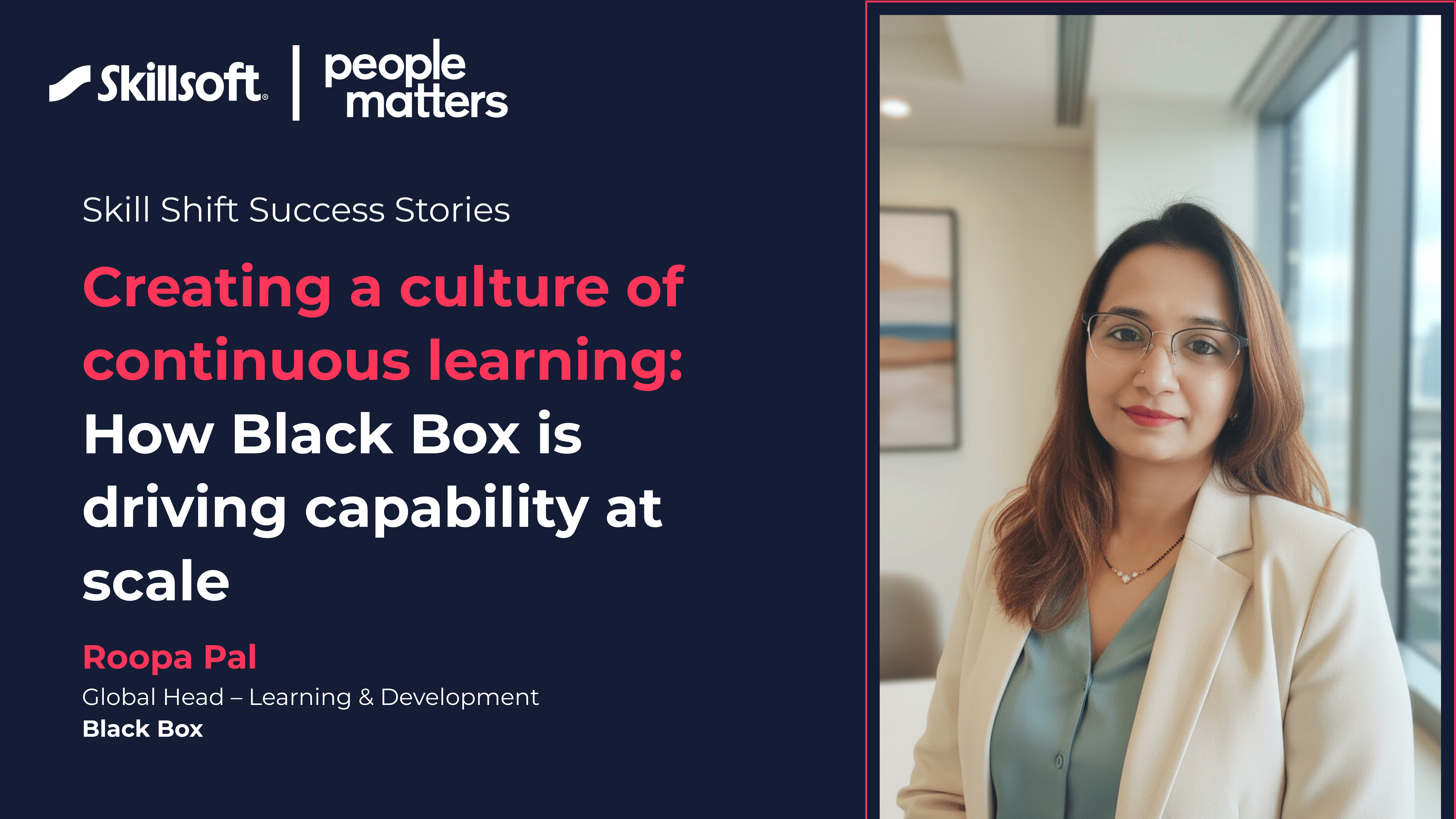
“Learning was happening, but it was just episodic,” says Roopa Pal, Global Head – Learning & Development, Black Box. “People attended programmes, but learning wasn’t becoming a habit.”
This prompted a deliberate rethink of learning, not as a series of interventions, but as a continuous, role-aligned capability ecosystem designed to support evolving business needs. “We realised our learning ecosystem also had to evolve in a way that supports these shifts,” Roopa explains.
This shift reflected more than a change in learning strategy. It represented a broader effort to build a globally aligned capability framework that could continuously support performance, growth, and readiness across the organisation.
As part of The Skill Shift Series by Skillsoft and People Matters, this case study explores how Black Box moved from episodic training to sustained capability building across the organisation.
Responding to change in a fast-evolving business environment
As the pace of technological change accelerated and customer expectations continued to rise, Black Box recognised that its existing learning approach was no longer sufficient. While employees were participating in learning programmes, development remained largely episodic and disconnected from day-to-day performance.
As Roopa Pal explains, “Learning was happening, but it was just episodic.” Employees attended programmes, yet learning had not become a sustained habit or a visible contributor to business outcomes.
At the same time, Black Box faced challenges common to many global organisations: inconsistent capability depth across regions, varying levels of skill proficiency, and limited clarity around which capabilities were most critical for specific roles. Although there was no shortage of content, employees often lacked a clear pathway for their growth.
“We had great content in place, but no single direction,” Roopa notes. “Employees did not always know what to focus on for their current role or future aspirations.”
“Our focus was anchored on three critical business imperatives,” Roopa says. These realities prompted Black Box to redefine its learning strategy around three priorities: building capability readiness at scale, driving greater consistency in skills across geographies, and making learning impact more visible.
Designing learning across the employee lifecycle
Rather than relying on standalone learning interventions, Black Box reimagined its learning strategy to support employees across every stage of their career journey.
As Roopa explains, “We looked at the entire employee lifecycle — from early career professionals to people managers, senior leaders, and women leaders.”
To bring this vision to life, Black Box established five structured learning academies, each built around clearly defined competencies and capability requirements: Technology Excellence, Sales Excellence, Leadership Excellence, Program Management Excellence, and Professional Excellence.
The Technology Excellence Academy focused on strengthening technical expertise through role- and band-aligned learning paths across areas such as cloud, networking, cybersecurity, project management, ITIL, and emerging technologies. The Sales Excellence Academy was designed to build consultative selling, customer engagement, account management, and business development capabilities across sales teams.
The Leadership Excellence Academy addressed managerial and leadership development across different career stages, while the Program Management Excellence Academy strengthened project, programme, and delivery management capabilities. The Professional Excellence Academy focused on foundational and future-ready skills such as communication, collaboration, business acumen, customer centricity, and personal effectiveness.
The learning portfolio was intentionally designed to support progression at every level. Programmes ranged from Path to Leadership for first-time managers to global interventions for middle managers and senior executives. For example, first-time managers participated in programmes focused on coaching, feedback, delegation, and leading teams, while middle managers engaged in interventions around strategic thinking, stakeholder management, and leading through change.
One of the flagship initiatives within this ecosystem was the Business Leadership Development Programme (BLDP), delivered through Skillsoft’s SLDP module and enriched with leadership content from MIT Sloan. Rolled out to senior managers and executives, the programme received strong participant feedback and demonstrated clear behavioural impact in areas such as strategic decision-making, business leadership, and executive presence.
However, Black Box recognised that motivation was never the challenge. “What stood in their way was not motivation,” Roopa shares. “It was the time constraint, the overload, and the confusion around what they needed to do to grow into a particular role or level.”
This insight reinforced the need for a learning ecosystem that provided not just access to content, but also clarity, direction, and a structured pathway for growth.
Co-creating a learning ecosystem with Skillsoft
From the very beginning, Black Box viewed learning transformation as a business-wide effort rather than an initiative owned solely by L&D.
As Roopa emphasises, “We as an L&D organisation cannot do anything alone.”
The success of the transformation depended on a strong partnership across the organisation — involving the C-suite, business leaders, HR business partners, people managers, and Skillsoft as a strategic learning partner. Together, they aligned around a common objective: shifting the organisation’s mindset from delivering training programmes to building long-term capability.
“The first mindset shift was moving from training programmes to capability building,” Roopa explains. “It was about helping employees understand not only what they needed to learn, but why those skills mattered to their role, performance, and future growth.”
Over the course of a two-year partnership, Black Box and Skillsoft co-created a series of initiatives designed to embed learning into everyday work and make it both relevant and engaging.
The journey began with the "21 Days of Learning Challenge", created to help employees build consistency and develop learning as a habit rather than a one-time event. The response was significant, with more than 1,000 employees participating globally.
As Roopa shares, “Almost 1,000 plus employees globally took this challenge.” More importantly, the momentum continued well beyond the campaign itself, with over 800 employees maintaining daily learning habits, often through short, five-minute learning moments integrated into their workday.
To further strengthen engagement and excitement around learning, Black Box and Skillsoft launched a global Learning Carnival across India, the US, EMEA, and APAC, delivered through both virtual and in-person experiences. The carnival introduced employees to new capabilities within Skillsoft Percipio, mobile learning, AI-powered tools, and Microsoft Teams integration through Black Box’s internally branded learning platform, Odyssey.
The approach was intentional: learning needed to feel accessible, practical, and inspiring.
“We don’t want learning to be serious,” Roopa explains. “We want learning to be fun and adventurous.”
Measuring impact beyond participation
From the outset, Black Box recognised that participation metrics alone would not be enough to demonstrate the value of learning. While enrolments and completions were important, the organisation wanted to understand whether learning was truly influencing capability and performance.
As Roopa reflects, “Participation was great, the numbers were great, but the real question was: how do we demonstrate impact?”
To answer that, Black Box focused on three categories of measurement.
The first was engagement — not simply how many employees logged into the platform, but how actively and consistently they were learning. As Roopa shares, “We had 72% of our employees going onto the portal and learning every day.”
The second area focused on capability building. Black Box tracked how employees were progressing against the skills and competencies required for their roles, enabling greater visibility into skill depth, readiness, and development across the organisation.
The third and most important measure connected learning directly to business performance. The organisation worked with leaders to assess whether employees were applying newly acquired skills in their day-to-day work, whether capability gaps were reducing, and whether there was a visible improvement in performance, quality, and outcomes.
This shift allowed Black Box to move beyond measuring activity to measuring impact — ensuring that learning was not only being completed, but also translating into stronger capability and better business results.
Solutions that enabled scale and relevance
Several Skillsoft solutions played a major role in enabling Black Box’s learning ecosystem. The SLDP provided insight into leadership readiness and progression among senior leaders. Role-based learning paths aligned to more than 270 roles helped employees focus on what mattered most for their responsibilities.
AI Assist empowered employees to explore learning independently, reducing reliance on structured interventions. Skill benchmarking, a new concept for the organisation, brought further clarity.
As Roopa explains, “Skill benchmarking gave us the clarity to understand where employees stood today and what they needed to do to progress further.”
Key lessons from the journey
Reflecting on the transformation, Roopa identifies three principles that continue to shape Black Box’s learning strategy.
First, “learning succeeds only when business leaders co-own it.” Capability building cannot be driven by L&D alone. Leaders and managers must play an active role in enabling and reinforcing it.
Second, relevance beats abundance - having the right learning for the right role matters more than access to unlimited content.
Third, sustained impact comes from ecosystems. Learning must be embedded into everyday work, connected to performance, and integrated into the employee experience, rather than delivered as a series of isolated programmes.
“Ultimately, this journey reaffirmed for me that learning is not just a support system, but a strategic growth engine for any organisation,” Roopa reflects. “When it is designed with intent and executed with passion, it becomes a true enabler of growth.”
This article is part of The Skill Shift Series, where Skillsoft and People Matters explore how organisations are redefining learning to build capability, bridge skills gaps, and drive measurable business impact.
Learn how Skillsoft Percipio can transform your organisation’s learning journey today.