








India’s higher education institutions are navigating a period of structural change. Regulatory reforms, evolving student expectations, and the growing emphasis on employability and workforce relevance have placed new demands on how learning is designed, delivered, and assessed.
For Bharati Vidyapeeth Deemed University (BVDU), these shifts triggered a deliberate move to strengthen their online education ecosystem - one that could scale access, ensure academic rigour, and embed industry-relevant skills and career readiness into learning outcomes.
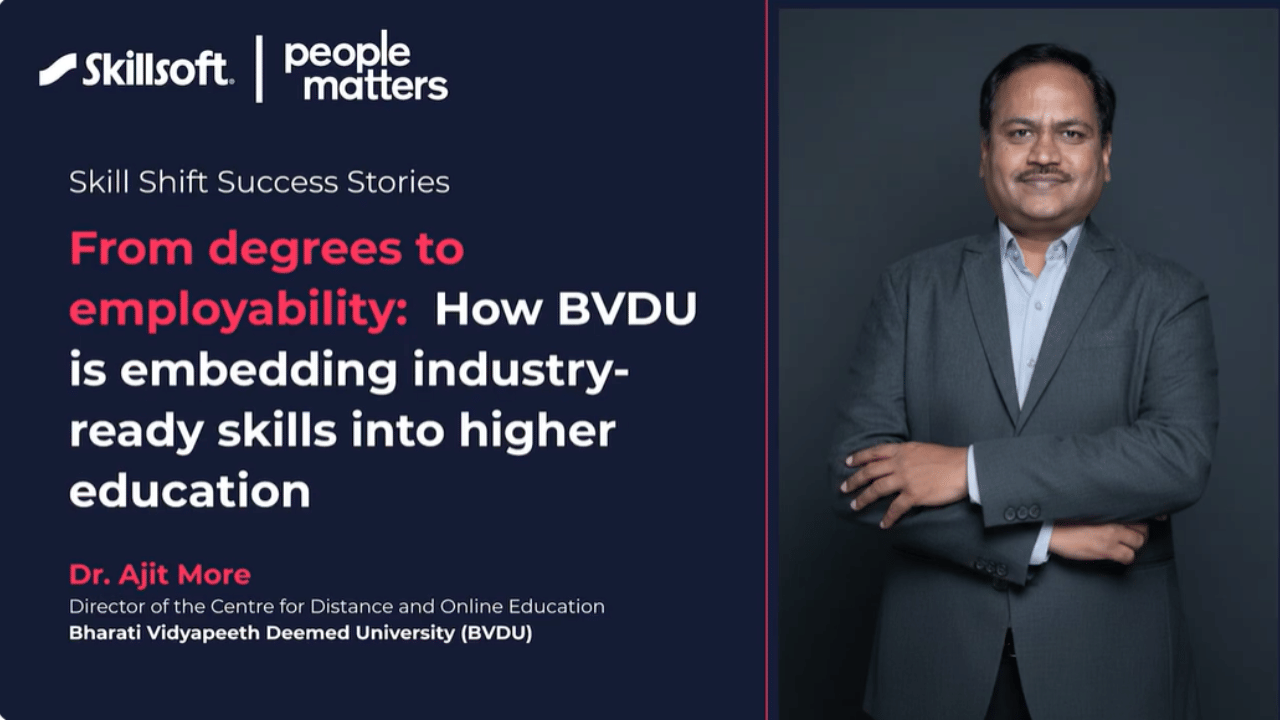
This transformation has been shaped and articulated by Dr Ajit More, Director, Centre for Distance Education, BVDU, who has been closely involved in BVDU’s online education strategy and the establishment of its digital learning infrastructure. The journey culminated in the creation of the Centre for Distance and Online Education (CDOE), supported by a structured digital learning strategy and a strategic partnership with Skillsoft to enable skills-based learning at scale.
As part of The Skill Shift Series by Skillsoft and People Matters, this case study explores how BVDU is operationalising skills-based online education while remaining aligned with academic standards, industry expectations and national education priorities.
Responding to change in higher education
Multiple external and internal drivers shaped BVDU’s move toward online education. Regulatory frameworks such as NEP 2020, along with accreditation and ranking expectations, created a strong mandate to rethink traditional delivery models. At the same time, learners increasingly sought flexible, accessible education that translated into real-world employability and job readiness.
Rather than viewing online education as a parallel channel, BVDU positioned it as a core institutional capability designed to extend reach without compromising quality or relevance to the evolving world of work. As Dr More explained, the establishment of CDOE became a foundational step in formalising this vision, bringing governance, pedagogy, technology, and faculty enablement under a single umbrella to ensure consistency, scale, and measurable outcomes.
"The National Education Policy is emphasising multidisciplinary and skill-oriented education, while global trends like AI integration are creating demand for digital literacy among students," says Dr More.
Building the centre for distance and online education (CDOE)
CDOE was designed to serve as the operational backbone for BVDU’s online programmes. Its mandate went beyond content digitisation to include academic design, faculty readiness, learner engagement, skills and outcome tracking.
A key priority highlighted by Dr More was ensuring that online learners received an experience comparable to on-campus students. This meant structured curricula, consistent assessments, and access to high-quality learning resources that could support both conceptual understanding and applied, workplace-relevant skills.
The scale of the initiative required technology that could deliver consistency across programmes while remaining flexible enough to accommodate diverse learner needs and different levels of digital and professional skill maturity.
Integrating skills into academic learning
One of the central challenges BVDU addressed was the gap between academic instruction and employability outcomes. While disciplinary knowledge remained essential, the university recognised the need to complement it with transferable, industry-aligned skills to enhance workplace readiness.
As Dr More highlighted, digital learning content became a critical enabler in this shift. Through Skillsoft’s campus learning solutions, curated content was integrated to support areas such as professional skills, digital fluency, leadership fundamentals, and applied competencies that align with real job roles and industry expectations. This allowed students to engage with skills-focused learning alongside their formal curriculum.
"The students are acquainted with theoretical concepts, but when they enter the field, they should also be acquainted with real-world cases and industry problems," Dr More explains. "These additional inputs complement the regular programme and increase students' employability."
This integration helped bridge the divide between theory and practice, enabling learners to contextualise academic concepts within practical, real-world scenarios they are likely to encounter in their careers.
Empowering faculty and learners through digital platforms
Faculty adoption was a crucial success factor in BVDU’s online education journey. Structured support systems, technology enablement, and access to curated digital resources helped faculty transition from traditional classroom instruction to blended and online delivery models without diluting academic ownership.
For learners, the digital platform enabled flexibility, self-paced learning, and exposure to a broader range of industry-relevant and future-facing skills. This approach allowed students to take greater ownership of their learning journey while remaining anchored to defined academic outcomes and employability goals.
"The most important thing is that students are learning at their own pace and as per their own convenience," says Dr More. "Wherever they feel a course is needed for their enhancement, they can engage with it."
The emphasis was not on replacing traditional education models, but on enhancing them through thoughtful use of technology to build confidence, adaptability, and career readiness.
Aligning online education with quality and outcomes
Quality assurance remained central to BVDU’s approach. Online programmes were designed in alignment with regulatory expectations and institutional benchmarks, ensuring that learning outcomes, assessments, and engagement metrics were clearly defined and monitored across both academic and skills dimensions.
By embedding skills-based learning within formal academic structures, the university avoided the common pitfall of treating employability as an add-on. Instead, as Dr More articulated, skills development became an integrated and measurable component of the learner experience.
"We realised that students engaging with these programmes were comparatively performing better in interviews," Dr More notes. "The level of confidence, analytical ability and problem-solving approach improved significantly."
This alignment also strengthened the credibility of online education within the institution, reinforcing its role as a legitimate and valuable mode of learning for both students and employers.
A scalable model for the future of higher education
BVDU’s online education journey illustrates how universities can respond to systemic change without compromising academic integrity. By institutionalising CDOE, integrating digital learning platforms such as Skillsoft for Campus, and aligning skills with curriculum design, the university has created a scalable framework for future growth.
The focus now extends beyond access alone to outcomes, ensuring that learners graduate not only with degrees but also with the skills, confidence, and adaptability required to navigate a rapidly changing professional landscape.
"Students should graduate equipped with all the required skills and be confident enough to face industry challenges," says Dr More.
This article is part of the Skill Shift Series, where Skillsoft and People Matters explore how institutions and organisations are redefining learning to bridge skills gaps and improve readiness for the future of work.
Learn how Skillsoft Percipio can transform your organisation’s learning journey today.