








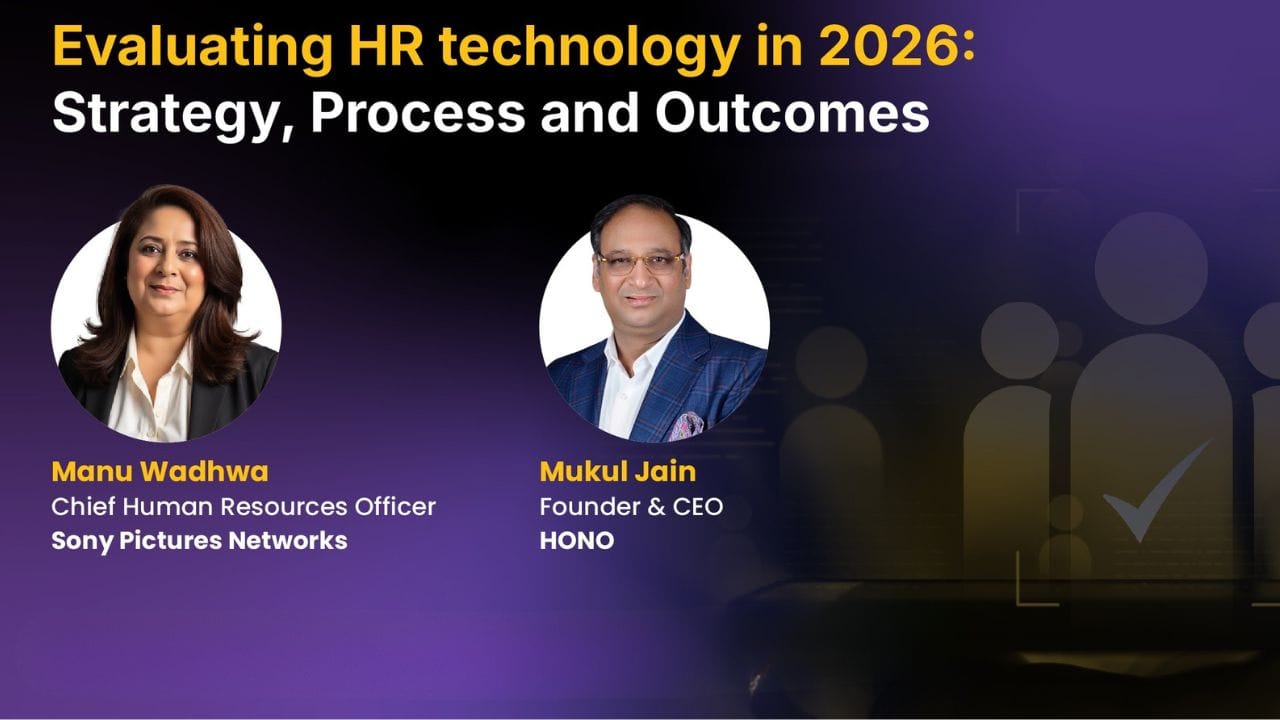
The corporate landscape in 2026 is navigating the convergence of agentic artificial intelligence, skills-based architecture and evolving data compliance regulations. In this climate, the discourse around Human Resource Management Systems (HRMS) has fundamentally shifted. For decades, organisations viewed HR technology primarily through an administrative prism, akin to a digital filing cabinet designed to manage basic employee lifecycles.
However, modern enterprises are realising that technology limitations are rarely the
barrier to value realisation; rather, the flaw lies in outdated evaluation frameworks. To
discuss unlocking the true potential of digital transformation, People Matters, in
partnership with HONO, brought together two leading HR voices, Manu Wadhwa, Chief
Human Resources Officer, Sony Pictures Networks and Mukul Jain, Founder & CEO,
HONO, to discuss how HR technology can be repositioned and elevated as core
enterprise infrastructure that drives business agility, systemic intelligence and fiscal
performance.
Shifting from administrative automation to strategic
infrastructure
The persistent tendency to evaluate HR platforms using feature checklists and procurement grids is rooted in the function's historical evolution, Manu notes. For
almost half a century, the architectural focus remained locked on solving administrative
pain points. To break this cycle, organisations must build new internal narratives that
explicitly connect HRMS capabilities to enterprise-wide growth, shifting the focus from
simple automation to deep structural transformation.
When infrastructure is treated strategically, the HRMS ceases to be an isolated
repository and becomes the central connective tissue of the enterprise digital ecosystem. Mukul suggests that this transition requires a mindset shift across the
entire C-suite. Business strategy and people infrastructure are not separate
workstreams; they are deeply interdependent components of the same transformation
goals. Operational frameworks like HONO exemplify this modern approach, positioning
the HRMS as the enterprise's underlying nervous system to ensure that people data
actively informs capital allocation and operational scaling.
Overcoming execution issues through cross-functional synergy
A significant vulnerability in contemporary HR technology evaluations is the disconnect
between platform selection and systemic implementation. Organisations frequently
optimise for exhaustive capability lists while ignoring the operational realities of the end
user. Maximising investment value requires a unified evaluation coalition where all
stakeholders assess the platform against shared enterprise goals. A truly future-ready
HRMS must function as an open ecosystem, utilising modern frameworks like the
Model Context Protocol (MCP) to break down information barriers and allow disparate
corporate systems to communicate fluidly.
When an HRMS is built on open API-first frameworks, it seamlessly unifies a diverse
corporate architecture:
- Core Operational Systems: Connecting payroll, recruitment, learning and performance analytics.
- Cross-Functional Suites: Integrating with external ERPs, finance software and sales tracking platforms.
- Autonomous Networks: Enabling agent-to-agent interactions on the cloud for real-time information exchange.
This level of connectivity transforms standard data into decision intelligence. For
instance, evaluating an employee's absenteeism alongside real-time productivity data
drawn directly from a connected CRM allows leaders to make highly contextualised
talent decisions, transforming isolated metrics into comprehensive operational clarity.
Building a trust-based foundation for agentic AI architecture
The rapid rise of agentic AI is transforming the workplace into a hybrid ecosystem
where human employees and autonomous AI agents collaborate on shared workflows.
As these cognitive agents become deeply embedded in corporate operations, the
architectural expectations placed on the core HRMS are also changing dramatically.
However, an enterprise cannot successfully deploy advanced AI capabilities if its
foundational data layer is unstable or untrustworthy.
Organisations cannot transition directly from legacy operational models to autonomous,
agentic frameworks without fixing their underlying core, Manu says. If an enterprise
lacks absolute trust in its basic infrastructure, such as payroll processing, core data
integrity and essential lifecycle workflows, introducing AI layers will only amplify
existing systemic friction.
The prerequisite for advanced innovation is a sturdy digital foundation. Mukul highlights
the architectural shift required to support this evolution, noting that modern systems
must transcend historic operational boundaries. "The tech systems are moving forward
but we need the internal capability building to be taken up in a direction that they can
adopt these systems very well."
Embedding privacy architecture and compliance in core design
The implementation of the Digital Personal Data Protection (DPDP) Act has
fundamentally reshaped the expectations surrounding employee data governance.
Employee data, ranging from medical records to historical performance trajectories,
represents privileged information that demands stringent architectural protection.
Modern HRMS evaluations must look beyond simple functionality to examine how data
privacy and AI ethics are natively embedded within the core infrastructure.
Rather than treating compliance as an afterthought or a reactive audit trail, future-ready
architecture must build accountability and data masking directly into its workflows to
actively eliminate human bias in talent decision-making. Furthermore, as organisations inherit foundational Large Language Models (LLMs) from external builders, maintaining
data security requires shifting toward private enterprise environments. Storing data
within dedicated corporate environments ensures that sensitive information is never
exposed to third-party models during automated processing or collaborative workflow
execution.
Redefining ROI: Moving from efficiency to hard business values
The financial justification for HR technology investments has historically relied on soft
metrics like time saved or administrative efficiency. While these metrics matter, they are
insufficient in modern boardroom discussions. Cloud-based HR ecosystems, such as
HONO, allow leaders to shift the conversation toward predictive, high-value financial
indicators that measure concrete productivity gains. To secure capital allocation, HR
leaders must present a business case rooted in fundable, quantifiable enterprise value.
Modern ROI frameworks should prioritise sophisticated diagnostic and predictive
capabilities that tie talent metrics directly to revenue generation. For example, when an
enterprise identifies a critical growth agenda, the HRMS should instantly run diagnostic
queries to identify the exact human capital drivers behind peak financial performance,
allowing leaders to position their best people against the highest-value business
opportunities.
Value realisation must also leverage predictive analytics via early warning systems and
real-time sentiment analysis. A strategic HRMS moves beyond tracking historic turnover
metrics to forecasting the financial consequences of talent flight. By calculating how
attrition or reduced engagement in a specialised division directly depresses business
revenue, the system transforms qualitative human resource data into hard capital
metrics.
Actionable playbook for future-ready HRMS implementation
To navigate the complexities of HR technology transformation successfully, enterprise
leaders can implement a structured execution playbook tailored for consumer-centric
usability and long-term scalability. As Manu observes, the ultimate operational test of
any new system comes down to how effortlessly a manager can navigate daily
workflows. "The ultimate test is that on a Monday morning, a manager receives a
particular workflow related to leave applications or performance evaluation, and they do
not have to reach out to anybody to be able to create that natural approval cycle."
To achieve this level of friction-free operations, organisations can adopt the following
strategic steps:
Establish a unified dataset: Stop treating HR technology as an isolated silo. Consolidate employee, consumer and
supplier data into a singular, cohesive corporate data lake where connected LLMs can
safely extract high-fidelity insights.
Utilise sandbox testing environments: Before finalising a technology partner, invest in a dedicated sandbox environment.
Testing a vendor's platform with authentic corporate data allows leadership to game
scenarios, evaluate user adoption and verify specific business outcomes prior to full-
scale deployment.
Design for the future state: Evaluate platforms not against current administrative needs, but against mid-term and long-term strategic objectives. Prioritise agile solutions that scale seamlessly alongside evolving AI integration, shifting business models and tightening global compliance laws.
Leverage hybrid consulting expertise: Overcome internal skill gaps by engaging objective, independent consulting support
during the implementation phase. Combine human strategic experts with AI-driven
testing models to accelerate deployment timelines, lower workflow error rates and
construct comprehensive audit trails from day one.
As organisations look to evaluate or replace their HRMS platforms over the coming
year, they must reject the traditional procurement checklist in favour of a strategic
infrastructure blueprint. By moving away from isolated point solutions and treating the
HRMS as a central engine of enterprise intelligence, leadership can ensure that their
technology investments do not constrain operational agility, but instead power long-
term business growth.