







AI & Emerging Tech
Agentic AI meets employee experience: Redefining well-being and recognition




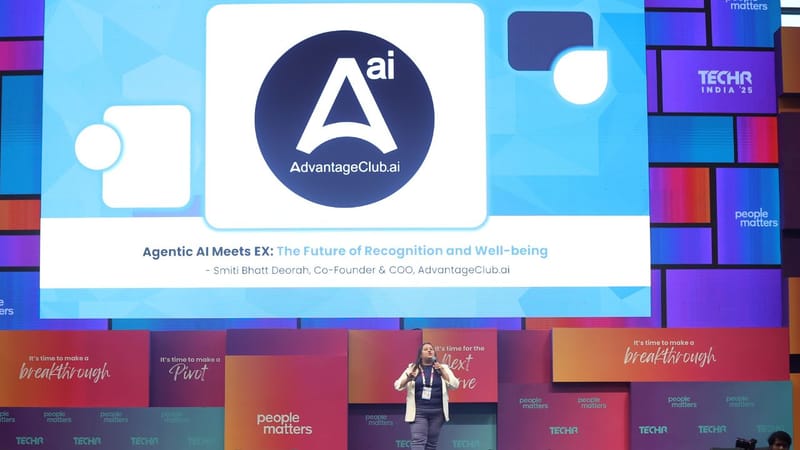
Advantage Club.ai's Smiti Bhatt Deorah explains how agentic AI is reshaping recognition, well-being, and employee experience.
At the recently organised People Matters TechHR India 2025, Smiti Bhatt Deorah, Co‑founder and COO of AdvantageClub.ai, gave a future-forward keynote address and compelling session on the role of agentic AI in rewards, recognition, and employee experience. Drawing a clear distinction between traditional AI tools and agentic AI, she demonstrated how this evolution is set to bolster employee engagement and organisational culture. This article is based on key excerpts from the keynote address.
Understanding Agentic AI in the EX
While AI has already permeated the workplace, Smiti underscored that the next leap is happening now: the move towards agentic AI. To introduce the concept, the session began with a quiz to ascertain the role of agentic AI. The idea was to help distinguish between automated tasks and AI, and the fact that AI itself is not always agentic either.
Where automation only replicates processes on a large scale (such as analysing employee performance in bulk through uniform data), agentic AI goes a step further. It listens to your intent through a prompt (such as “award X with a ‘good job’ citation”) and acts without requiring users to navigate platforms manually. The key element lies in the delegation of execution, which can reduce friction in adoption and dramatically improve the user experience.
Another question addressed a challenge many fear: what can AI not replace? The answer was human empathy, and Smiti stressed that no technology, however advanced, can authentically replace the emotional depth of genuine human connection in recognition and care. This dual narrative of AI becoming an enabler, yet empathy being irreplaceable, set the tone for the session on how to balance AI with human interaction.
Rethinking recognition through the CARE framework
The CARE framework, a comprehensive lens for embedding effective recognition into organisational culture, can help in understanding the different facets of employee recognition. Each component of the framework also reveals how AI, and particularly agentic AI, can bring new efficiencies while preserving human meaning:
1. Culture‑led Recognition
Spot awards, nominations, and social recognition practices form the core of culture‑driven recognition. By digitising these through agentic AI, organisations can streamline processes while allowing employees to choose personalised rewards that resonate more deeply. Social features, such as hall‑of‑fame announcements or public feeds, can compound the impact by letting recognition be seen and celebrated widely.
2. Achievement‑led Recognition
While cultural values remain critical, performance‑based recognition has been the norm across roles and industries. Real‑time leaderboards, achievement dashboards, and KPI‑linked awards extend recognition into diverse functions beyond sales, from technology to legal teams. This ensures excellence is visible, measurable, and acknowledged consistently. With agentic AI, managers can customise dashboards quickly, creating dynamic performance benchmarks that give employees a clearer line of sight on how they compare with peers, providing concrete, data‑driven motivation to improve.
3. Rewarding Key Moments That Matter
Milestones such as birthdays, work anniversaries, first days, and major successes provide universal opportunities to strengthen employee connection. Agentic AI allows organisations to automate certificates, badges, and warm celebratory notes for these key occasions, ensuring no such moment slips through the cracks. At the same time, leaders can add personal touches on top of these automated processes to humanise the interaction. By addressing both big milestones and smaller life‑cycle moments, companies can create a framework of recognition that engages every employee beyond the lens of culture and performance.
4. Engagement‑led Healthy Habit Formation
Recognition also extends to employee well‑being as flex-rewards and curated wellness packages can incentivise employees to form healthier everyday habits, such as participating in fitness activities or making preventive health choices. Agentic AI enhances this experience by digitising, organising, and offering nudges to make participation effortless. Small reminders and timely prompts help employees take consistent action, eventually forming better habits. The end result is a workforce that feels cared for while simultaneously becoming more productive and engaged.
At the heart of CARE lies a practical truth: unless your policies are digitised and customised effectively, your employee well-being programmes risk being generic and uninspiring. In this context, agentic AI can offer the adaptability needed to ensure recognition speaks to unique employee journeys rather than a standardised, one‑size‑fits‑all approach.
Practical use cases for agentic AI across the employee journey
To bring the concept to life, Smiti shared six practical use cases where agentic AI like Advantage Club.ai’s ADVA can transform employee experience. For HR professionals striving to boost adoption and impact, these examples make a compelling business case:
1. Peer‑to‑peer and Manager-led Recognition
With conventional recognition platforms, managers typically go through multiple steps: log into a portal, search for an employee, select an award, write a citation, and confirm the submission. ADVA condenses this entire journey into a single, conversational command. For instance, Bill, a manager, simply tells Adva, “Give Sam the 'Top Performer’ award,” and it takes care of the rest, pulling up Sam’s profile and completing the award allocation in one smooth flow.
2. Gifting and Redemption Experiences
Reward redemption traditionally required browsing catalogues, comparing gift options, and navigating payment processes, often making the experience tedious. ADVA simplifies this into a single conversational step. For instance, an employee just types, “Redeem 1500 points on Myntra,” and ADVA completes the redemption for him -- all within the chat, without needing to click through the platform. This ease leads to higher redemption rates and greater satisfaction, as employees feel their efforts are swiftly rewarded without logistical or administrative strain.
3. Wellness Access
Wellness programmes often see low participation due to complex access. With agentic AI, the process becomes conversational -- finding suitable options, showing nearby centres, and enabling one-click activation. For instance, Adva can suggest a fitness or health membership based on the user’s past choices and activate it once they confirm, making wellness benefits effortless and engaging. This ensures no benefit goes unused and employees feel supported in their personal well-being journeys.
4. Milestone events and reminders
Recognition for birthdays, anniversaries, or joining dates is common, but these often become mechanical. ADVA adds value by allowing leaders to pre-schedule meaningful gestures well ahead of time. The system can then nudge leaders or teams, reminding them to add personalised notes or actions. For instance, Adva might remind a manager, “Liam’s birthday is tomorrow -- would you like to send him a personalised message?” The manager can then ask Adva to draft and send the wish, ensuring the celebration feels timely and thoughtful.
5. Reporting and Analytics
Data and reporting are critical for HR, but sifting through extensive datasets for insights is often time-consuming. ADVA makes this effortless by enabling leaders to ask their questions directly. For instance, an employee can simply ask, “Show me the top 10 awardees from last quarter,” and the system instantly provides the insights -- no more juggling dashboards or downloading spreadsheets.
6. Knowledge Base and Policy Queries
Recognition policy education often creates bottlenecks in HR operations, with managers spending unnecessary time interpreting budgets, allowances, or policy restrictions. ADVA simplifies this by acting as an intelligent policy assistant. For instance, an employee can simply ask ADVA in chat, “How many people can I award, and what is my budget?” and get the exact information instantly, without switching tabs. This reduces ambiguity, boosts manager confidence in applying policies, and frees HR teams from repetitive clarifications.
Together, these applications demonstrate how AI shifts from being a passive backend tool to becoming an everyday enabler for HR leaders, managers, and employees alike.
The takeaway for HR leaders
While the advantages of integrating agentic AI with the employee experience are immense, HR leaders must ensure that agentic AI serves as an amplifier of human connection, not a substitute. AI cannot replicate human empathy, compassion, or interpersonal skills, which makes the future of recognition symbiotic: letting AI handle the mechanics so that humans can focus on authentic gestures of care and appreciation.
For those shaping employee experience, the message is clear:
Embrace agentic AI to simplify execution.
Digitise and customise recognition frameworks like CARE
Anchor every AI‑powered intervention with empathy
As Smiti summed up through the examples in the session, the future is no longer about AI being a distant prospect. It is about agentic AI at work today that can help HR teams pivot from process to impact, and from automation to truly meaningful engagement.
Author

Loading...