







AI & Emerging Tech
AI Changes the Rules of Work: Lupin’s Yashwant Mahadik on HR’s Next Chapter






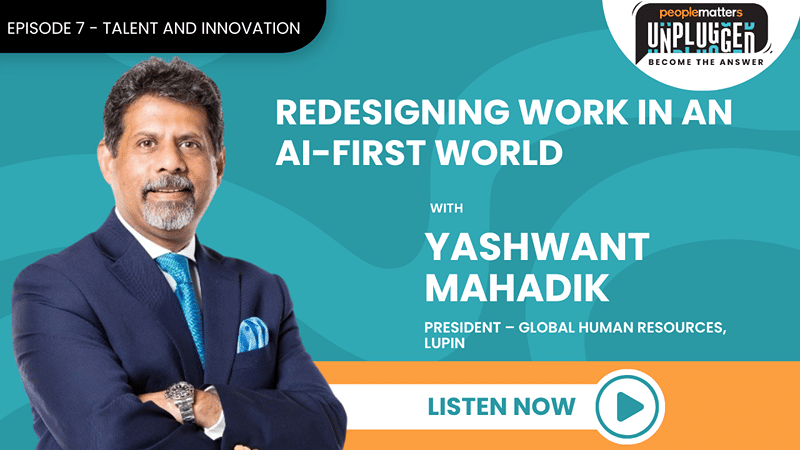
Lupin’s President – Global HR explains why AI fluency, digital workforces and reimagined business models are becoming central to the CHRO’s evolving mandate.
For years, transformation has been a familiar language for organisations navigating changing markets, technology and workforce expectations. But as the pace of disruption accelerates, transformation itself is becoming embedded in how organisations operate.
The next challenge for business and HR leaders, according to Yashwant Mahadik, President – Global Human Resources, Lupin, is to reimagine the organisation itself.
Speaking on the latest episode of our Unplugged podcast with Cheshta Dora, Head of Content & Research at People Matters, Mahadik argues that the role of the CHRO is moving well beyond talent management and workplace strategy. As AI reshapes work, business models and employee experiences, HR leaders need a stronger understanding of technology, business architecture and emerging capabilities to help shape what comes next.
“Transformation per se to me has got embedded as a process, as a skill, as a capability within every leader,” Mahadik says. “What today's leaders are focusing on is re-imagining.”
From disruption at scale to disruption at speed
Disruption is not new to business, Mahadik says. Organisations have dealt with economic cycles, geopolitical shifts, talent shortages and demographic changes for decades. The COVID-19 pandemic was a particularly significant disruption, fundamentally changing expectations around work and flexibility.
What is different today is the speed at which change is occurring. AI, in particular, is creating what Mahadik describes as disruption not only at scale, but at speed. Organisations can begin developing an AI agent using a particular technology platform only to find that the platform itself has evolved by the time the work is complete.
The rapid progression from generative AI to agentic AI and, increasingly, physical AI is changing the technology landscape faster than traditional organisational planning cycles can accommodate.
For business leaders, this makes waiting for certainty increasingly difficult. “There's no choice anymore,” Mahadik says of AI adoption. “If someone is still debating it, you have already lost the plot.”
For HR, AI fluency must go beyond productivity and automation. Leaders need to understand how the technology works, reshapes processes and impacts the workforce.
HR's role is moving from transformation to reimagination
Mahadik's own remit at Lupin reflects a broader shift in how organisations are approaching transformation. Rather than concentrating transformation responsibility in a central office, he says, Lupin has moved towards a model where leaders across functions own transformation within their respective areas.
The global CFO, technology and operations leadership, quality leadership and HR all have transformation responsibilities. The underlying shift is from functional thinking towards an enterprise mindset.
“Transformation cannot be a single person's responsibility,” Mahadik says. The more significant shift, however, is that transformation itself is no longer the endpoint.
As technology, customer expectations and business ecosystems change rapidly, organisations need to repeatedly reconsider how they operate, serve customers and develop products. Mahadik therefore prefers the language of “reimagination”.
“It's to re-imagine how the company will operate, re-imagine how the company will serve its customers, re-imagine how we will develop products,” he says.
For CHROs, this expands the mandate. They need to think beyond transformation programme, about how the people function can help the organisation rethink its business and work models.
AI is becoming a thinking layer for HR
At Lupin, AI adoption is moving beyond isolated experiments. Mahadik says the company is applying AI across areas including manufacturing, quality, commercial operations, finance, R&D and HR.
In HR, he describes the work as AI transformation at scale, while emphasising that much of the current work remains in the design and production stage.
The opportunity goes beyond simply introducing another digital tool. Mahadik describes the evolution in three broad layers. Digitisation created systems of record and established the infrastructure needed to organise organisational data. AI can then act as a “thinking engine” on top of that infrastructure, while employees and customers interact with the resulting systems through the experience layer.
That creates an opportunity to fundamentally rethink employee experience. Organisational technology has traditionally prioritised data accuracy, security and compliance. Consumer platforms, by comparison, have conditioned people to expect intuitive, fast and personalised experiences.
AI could narrow that gap. “The experience has to be consumer grade,” Mahadik says, pointing to the difference between interacting with an organisational HR system and using social media platforms.
For HR leaders, the implication is significant: AI transformation is not simply about automating existing HR processes. It creates an opportunity to redesign how employees access information, make decisions and interact with the organisation.
The rise of the digital workforce
Mahadik argues that traditional distinctions such as blue- and white-collar work are becoming less relevant as technology reshapes how work is organised.
Alongside human employees, organisations are developing a digital workforce of chatbots, AI agents and other systems that perform tasks and support decisions. This could also change how CHROs think about organisational scale.
Rather than focusing only on headcount, leaders may increasingly need to consider how many AI agents the organisation builds, buys and manages alongside its human workforce. That makes AI fluency a core leadership capability.
Mahadik sees generative AI as only the starting point, followed by agentic AI and eventually physical AI. As the technology evolves, leaders will need to keep learning. “I’m still a student,” he says.
In pharmaceuticals, Mahadik argues that regulation does not necessarily limit AI adoption. Instead, AI can reduce manual work, improve consistency and strengthen quality and compliance.
At Lupin, AI use cases span product filing, manufacturing and quality operations. In R&D, AI models can support product filing, while in manufacturing, AI agents can analyse production data and flag issues earlier.
The human remains in the loop. AI can reduce repetitive work and surface insights, while people continue to make critical decisions.
Mahadik says it is still too early to quantify the full impact, as many initiatives remain in the design or production stage. Expected benefits include productivity, efficiency and stronger compliance.
Capability building must combine ‘build’ and ‘buy’
As Lupin expands from generics into complex generics and specialty products, the talent challenge is not simply about hiring more people. It is about identifying which capabilities the organisation can build internally and which it needs to acquire.
Mahadik describes this as a deliberate “build and buy” approach. Some capabilities can be developed within the existing workforce. Others, particularly highly specialised expertise, may need to be acquired externally.
The distinction becomes particularly important as the organisation moves into areas where existing expertise cannot simply be extended.
For example, regulatory affairs and R&D capabilities required for specialty products can differ significantly from those developed around generics. In such cases, organisations need to identify the capability gap early, determine whether it can realistically be developed internally and, where necessary, acquire the expertise.
This requires HR to work closely with the business rather than treating talent planning as a separate exercise.
Innovation may become the defining organisational capability
If technology capabilities become increasingly accessible, Mahadik believes organisations will need to place greater emphasis on something that cannot simply be outsourced: the ability to innovate and reimagine.
“Disproportionate investment by organisations should go in building innovation as a capability,” he says. That includes the ability to develop new solutions, products and services for customers and employees.
The emphasis on innovation does not mean efficiency becomes less important. Mahadik argues that organisations also need discipline around productivity and efficiency regardless of whether business conditions are strong or weak.
For HR, this creates a more interconnected leadership agenda. Technology, productivity, innovation, behaviours, values and capabilities can no longer be treated as separate conversations.
Even organisational values are increasingly becoming capabilities, Mahadik argues. Respect and care, for instance, may traditionally be described as values, but organisations increasingly expect leaders and employees to demonstrate the capability to act on those values.
What makes transformation stick?
While organisations often focus heavily on technology, operating models and project plans during transformation, Mahadik highlights two people-related factors as particularly important: communication and learning.
First, leaders themselves need to understand and buy into the change before they can build organisational support for it.
“You can never over communicate,” he says, arguing that leaders need to consistently communicate the rationale and direction of change.
Second, organisations need to give employees room to learn, experiment and fail.
Transformation cannot be managed entirely through pressure for immediate results. People need space to test new approaches and develop the capabilities required for a new operating model.
Recognition and rewards also matter, Mahadik adds, because organisations need to reinforce the behaviours and outcomes they want to see.
The CHRO as a perpetual learner
For Mahadik, the changing CHRO mandate ultimately comes back to one capability: the willingness to keep learning.
That means moving beyond familiar HR domains and becoming comfortable with subjects such as technology architecture, AI models and digital systems.
The learning curve can be steep, he acknowledges, but leadership capability cannot evolve if leaders themselves remain distant from the technologies reshaping their organisations. “Keep learning,” Mahadik says. “Be a student.”
As AI reshapes platforms, business models and workforce structures, the CHRO’s edge may lie less in having all the answers and more in asking better questions, understanding what is changing and helping the organisation reimagine what comes next.
The future of HR, in that sense, is not simply about preparing people for transformation. It is about helping shape an organisation capable of continually reimagining itself.
Topics

Loading...