







AI & Emerging Tech
Can AI Create Value Without People? Kameshwari Rao highlights the crucial role of human-centred transformation



|
Updated on


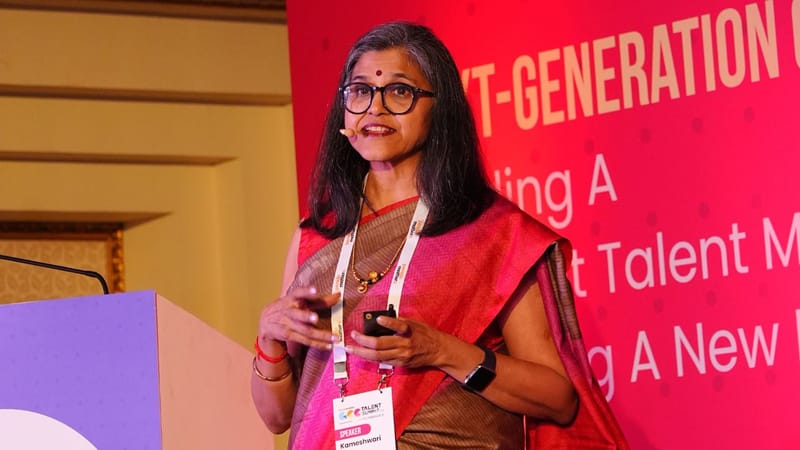
Rather than focusing on technology for technology’s sake, Rao urged HR leaders and business executives to place people at the core of transformation, advocating for a holistic approach that weaves together mindsets, skill sets, and tool sets.
As artificial intelligence (AI) sweeps through the business world, one message rang clear at the People Matters GCC Talent Summit 2026 in Bengaluru: true innovation starts with people, not machines. Kameshwari Rao, Global Chief People Officer at Publicis Sapient, captivated delegates with a call to reimagine AI not as a technological fix, but as a catalyst for cultural and organisational reinvention—one that puts human capability and curiosity at its very core.
Rather than focusing on technology for technology’s sake, Rao urged HR leaders and business executives to place people at the core of transformation, advocating for a holistic approach that weaves together mindsets, skill sets, and tool sets.
Redefining value in the age of AI
Rao opened her address with a provocative question: “Can AI really create value?” She noted that while AI tools such as ChatGPT and Copilot have become ubiquitous, true organisational value cannot be unlocked through mere adoption of technology. “It’s not just about using AI for productivity,” she asserted. “The real challenge is to leverage AI in a way that creates value for the entire organisation, not just the individual.”
As the leader of Publicis Sapient’s global people function, Rao is no stranger to this challenge. Publicis Sapient, part of the larger Publicis Groupe, operates across multiple countries and works with a diverse portfolio of clients, including many that are establishing Global Capability Centres (GCCs) in India. Rao drew on the company’s two-decade journey in India to frame the immense opportunities and complexities facing HR leaders.
A moment of realisation
The turning point for Publicis Sapient’s transformation, Rao recalled, occurred two years ago at an internal offsite. There, the Chief Engineering Leader demonstrated a striking example: a task that once required ten engineers working for fifteen days could now be accomplished in just fifteen minutes with the help of AI. “That was our moment of realisation,” Rao explained. “But we also recognised that achieving this at scale required much more than just new tools; it called for systemic, enterprise-level change.”
Three Dimensions of Change: Mindset, skill set, tool set
Rao outlined the three pillars of the company’s transformation journey:
Mindset: The foundation of change
Rao emphasised that transformation must begin with the right mindset. “It’s about how people think, behave, and act,” she said. In the context of AI, this means creating an environment where employees feel confident experimenting, learning, and—crucially—moving past fear of the unknown. “We started by fostering AI habits and curiosity, building comfort and fluency across the organisation,” she noted.
Skill Set: Learning in context
“Upskilling isn’t just about classroom training or certifications,” Rao argued. “In the world of AI, contextual learning is paramount.” She advocated for learning on the job, from peers, and through real-world projects. “Certifications are table stakes, but the real value comes from learning in context and continuously improving your craft, domain knowledge, and ability to adapt.”
Tool Set: Platforms for productivity and scale
The final piece of the puzzle is the tool set; the technologies and platforms that enable productivity, accuracy, and organisational scale. Rao described how Publicis Sapient provided employees with access to AI-driven tools and encouraged experimentation, codifying best practices into playbooks that could be shared throughout the organisation.
From people to people-plus-product
Rao revealed that this three-pronged approach has fundamentally shifted Publicis Sapient’s identity, from a people-based company to a people-plus-product company. The firm now boasts three enterprise-level products:
- Slingshot: A platform that helps individual coders boost productivity in a contextual, hands-on way.
- Bodhi: An organisational platform drawing on over thirty years of industry knowledge, delivering solutions across industry groups.
- Sustain: A product designed to help legacy organisations navigate the challenges of transformational change.
Rao highlighted how these platforms have not only transformed internal operations but have also become key enablers for client success. The company’s business results, she said, speak for themselves: improved revenues, increased speed, greater accuracy, and better client outcomes.
Lessons for HR and business leaders
Throughout her address, Rao repeatedly returned to the importance of putting people at the centre of transformation. She challenged HR professionals in the audience to see themselves as architects of change, arguing that full system redesign rather than incremental or cosmetic shifts is required in the AI era.
“Orchestrated learning, people-centric transformation, and system redesign are not just buzzwords,” Rao concluded. “They are imperatives for the future of work. As HR professionals, we are at the centre of this shift. We can—and must—make it happen.”
Rao’s address left the audience with both a practical framework and a call to action: in the age of AI, it is the human element—mindset, skill set, and tool set —working in concert that will determine which organisations thrive and which are left behind.
Topics
Loading...