







AI & Emerging Tech
Dreaming in code: Hod Lipson on AI’s human reflection





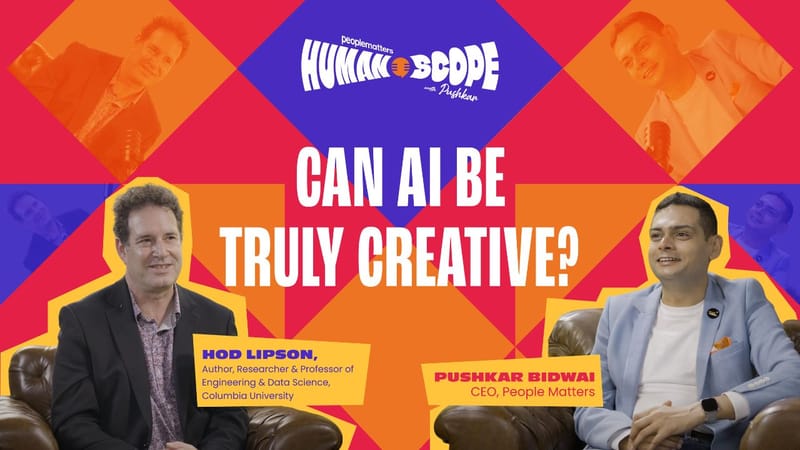
Professor Hod Lipson, Director of Columbia University’s Creative Machines Lab, explores how AI is reshaping creativity, imagination, and the future of human potential.
Imagination, once, was a human prerogative. We built machines to serve us. Then we taught them to mimic the mind. But what happens when machines begin to imagine? When algorithms not only calculate but also create? The ghost of our own curiosity lives on in these machines, reflecting not just what we know, but what we wish we could be.
It’s not often that you hear a scientist talk about the future with both awe and urgency. But Professor Hod Lipson, one of the world’s leading roboticists and director of Columbia University’s Creative Machines Lab, does exactly that. In the latest episode of the Humanscope Podcast, Lipson joined Pushkar Bidwai, CEO of People Matters, to explore what happens when artificial intelligence stops obeying and starts dreaming.
“We’ve been teaching machines to see, hear, and move,” Lipson explained. “But the next step is teaching them to imagine.”
From obedience to imagination
The conversation began with the question that has defined Hod’s career: What if machines could design themselves? His team at the Creative Machines Lab has been developing self-modelling systems that learn, fail, and change without human input, as well as robots that do more than simply follow commands.
“When we started, we didn’t tell the robot what it was,” he recalled. “It figured it out.” He calls it emergent creativity: when intelligence arises not from instruction, but from curiosity.
For him, AI’s evolution mirrors humanity’s own. “Every major leap in civilisation,” he said, “came when we learned to offload a skill from our hands to tools, from memory to writing, from computation to machines. Now we’re offloading imagination.”
The lazy spark that started it all
Lipson’s fascination with intelligence began not with a grand vision but with a simple frustration. As a young design engineer, he found himself weary of repetition. “Why do I have to design the same thing over and over again?” he recalls. “Why not design something that can design everything else?”
That question, equal parts laziness and genius, became the foundation of his career. What began as a search for efficiency evolved into a philosophical pursuit: Can creativity itself be automated? For two decades, Lipson has been exploring that question, pushing robotics and AI to probe the boundaries of what we once thought was uniquely human.
“The idea that machines can’t be creative was a fantasy,” he said. “Now, the answer is obviously yes.”
Filling the blank page
To explain creativity, Lipson uses an analogy. “Imagine taking a picture and removing one pixel,” he says. “Ask the AI to fill it in. Then remove two. Then four, then the whole patches. Each time, the machine learns to complete the missing parts better. One day, you remove the entire image, and when it fills the blank page, that’s creativity.”
For him, creativity isn’t divine inspiration; it’s the act of filling in the blanks. “Both evolution and AI work the same way,” he explained. “They repeat small processes millions of times, and complexity emerges.”
Once you understand that, he adds, you can apply it anywhere from designing proteins to composing music to solving cancer. “It’s not about coding genius. It’s about knowing what problem you want to solve and what data you’ll train it on. That’s not technical skill, that’s business skill.”
Rewriting the future of work
What does this mean for organisations navigating the AI era? Lipson’s advice was deceptively simple: stop thinking of AI as a tool, and start thinking of it as a collaborator.
“If you want your AI to surprise you,” he said, “you have to stop telling it exactly what to do.”
It’s the same philosophy that distinguishes great leaders from good ones. As Pushkar noted, the best innovators create frameworks, not formulas. They build cultures where curiosity can thrive, even if it means embracing a little chaos.
Lipson agreed: “We have to learn to be comfortable with not knowing. Because that’s where discovery happens.”
In HR and organisational life, this principle applies directly. The future of work isn’t about automating empathy, but scaling it. AI can process data faster than humans ever could, but only humans can assign meaning, intention, and care. “We need AI to take over the repetitive,” Lipson said, “so humans can focus on the reflective.”
The car that needs a driver
Lipson often describes AI’s rise through a metaphor that’s both mechanical and moral: the car.
“Computers are faster now. Data is our fuel. The AI engine is more powerful. But the car doesn’t know where to go,” he said. “That’s where we come in.”
He believes the explosion of generative AI is only the beginning. The real shift, he says, will come when multiple AIs begin to collaborate in invisible fleets of systems learning from and with each other. “Behind ChatGPT or Gemini are hundreds of thousands of AIs already talking to each other,” he said. “And that ecology is growing. It’s the hidden civilisation forming inside our data centres.”
For leaders, his message is clear: this power is neutral until we steer it. “We’ve just discovered pure horsepower,” he said. “It wants to do things. Our job is to decide where to drive.”
It’s a sobering thought, but Lipson offers it without alarmism. “You’ll never catch up,” he said. “That’s not the goal. The goal is not to be the last one.”
A future worth staying for
For Lipson, the best way to understand what’s coming is to look back. “Before the internet, getting information was like being blind,” he said. “You had to go to libraries, read outdated encyclopedias, and make phone calls. People twenty years from now will look back at us and feel the same. They’ll wonder how we ever survived being this limited.”
And perhaps that’s the point. Progress rarely feels like progress in the moment. It arrives disguised as chaos, uncertain, too fast to hold. But as Hod reminds us, it’s also a privilege to be alive at a time when imagination itself is being redefined.
“The future isn’t waiting for us to catch up,” he said. “It’s already here, and it’s moving fast. Our job is to drive.”
For further insights from this enlightening conversation, watch the full episode on the People Matters YouTube channel.
Topics
Author
Loading...