







AI & Emerging Tech
From anxiety to adaptation: Shakti Goel's views on AI





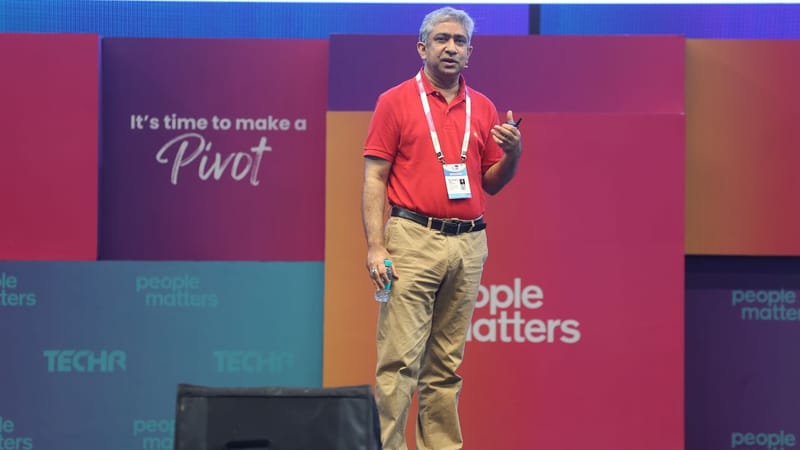
At People Matters TechHR 2025, data scientist Shakti Goel urged leaders to embrace a mindful, thoughtful vision of AI-driven business realities to come.
At People Matters TechHR 2025, the conversations went beyond buzzwords, checklists, and product demos. In a packed auditorium filled with tech leaders, HR professionals, and talent strategists, one resounding theme cut through the noise. How do we humanise technology while still driving innovation? Artificial Intelligence (AI) is no longer a trend for tomorrow; it’s already shaping our realities today.
One of the standout sessions of the conference came from Dr. Shakti Goel, chief architect and data scientist at Yatra.com, whose talk on “Vision 2030: Shaping Future Business Realities With Talent At the Core” left the audience energised, and most importantly — thinking. AI is not an apocalypse, Goel reminded the audience. “It is an evolution. People are not dying. Nuclear winter has not set in. It’s a change,” and humanity has always learned to adapt.
As he rightly pointed out, the change is real, the impact is massive, and the response must be thoughtful. From discussing AI's evolution to its limitations, and finally to strategies for navigating this shift, the session was a comprehensive exploration of what it means to lead and work in the age of intelligent machines.
From AI's origins to omnipresence
AI didn’t arrive overnight. As Goel explained, its roots trace back over 70 years. Starting from the perceptron in 1950, AI evolved through critical developments such as Rapid Neural Networks (1988), Long Short-Term Memory (1997), and Generative Adversarial Networks (2010). These advancements were powered not just by clever algorithms but also by energy and computing infrastructure. For instance, energy sources have moved from coal to natural gas to today’s solar-powered GPU-driven environments.
The major turning point came in 2017, when Google introduced Transformer Architecture with attention mechanisms. “This changed the whole game…GPUs moved from having three million transistors to 90 billion,” he said, adding that the kind of processing power we have now is phenomenal.
AI today is omnipresent: generating images, mimicking speech, composing music, and even assisting in legal drafting and medical diagnostics. As Goel stated, “AI now processes at the speed of thought. It feels omnipotent. You ask it anything, and it knows everything — or at least, it seems to.”
The core dilemma: Standardisation versus personalisation
In a panel discussion that sparked strong audience engagement, experts debated how future organisations could balance two fundamentally opposing forces: the need for standardisation and the increasing demand for hyper-personalisation. “This tension is not new,” one expert noted. “But AI has amplified it.”
Goel addressed this by offering relatable workplace examples: Look at learning and development. Traditionally, people did a training needs analysis, and everyone attended the same classroom session. “Today, we have enough employee data to personalise learning journeys — right down to mobile-based microlearning tailored to roles, performance, and growth potential.”
The same applies to career progression. “Earlier, career paths were linear and uniform,” he said. “Now we can personalise them based on an employee’s skills and the jobs available internally. It’s no longer about ladder-climbing; it’s about matching talent supply with job demand.”
The conclusion was clear. Organisations of the future must craft employee experiences that are both scalable and personal, standard yet meaningful.
Riding the AI wave without drowning
Goel acknowledged the emotional undercurrent that often accompanies discussions around AI. “AI has triggered anxiety,” he said. “We feel fear, uncertainty, and sometimes a loss of identity.”
And yet, the message was far from alarmist. “Don’t see AI as an existential threat. Don’t be an ostrich hiding from the storm. Educate yourself. Embrace it. Learn what AI really is. You’ll stop fearing it once you understand it.”
The way forward is adaptation — not avoidance. “If you can’t beat them, join them,” he said. “Humanity evolved because we adapted. We didn’t stop at lighting fire with stones.”
He urged professionals to lean into task augmentation rather than fear job replacement. AI may do the tasks of a system admin or MIS developer faster — but only when people know the business context, that is their strength. Let AI handle the grunt work, and you take it further, he said.
Use cases: From expense reports to cancer research
One of the most compelling aspects of Goel’s session was his use of real-world examples that highlighted both the opportunities and the economic logic behind AI adoption.
At Yatra.com, Goel shared how AI handles expense receipt processing, a task that would otherwise require 10–20 people at a cost of Rs 30 – Rs 60 lakhs a year. “AI does it faster and costs under Rs 50,000 per year,” he explained. “Why would I not use it?”
But perhaps the most inspiring use case was from the world of science. “Last year’s Nobel Prize in Chemistry was awarded to AI — to AlphaFold, which can predict protein structures in minutes,” he said. “What used to take 5–10 years can now be done in under 10 minutes. This means we’re closer than ever to curing cancer, Parkinson’s, and Alzheimer’s.”
Mitigation strategies: What can humans still do better?
Despite AI’s advances, Goel was firm on one point: AI cannot replace human nuance, ethics, or emotion. “AI is not trained on morality,” he said. “It doesn’t understand the difference between right and wrong. It doesn’t understand Western versus Eastern ethics.”
That’s where the human edge lies. He emphasised several strategies for adapting:
Embrace lifelong learning: essential in the medical profession.
Focus on skills AI cannot replicate: empathy, emotional intelligence, and ethical judgment.
Shift to roles that collaborate with AI: data privacy experts, prompt engineers, AI governance leaders, and strategy professionals.
Elevate output and thereby impact: in specialised sectors like travel, transition from basic booking to designing complex, bespoke itineraries.
“Only you know your customer, your culture, your context,” Goel said. “AI doesn’t.”
Separating fact from fiction: The practical limitations of AI
Goel didn’t shy away from acknowledging AI’s current flaws. You must separate the wheat from the chaff, he warned.
Hallucinations are common — AI can confidently give incorrect answers. It lacks common-sense reasoning. Bias is real; AI can replicate harmful stereotypes. And the tech isn’t always reliable: “If you're using GPT 3.5 now you move to GPT 4.1, you have to retrain the whole application, because the response from these models will change. And you know, when these models are introduced, they are not static. They get trained on a regular basis.”
Even image generation can produce faulty visuals — people with two right thumbs or missing limbs. And then there’s the matter of accountability. “If a worker dies due to a faulty AI-powered robotic arm, who’s responsible? The manufacturer? The software developer? There’s no clear legal framework yet.”
He said: AI is powerful, but it isn’t magic. And it certainly isn’t perfect.
Leading with empathy in the AI era
Echoing the central theme of the discussion, Goel emphasised that tech innovation cannot be divorced from human emotion and leadership foresight. The duality is real — the push for advancement, and the pull of ethical responsibility.
“Before you innovate, think,” he said. “Innovation must not hurt society. Make sure its positives aren’t lost in the negatives.”
This sentiment echoed a quote from an earlier panelist in the day’s sessions:
“With the right data and technology, businesses no longer have to choose between scale and personalisation. They can build experiences that are consistent and uniquely tailored.”
That philosophy extended to managing change, too. Leaders must recognise the emotional impact of transformation. Anxiety, uncertainty, and fear are real — and ignoring them risks alienating the very people innovation is meant to support.
Goel’s final words summed it up best. “Use AI. See AI as an undeniable evolution. It is demanding adaptation, not fear. Like nuclear energy, it can be used for bombs or for medicine. The choice — and the responsibility — is ours.”
Topics
Author
Loading...