







AI & Emerging Tech
Inside TechHR India 2026: Come with a business dilemma, leave with a way forward







Explore how TechHR India 2026 helps HR leaders turn AI insights into practical action through immersive learning, masterclasses and hands-on experiences.
AI may dominate workplace conversations, but for HR leaders, the harder question is no longer whether AI matters. It is what to do with it.
How should organisations move from experimentation to meaningful adoption? Where should HR invest? How can leaders build AI-ready workforces without losing sight of judgement, trust and human connection? And what does leadership look like when one of the members of your team is not human?
At TechHR India 2026, these questions are designed to move beyond the conference stage. The experience is built around a simple proposition – come with a business dilemma, and leave with a way forward.
Across hands-on AI experiences, research-led conversations, masterclasses, hackathons and high-energy networking formats, the event brings together the people, ideas and practical tools needed to turn workplace transformation from an abstract ambition into something leaders can act on.
When AI stops being a conference buzzword
The How To AI @ Work Playground is perhaps the clearest expression of this approach.
Rather than another conversation about what AI could do, the Playground is designed around what professionals can actually do with it. Participants can experiment with AI applications, test practical tools, explore workflows and discover ways to create, automate and analyse work differently.
The premise is deliberately hands-on: the fastest way to understand AI is to experience it.
The day begins with “Experiment, Build, Apply: Welcome to How to AI @ Work Playground”, inviting participants to explore at their own pace and discover applications they can take back to work immediately.
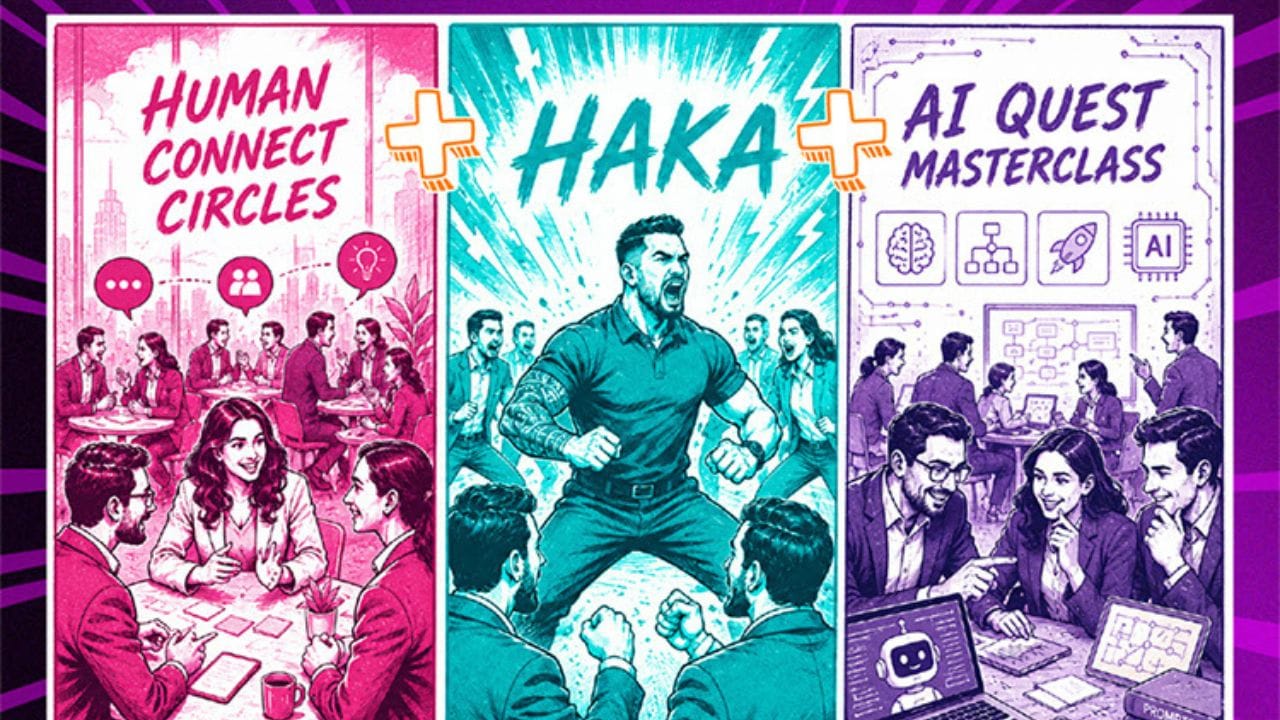
That practical orientation continues with the AI Quest Masterclass, led by Anil Mishra of Team Activators. In just 30 minutes, participants will select an everyday work task and turn it into a smarter, AI-powered workflow. The challenge moves from idea to execution, with the best builds showcased live. It is less about watching someone demonstrate AI and more about building something useful yourself.
That distinction matters. As AI adoption moves deeper into organisations, the gap is increasingly not between those who have heard about AI and those who have not, but between organisations experimenting with AI and those that can translate experimentation into repeatable workflows, skills and business value.
From AI readiness to workforce readiness
The next question is what happens after the experiment. The “Hands On Masterclass: Generative AI for Workforce Readiness” shifts the focus towards the workforce itself. For HR leaders increasingly expected to act as architects of a borderless workplace, the challenge is to determine which skills, structures and learning interventions will help employees work effectively amid a growing number of AI-powered tools.
The session will explore how organisations can build the right skilling programmes while identifying quick wins through GenAI-driven task allocation.
It reflects a broader shift in the HR agenda: AI transformation is not simply a technology deployment exercise. It is increasingly a workforce design, capability and change-management challenge.
People Matters’ SHRPA State of HR Industry 2025–26: India Insights report highlighted this very tension, identifying AI readiness, technology investment, capability gaps and organisational change readiness among the issues shaping HR priorities for 2026.
The research was positioned as a strategic compass for HR leaders looking to understand where they stand and make sharper workforce, technology and investment decisions. That makes the SHRPA 2026 report launch an important part of the TechHR India experience.
Know where you stand before deciding where to go
Transformation becomes difficult when organisations do not know what they are benchmarking themselves against.
The SHRPA 2026 report is designed to provide that reference point, helping HR leaders understand how their transformation journey compares with wider regional trends, where enterprises are directing investments in AI and HR technology, and how leading organisations are approaching implementation, governance and change management.
In other words, research tells you where the gap is, and the experiences at TechHR help you close it.
The report can help leaders move from broad questions around AI and transformation to more specific ones: Are we investing in the right areas? Are our people ready? Where are the capability gaps? Is our governance keeping pace? And what should our next move be?
Those are questions that cannot be answered by technology alone.
The hiring problem gets a new playbook
Talent acquisition gets its own experiential intervention through The Hiring Hack: India’s First Talent Acquisition Hackathon.
Bringing recruiters and HR leaders together, the hackathon creates space to rethink hiring through creativity, collaboration and technology. Rather than treating recruitment as a process that needs incremental optimisation, it invites participants to challenge assumptions and develop new approaches to one of HR’s most business-critical responsibilities.
The format also reflects the reality of AI in talent acquisition: the question is no longer simply whether AI can make hiring faster, but how recruiters can redesign the work around technology while retaining human judgement.
When one member of the team isn't human
Leadership itself comes under scrutiny in “Two Natives, One Triangle: How Do You Lead When One of Your Team Isn’t Human”, featuring Anand Shankar of Deloitte.
The session explores a workplace being shaped simultaneously by generational change and AI. Gen Z is already challenging established expectations around work and leadership, while AI-native Gen Alpha is beginning to enter the conversation about the future workforce. At the same time, AI is becoming a resource that leaders must direct, rather than simply another tool handed to employees.
That creates an unusual leadership challenge. AI cannot be motivated by urgency, emotion or approval in the way human employees can. Traditional assumptions about authority, motivation and management therefore begin to look less certain.
The session asks leaders to rethink three core instruments, style, bandwidth and knowledge, while remaining anchored in purpose and values. It is a timely reminder that AI transformation ultimately requires leader transformation too.
From HR custodian to enterprise orchestrator
For leaders looking to go deeper, Holger Mueller of Constellation Research will lead “The Proven Strategies to Make Your Enterprise Thrive with AI.”
The workshop is designed around real scenarios, hands-on activities and practical frameworks, exploring how organisations can balance AI-driven efficiency with human judgement.
That balance is becoming increasingly important as organisations move from AI pilots towards wider deployment. Employees need confidence in how AI is being used, while organisations need practices that are fair, transparent and trustworthy.
For HR, this changes the role considerably. The function is no longer simply responsible for managing the people implications after a technology decision has been made. HR increasingly has a role in shaping how AI is adopted, how employees experience it, how work is redesigned and how trust is maintained.
The shift is from HR custodian to enterprise orchestrator.
But transformation cannot happen without people
TechHR India 2026 also makes room for something that can get lost amid conversations about AI, data and technology: human connection.
The Human Connect Circles, led by Anil Mishra and Team Activators, are designed as guided speed-networking experiences that go beyond conventional introductions and business-card exchanges. Through curated prompts and rapid group interactions, participants connect across roles, industries and perspectives, creating the possibility of conversations that continue beyond the event.
And then there is Haka: Unleash Collective Energy, another experience led by Team Activators. Inspired by the spirit of the Haka, the movement-led session brings participants together through rhythm, voice and synchronised action.
It is deliberately different from a conventional conference session. The aim is to create a shared experience around trust, unity, confidence and collective purpose, the same qualities organisations will need as work becomes increasingly distributed between humans and machines.
The value is in what happens next
What makes TechHR India 2026 different is not simply the breadth of its agenda. It is the deliberate movement between insight, experimentation and action.
You can begin with research that tells you where your organisation stands. You can then test an AI workflow in the Playground, build a solution through AI Quest, rethink talent acquisition at the Hiring Hackathon, explore workforce readiness through GenAI, challenge your leadership assumptions and work through practical strategies for enterprise AI adoption.
And in between, you can meet people who are wrestling with many of the same questions.
That is the larger proposition behind the experience. The conference, happening on 6–7 August 2026 at Yashobhoomi Convention Centre, Delhi, is not designed merely to give leaders more things to think about. It is designed to help them figure out what to do next.
Because beyond the normal conversations about AI, transformation and the future of work, these are the learning experiences that can turn a business dilemma into a way forward.
Topics
Author
Loading...