







AI & Emerging Tech
McKinsey’s Indy Banerjee sets the agenda for AI-driven talent at People Matters GCC Talent Summit 2026



|
Updated on


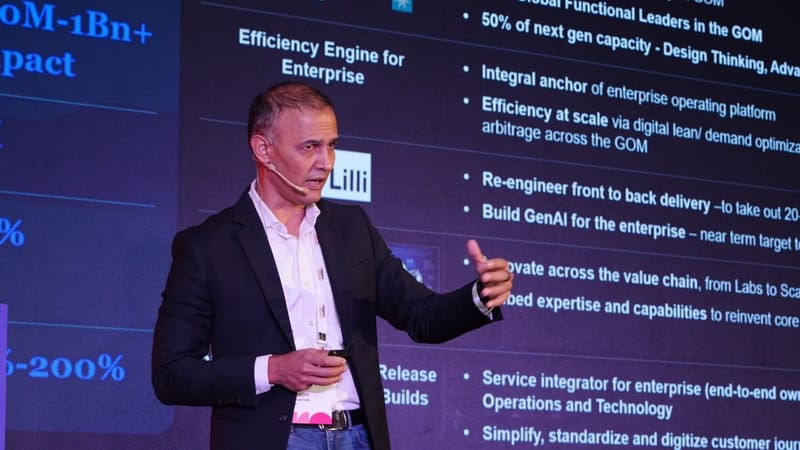
Banerjee’s address was rooted in a pragmatic optimism. He cited fresh data from the World Economic Forum at Davos: while 40% of global leaders foresee turbulent times in the short term, a staggering 60% anticipate catastrophic challenges over the next decade.
At the bustling People Matters GCC Talent Summit 2026 in Bengaluru, Indy Banerjee, Senior Partner at McKinsey and Company, India, delivered a keynote that challenged the audience to rethink the very foundations of organisational resilience, talent, and the role of artificial intelligence (AI) in shaping the global operating model.
Far from a conventional address, Banerjee’s speech was a clarion call to embrace volatility, interrogate old paradigms, and prepare for a new era where the boundaries between human and machine intelligence are increasingly blurred.
Resilience more than endurance
Banerjee opened by questioning the very premise of resilience. “Why do we need resilience?” he asked, positing that it is not merely about withstanding headwinds—be they geopolitical, strategic, or operational—but about ensuring long-term sustainability and continuity amidst uncertainty. Drawing a distinction between resilience and mere pain tolerance, he urged the audience to move beyond the language of hardship and consider the paradigm shift from a VUCA (Volatile, Uncertain, Complex, Ambiguous) world to a BANI (Brittle, Anxious, Nonlinear, Incomprehensible) reality. In such a world, resilience becomes the capacity to hedge against uncertainty and enable uninterrupted progress.
Banerjee’s address was rooted in a pragmatic optimism. He cited fresh data from the World Economic Forum at Davos: while 40% of global leaders foresee turbulent times in the short term, a staggering 60% anticipate catastrophic challenges over the next decade. Yet, this global volatility is paralleled by unprecedented innovation and opportunity, particularly in the context of artificial intelligence. “2025 is the year AI came alive,” Banerjee declared, noting that recent advances have elevated AI from a theoretical tool to an active teammate in the enterprise landscape.
This duality—of headwinds and tailwinds—frames the significance of GCCs (Global Capability Centres), or as Banerjee prefers, the “GOM” (global operating model). He described these centres as “islands of stability and transformation,” now pivotal not just for cost efficiency but as crucibles of innovation. Notably, 38% of McKinsey’s global innovation now originates from these hubs, underscoring a decisive shift in their strategic value.
Banerjee introduced the concept of the “Edge Global Operating Model”—the elite enterprises that will capture 80% of the value generated across global operating models. However, he warned against complacency: while 74% of organisations self-identify as being “on the edge”, McKinsey’s data suggests that only 7% truly possess the transformative talent, outcome-oriented mindset, and AI capability required to lead.
Crucially, Banerjee argued that the real conversation should shift from headcount and scale to value creation. Using the example of the “Magnificent Seven” technology firms, he observed that, even as these companies increased their revenues by 30%, their collective headcount grew by just 3%—and excluding Amazon, headcounts actually declined. This demonstrates that value per employee, not sheer numbers, is the new metric for success, and AI is a powerful driver of this shift.
Banerjee’s keynote was replete with data evidencing AI’s impact. He highlighted a sevenfold difference in AI usage (“token” consumption) between edge organisations and the median, with direct correlations to productivity—users at the edge experience an 8x variation in usage and a 25% increase in productivity. This is not theoretical; it is borne out in real-world data across writing, coding, and information gathering.
Talent transformation imperative
Himanshu Agrawal, Senior Engagement Manager at McKinsey, complemented co-presenter Banerjee’s keynote by shifting the audience's focus to the immediate talent shifts facing GCCs.
Agrawal highlighted that while organisations grapple with AI readiness gaps, GCCs stand at a decisive inflection point. He opened with a striking observation: “Edge GOMs are already leveraging GenAI to disrupt themselves and changing the way they deliver.”
Maturity differences between edge and median firms — and between high- and average-performing employees — are already driving 25%+ productivity variation. At the Global Operating Model level, the GenAI readiness divide between leaders and laggards has reached 4X and continues to widen.
GCCs, Agrawal noted, sit at a unique opportunity. McKinsey analysis points to a 2.5–3X potential uplift in value per employee once GenAI is fully blended with human talent. Many established centres have already reached peak headcount. Bottom-of-the-pyramid roles are expected to compress materially in the next 12–24 months. Growth will continue — but it will be non-linear, skill-led and value-led.
Agrawal urged talent leaders to evolve from traditional Human Resources to Intelligence Resources — managing capacity, capability and culture across blended human + digital teams, and leading AI adoption from the front.
From Tool to Teammate: The new archetypes of work
The keynote forcefully dismantled the notion of AI as a mere tool or intervention. Instead, Banerjee argued, AI is now a skill—a capacity that must be integrated at the team and organisational level. The future will see the emergence of hybrid teams: human-led with AI augmentation, agent-led with humans in the loop, and, increasingly, teams orchestrated by AI agents with minimal human oversight. The archetypes are already manifesting, particularly in coding, where AI now writes AI code, with humans providing oversight and debugging.
For HR and talent leaders, the message was stark: the era of human resources is giving way to the era of intelligent resources. The lines between human and artificial capacity are blurring, and performance markers must adapt accordingly. Banerjee recounted how McKinsey’s own interviews now allow candidates to “cheat”—to use AI tools—because the true test is not innate knowledge but the ability to leverage AI to augment capacity.
A call to action for talent leaders
Perhaps the most urgent takeaway from Banerjee’s address was the need for HR to catch up. Despite being tasked with managing the workforce of the future, HR remains the least mature function in terms of AI adoption. Strategic workforce planning must now account for both human and AI capacity, and the ability to orchestrate these resources will define tomorrow’s competitive edge. Banerjee concluded by urging the industry to abandon outdated dichotomies and embrace the intelligence resource model. The single biggest headwind—and the greatest opportunity—lies in redefining how we think about talent, value, and the very architecture of the global operating model.
Topics
Loading...