







AI & Emerging Tech
“One Aha Moment can rewire how we work”: Vaibhav Sisinty on AI at TechHR India 2026





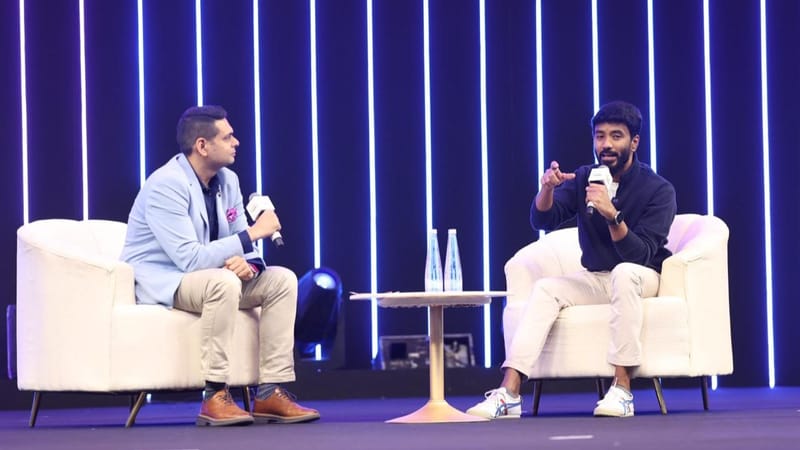
At TechHR India 2026, Vaibhav Sisinty explored how AI is reshaping work, productivity and leadership, from the first aha moment to AI-led transformation.
The most important AI skill may not be knowing how to use another tool. It may be knowing what to do with the time and capability that AI gives back.
That was one of the central ideas in a candid conversation between Pushkar Bidwai, CEO, People Matters, and Vaibhav Sisinty, Founder, Outskill, at TechHR India 2026.
The session, titled “AI As The New Growth Multiplier”, moved beyond the usual conversation around AI adoption. Sisinty spoke about his own AI journey, the moment he realised how quickly the technology was advancing, and what organisations need to change if AI is to create real business value.
A robot on stage at the beginning added a visual cue to the conversation that followed: where does technology end and human capability begin?
The "Aha moment"
Sisinty traced his AI journey to an early experience with OpenAI's Code Interpreter.
“I just dumped the data, asked the question, and I saw AI write code for the first time in my life, draw charts and analyse for me, and I got insights out of it,” he explained.
For someone used to relying on data scientists for similar work, the experience was a turning point.
That was his first real “aha moment” with AI.
The significance was not simply that AI could analyse data. It was the speed at which it could do so.
“Something that would take a data scientist probably a couple of days, I would have to write a lot of Python, AI was able to give me answers in like two minutes, three minutes,” Sisinty mentioned.
But even that expectation was conservative.
“I thought AI was going to move very fast. It has at least moved 10 times faster than I thought it would,” he elaborated.
The learning problem
That pace is also changing how people learn.
Sisinty said his work has reached 17 million people across 150 countries, reflecting the scale at which AI learning is now being consumed.
But traditional learning models may struggle to keep pace with the technology.
“By the time Sam Altman teaches you something, by the time we record it, that gets edited and it goes live on a platform, that content is outdated,” Sisinty pointed out.
For him, this changes the purpose of learning.
People cannot simply consume information and wait for the next course.
They need to experiment continuously.
“The time duration of identifying the workflow, testing it to actually teaching it has to be the shortest,” he added.
The point is not to learn everything about AI. It is to learn enough to apply it to real work.
The ROI test
The conversation then moved from learning to investment.
Sisinty revealed that his organisation spent $85,000 on AI tools and related infrastructure in one month.
For a relatively small company, he described that as a significant investment.
That raises a more important question than how much organisations are spending on AI.
What are they getting back?
“The way to measure AI impact is based on ROI. So if I invested 100 bucks in a tool or training, how much impact is it driving for me?,” he questioned.
Organisations should not treat AI budgets as money that simply needs to be allocated.
The investment needs to be connected to measurable outcomes.
“You can't say that I have X dollars of budget, and I'm going to invest that budget. The way to measure AI impact is based on ROI,” he also commented.
Beyond tool access
Sisinty also challenged the idea that AI transformation begins with buying tools.
Giving employees access to AI does not guarantee that they will use it effectively.
“The leadership teams which believe that my job is to give access to the tool, that is not solving the problem,” he said.
The bigger challenge is adoption.
Employees need to understand what AI can actually change in their work. That requires experimentation, not simply access.
“Everybody, for your change to happen, you need an aha. And AI gives you aha. Our job as leadership is to give them their first aha moment.”
Building the first win
Sisinty described how his organisation creates those moments.
New employees are encouraged to spend time exploring different areas of the business. Their first project is then to solve a specific problem using AI.
The solution is presented to the wider organisation.
That creates a different kind of learning loop.
A junior employee can solve a real business problem. A senior leader can see the solution working. Other employees can then begin asking what they could automate themselves.
“You have someone who is one or two years into work, a fresher completely, solving a problem end to end with AI, and the leaders of those organisations are speaking and listening to how a fresher is solving that problem.”
The point is not seniority.
It is proof.
The human multiplier
The conversation between Pushkar Bidwai and Sisinty ultimately moved beyond the question of whether AI will replace people.
The more relevant question is what happens when people learn to work with AI effectively.
Sisinty put it simply, “The future is not AI versus humans. It's humans who know how to work with AI versus those who do not.”
That shifts the conversation from replacement to capability.
AI can increase speed. It can expand what an individual can execute. It can reduce the time spent on repetitive work.
But people still need to decide what is worth doing, what should be built and where the organisation should go.
For leaders, the task is therefore not simply to introduce more AI.
It is to help people experience what is possible, identify where AI can create measurable value and give employees the confidence to experiment.
The next competitive advantage may not belong to organisations with the most AI tools.
It may belong to those that help the most people discover their first AI “aha” moment.
Author
Loading...