







AI & Emerging Tech
“Outcomes Come From Workflow Redesign, Not Simply Applying AI”: Phenom’s Amit Kumar



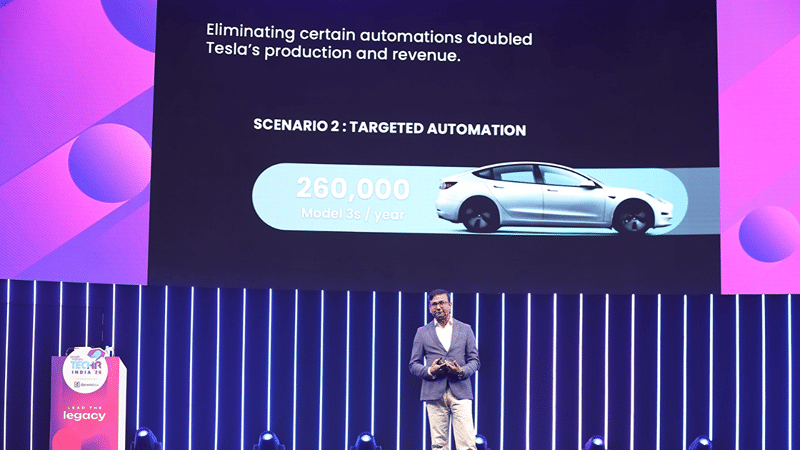
At TechHR India 2026, Phenom’s Amit Kumar argued that AI’s value lies in redesigning workflows to determine where machines should act and human judgment should lead.
Every enterprise is asking a version of the same question as AI moves deeper into the workplace: “What can be automated, and what should remain human?” At TechHR India 2026, Amit Kumar, Vice President of Product Management at Phenom, argued that most organisations still lack the context to answer that question well.
Speaking in his keynote, “Powering Work Without Jobs,” Kumar suggested that the conversation has moved beyond simply asking where AI can be applied. The more important question now is how work itself should be redesigned around the capabilities of humans and machines.
Kumar put the question more pointedly to the audience: “Just because something can be automated, should it be?”
The problem with automating without context
Kumar opened with the example of Tesla’s Fremont factory between 2016 and 2018. As demand for the Model 3 rose, Tesla increased automation and reduced human involvement on its assembly lines. Kumar pointed to what followed as a cautionary example: the company eventually brought people back into the process, after which production increased significantly.
For Kumar, the lesson extends beyond manufacturing. Over the past two to three years, enterprises have often similarly approached AI, applying automation and intelligence to processes without first understanding the context in which those processes operate.
“AI is not about replacing humans,” he said. Instead, the opportunity lies in identifying which moments should be orchestrated with AI, which tasks should be handled by agents, and where human judgment is still essential.
That becomes particularly important in HR, where the same workflow can look very different depending on the industry, geography, work zone or type of talent being hired.
A high-volume hiring process, for instance, may lend itself to a different mix of automation and human intervention than an early leadership search. A technology hire in Bengaluru may require a different workflow from a pharma sales hire in a tier-two city.
The idea of a standard, one-size-fits-all enterprise workflow, Kumar argued, is increasingly outdated.
From skills taxonomies to living context
This is where Kumar's argument moves beyond automation and towards what he calls “ontology”.
Traditional HR systems have typically organised work around roles and skills. But Kumar argued that this is no longer enough. The more important layer is task intelligence and workflow: understanding what work is actually being done, how it moves through an organisation, and what changes as business requirements evolve.
The challenge is that work is changing faster than many organisations can update their workforce strategies. Kumar pointed to a 12-to-18-month lag between evolving business and technology requirements and the way HR strategies, roles and skills are often mapped.
A static taxonomy created once and used as the foundation for workforce planning can quickly lose relevance.
What enterprises need instead, he argued, is a living ontology layer that can reflect change in real time: new applications, emerging skills, evolving roles and shifting business requirements.
The distinction matters because context determines what happens next. Once an enterprise understands its work at the level of tasks and workflows, it can make a more informed decision about where to apply human intelligence and where AI agents can take over.
Orchestration, not just automation
That decision sits at the heart of what Kumar describes as an orchestration engine.
Unlike traditional automation, where a predefined process is designed and deployed, orchestration adapts to context. Kumar described a scenario where an HR leader could simply specify that they were hiring for a particular role in a particular geography and have the system determine the relevant workflow: what the candidate experience should look like, where an interview or voice agent should be used, and where a recruiter or hiring manager needs to step in.
The shift is from designing a single process to dynamically determining who or what should perform each task.
“One-size-fits-all enterprise is gone. That is dead,” Kumar said, arguing that orchestration needs to adapt to differences in role, location and hiring context.
But Kumar was equally clear that automation cannot operate without boundaries. Policy, guardrails and a human in the loop remain critical to the system.
He also argued that the time required to redesign and deploy such workflows should be significantly shorter than the months traditionally associated with enterprise implementation. Kumar cited a five-day model in which structured and unstructured data are brought together, mapped through an HR-specific ontology and connected to an orchestration layer.
The five-day timeline was presented as Kumar's view of what is now possible, rather than a universal benchmark. His larger point was that enterprises need to rethink the traditional implementation model if they want their workflows to keep pace with the speed of change.
Where efficiency ends, and effectiveness begins
For Kumar, the value of this approach is not limited to doing existing tasks faster.
He described two distinct zones of value. The first is a “zone of efficiency”, where process-driven tasks can be automated. The second is a “zone of effectiveness”, where intelligence, context and human judgment influence how decisions evolve.
That distinction becomes particularly important when requirements change.
If a hiring manager identifies a new skill requirement today, for example, the change should not have to wait for a job description or hiring process to be manually updated weeks later. The fitment criteria, descriptions and other connected workflows should evolve in real time.
This creates a feedback loop in which the system continuously learns from changing requirements while policy and human oversight continue to govern the decisions.
Kumar described this evolution in terms of metacognition, with systems increasingly able to assess and validate how decisions are being made. But he also drew a clear line around what technology cannot simply replicate: empathy and human judgment.
That is where the human element remains consequential.
From point solutions to redesigned workflows
Kumar's final critique was directed at the way enterprises are currently deploying AI.
Many organisations, he argued, have moved from pilots to individual point solutions: a voice agent here, an interview agent there, a sourcing tool somewhere else. The problem is not that these tools are inherently ineffective. It is that they are often deployed without redesigning the workflow around them.
In that model, the human becomes little more than a trigger for the agent.
The next stage, Kumar argued, is different. Agents need to interact with other agents, operate within defined policies and workflows, and direct human recruiters or hiring managers when human intervention is required.
That makes orchestration the real challenge.
The question for enterprises is no longer simply whether to deploy an agent. It is where an agent should act, where a human should lead, and what rules should govern the handoff between the two.
Kumar's final point was perhaps the simplest: "Outcome doesn't come from applying some AI. Outcomes come from your workflow redesign." The task, he argued, is to determine which work should be done by humans, which by agents, and what policies and guardrails should govern the relationship between them.
In an AI-enabled enterprise, then, the competitive advantage may not belong to the organisations that automate the most. It may belong to those that understand their work well enough to know what should be automated in the first place.
Author
Loading...