







AI & Emerging Tech
Technology can be bought, but organisations must be built: The CEOs talent bet at LLC 2026





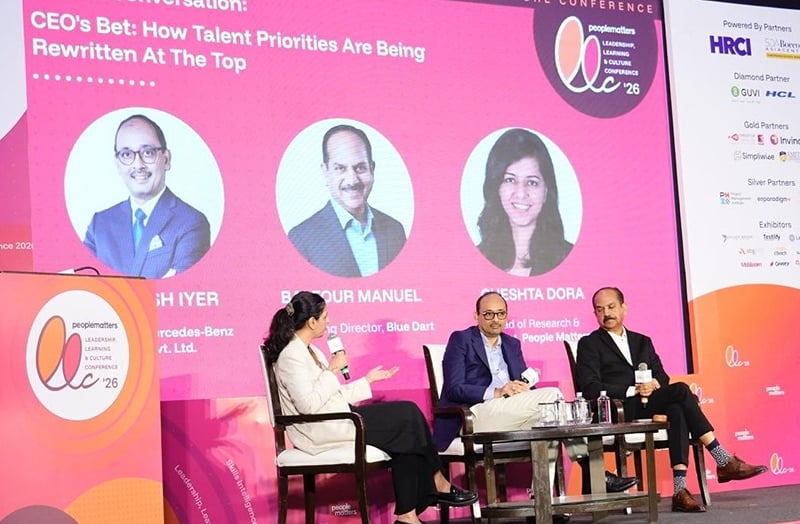
Mercedes-Benz India’s Santosh Iyer and Blue Dart’s Balfour Manuel explain why agility, internal mobility, digital fluency and leader-owned talent development are becoming central to business execution.
Technology is changing how organisations operate, but the defining talent question is not simply who can use the latest tools. It is whether people can make faster decisions, move across established boundaries and keep developing as business priorities change.
At People Matters Leadership, Learning & Culture Conference 2026, Santosh Iyer, MD & CEO, Mercedes-Benz India, and Balfour Manuel, MD, Blue Dart, shared how transformation is rewriting talent priorities in two industries moving at different speeds.
In conversation with Cheshta Dora of People Matters, the CEOs outlined the capabilities their businesses need, the talent bets they are making and why people development must remain a leadership responsibility.
Agility is becoming a core business capability
For Iyer, shrinking planning horizons are fundamentally changing what organisations require from talent.
The automotive industry works with long product and investment cycles, but geopolitical shifts, economic uncertainty and rapid technological change make it difficult to depend on assumptions several years into the future.
“Today’s leaders and talent need a high amount of agility and flexibility,” Iyer said. “You also need talent that does not take decisions only based on data. You need risk appetite, deep understanding and entrepreneurial thinking.”
Technical expertise remains important, but organisations also need people who can assess incomplete information, understand the wider business and take considered risks.
“Uncertainty, combined with the rapid change in the technology landscape, is going to define the kind of talent we need to develop and hire,” he added.
Blue Dart is digitising decisions, not jobs
For Blue Dart, technology creates value when it strengthens execution at the frontline.
“We have technology and aircraft, but every package has a person behind it,” Manuel said. “Assets may deliver packages, but talent runs the business.”
The company increasingly needs employees who combine operational excellence with digital fluency. They must understand the logistics network while using real-time information to improve predictability and respond quickly.
“We are not really digitising jobs. We are digitising decision-making,” Manuel said.
Blue Dart is placing relevant information in the hands of frontline employees, including people working through partner organisations, so they can take decisions within minutes rather than sending every issue through multiple layers.
The distinction is important: technology should expand the decision-making capacity of people closest to the work, not simply automate tasks.
Upskilling begins with a reason to learn
As organisations expand their AI and digital learning programmes, Iyer cautioned that access alone does not create capability.
“There has to be a desire in the individual first to learn and upskill,” he said. “If the recipient’s mind is not open, you can run as many programmes as you want.”
The leadership challenge is to make learning relevant. Employees need to understand why a capability matters to their role, career and future employability before they will invest sustained effort in building it.
With digital platforms and public resources making introductory knowledge widely available, organisations must focus on creating urgency, protecting time for learning and connecting development with meaningful opportunities.
Learning therefore becomes a shared responsibility: the organisation creates access and pathways, while the employee takes ownership of remaining relevant.
Internal mobility can build capability faster than external hiring
Mercedes-Benz India is using cross-functional movement to develop broader business understanding and sustain employee growth.
Iyer pointed to his own experience across different roles and described how employees are increasingly willing to move outside their established functions. A marketing leader, for example, could transition into retail finance and bring a different perspective to the role.
“That cross-pollination gives new challenges, drives entrepreneurial spirit and keeps the learning curve very steep,” he said.
Such movement requires employees to look beyond fixed departmental identities. It also asks leaders to back people who may not have followed a conventional route into a position.
“The leap of faith is to leave departments and look at jobs,” Iyer said.
Mercedes-Benz India has seen more employees raise their hands for internal opportunities over the past three to four years. For Iyer, that willingness reflects confidence that the organisation can offer credible avenues for development.
The strongest talent bets may already be inside the organisation
Asked about talent decisions that are not yet fully proven, both CEOs pointed towards building from within.
Iyer highlighted accelerated opportunities for younger talent and more frequent movement across roles. Employees should not remain in the same position indefinitely simply because current performance is strong.
“You are not changing because things are bad,” he said. “You are changing because you don’t want things to go bad.”
Manuel similarly argued that logistics cannot meet emerging capability needs through external hiring alone. Existing employees carry valuable knowledge of customers, operations and networks that a new hire cannot immediately replicate.
“Technology can be bought, but organisations need to be built,” he said.
He also shared that Blue Dart had onboarded close to 300 persons with disabilities during the year, many entering formal employment for the first time. Their performance, he said, challenged assumptions about their ability to succeed in logistics operations.
“The anxiety that they will not perform is a myth,” Manuel said. “They are performing brilliantly.”
The experience shows why organisations need to question conventional hiring profiles and invest in developing talent pools that may previously have been overlooked.
Capability gaps must be identified before they become business problems
For Manuel, the next talent shortage should not arrive as a surprise on a management dashboard.
“If the gap suddenly hits your dashboard, that is not a great place to be,” he said. “By the time it appears, it is already a big business issue, and you are too late.”
Organisations need to identify early signals of capability shortages and begin reskilling before those gaps disrupt service or growth.
Iyer added that talent decisions must increasingly prioritise enterprise and entrepreneurial thinking. Employees need to understand how their decisions affect the wider organisation rather than optimising only for a function.
AI can process growing volumes of information, but consequential decisions will continue to require human judgement and accountability.
“There is a lot of data, and AI is processing a lot of data, but the decision will still remain human,” Iyer said.
Every leader must own talent development
Both CEOs challenged the assumption that talent development sits primarily with HR.
“Talent development is a leadership topic. HR is more of an enabler,” Iyer said.
Manuel was equally direct: “Every leader is a talent leader. If the leader is not involved in leadership development, then the talent strategy is just adoption.”
Mercedes-Benz India is translating this ownership into succession planning. Leaders are being asked to identify first and second successors during periodic people discussions and clarify what those individuals need to become ready.
“The feeling is not great because you are already saying who can be your successor,” Iyer acknowledged. “But at least we have names, and now we have a development plan.”
The exercise makes leaders accountable for building the next layer rather than treating succession as an HR list. It also exposes whether an organisation has credible leadership depth before a vacancy emerges.
Alignment must continue after the strategy meeting
HR and business priorities may appear aligned during annual planning, but execution can drift as immediate pressures change.
“Execution, for me, is strategy,” Iyer said.
Mercedes-Benz India revisits its annual priorities through the year to ensure that shifting demands do not pull talent decisions away from the agreed direction.
The same principle applies to culture. Manuel and Iyer agreed that customer focus must be modelled by leaders before it can become consistent across the organisation. What leaders pay attention to, how they respond to customer issues and which behaviours they reward determine whether stated priorities reach the frontline.
Technology should amplify human potential
Across automotive and logistics, the CEO talent bets shared at LLC 2026 converged on one principle: technology should strengthen what people are capable of contributing.
Organisations will need employees who can work with new tools, move across functions, understand the enterprise and make decisions before certainty arrives. Retaining them will depend on whether they can see continued learning and meaningful growth inside the organisation.
The role of leadership is to create those opportunities, and remain accountable for developing the people who will carry the business forward.
Topics
Author
Loading...