







AI & Emerging Tech
The art of human-centric hiring: Rethinking talent acquisition





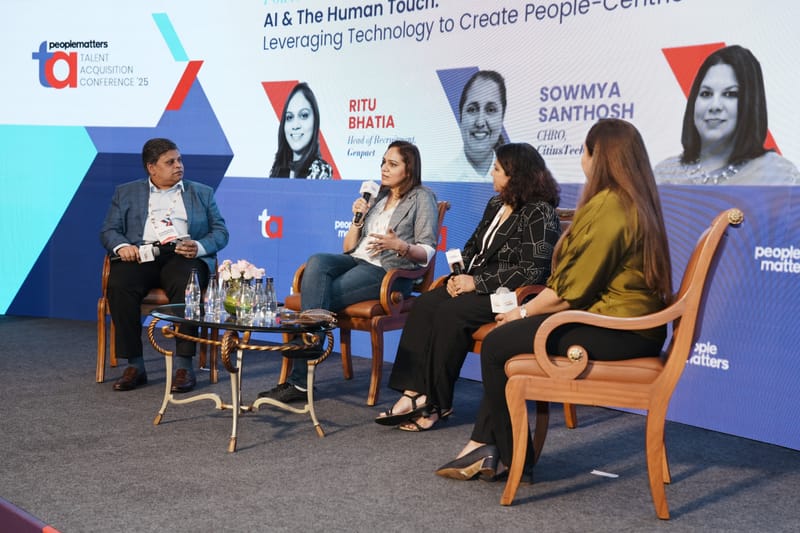
Leaders from Genpact, CitiusTech, and RippleHire discuss empathy, ethics, and building people-centric hiring strategies at People Matters TA Conference 2025
In the grunts of everyday decisions, the quiet choices shape the loudest outcomes. The mirror of recruitment is glazed with this truth, where every resume read, every conversation held, and every subtle gesture carries the weight of possibility. Artificial Intelligence can sway everything to everyone, but only a human can convince with empathy, inspire with understanding, and recognise the potential that data alone cannot see. In talent acquisition, the true mastery lies in weaving both the conviction and innovation of today’s world seamlessly.
At People Matters Talent Acquisition 2025, the interplay of forces harnessing progress highlighted the balance between technology and humanity and came alive in the form of a Power Panel on AI & The Human Touch: Leveraging Technology to Create People-Centric Policies. Chaired by Varadharaju Janardhanan, CHRO of Super Money (a Flipkart Group company), the discussion brought together leaders shaping the future of recruitment: Ritu Bhatia, Head of Recruitment at Genpact; Sowmya Santhosh, CHRO at CitiusTech and Shweta Maheshwari, Director-Sales at RippleHire.
The discussion focused on maintaining empathy and human insight while examining how AI may improve decision-making, tailor candidate experiences, and lessen bias.
AI as an enabler, not a replacement
For large organisations like Genpact, where talent demand runs into thousands of hires each year, Ritu Bhatia noted that AI-driven platforms are helping recruiters match skills with opportunities faster and more accurately. “It’s about cutting through the noise,” she explained. “AI allows us to quickly surface the candidates who are most aligned, so that human recruiters can focus on meaningful conversations rather than manual filtering.”
However, its effectiveness comes with a warning: technology should be viewed as a tool, not a substitute. The panellists emphasised that while technology can expedite processes and highlight patterns when used appropriately, it will never replace the interpersonal connections, emotional intelligence, and nuanced judgement that make recruiting truly people-centric.
Reducing bias, enhancing fairness
Bias in hiring, whether whispered in the subconscious or spoken outright, was another focal point. Sowmya Santhosh distilled its insidiousness into a sharp image: “Bias in recruitment is like glitter. You don’t realise how much there is until it’s everywhere.”
Sowmya explained how CitiusTech is deploying AI to anonymise résumés and standardise assessments. “When you strip away names, colleges, or even certain geographies, you give talent a fairer chance,” she said.
AI, when crafted with care, offers the promise of sweeping some of that glitter away. It can strip names from résumés, bring structure to interviews, and remind us to judge by skills rather than assumptions. Yet she was quick to add that technology cannot replace nuance. “AI can just as easily perpetuate bias if the data itself is biased. That’s why human oversight is non-negotiable. The role of leaders is to ask hard questions of the tools we adopt: Who built them? On what data? And are we auditing for fairness?”
This led to a deeper recognition that diverse data, careful audits, and thoughtful oversight are not just operational necessities; they are moral imperatives. AI may simplify, but human empathy and judgment must still guide the process.
Personalisation at scale
The needs of the organisation are met by efficiency and fairness, while the needs and expectations of the candidates are met by personalisation. According to Shweta Maheshwari, AI can assist recruiters in creating more effective candidate journeys.
“Every candidate today wants to feel seen, not processed,” she said. “AI can help by nudging recruiters when to reach out, by tailoring communication, and even by predicting what roles a candidate might find meaningful.”
But technology alone is not enough. “You can send 100 automated updates, but if the tone is cold or dismissive, it hurts the brand,” Shweta added. “At the end of the day, every interaction is a reflection of who you are as an employer. Candidates don’t remember the portal; they remember the person.”
The human compass: Empathy, ethics, and trust
Across the panel, one theme that kept resurfacing was the irreplaceable power of empathy. “Data can tell you that someone is a 70% match to a role,” said Ritu, “but it cannot tell you why they chose an unconventional career path, or how resilience built through personal struggle will translate into success. That’s where human judgment matters.”
The panel also ventured into the ethical questions surrounding AI in hiring. Who owns candidate data? How transparent should companies be about using AI in their processes? Shweta reminded the audience that “technology without trust is just noise”, warning that opaque processes risk eroding credibility if candidates feel decisions are a black box. Sowmya built on this by stressing that compliance is not enough: “Candidates should be told clearly where AI is applied and where human judgment takes over. Transparency is the foundation of fairness.”
Charting the future of talent acquisition
While each hiring decision may appear regular, they all have an impact on futures that we are not necessarily aware of. For Ritu, transformation in talent acquisition is not a switch to be flipped but a culture to be nurtured. The best idea can be generated from anywhere,” she said, describing how even SMEs on the ground are involved in workshops and testing to make innovation truly collective. The opinions of the other panellists were reiterated and extended.
Sowmya offered a warning: "We need to prepare our staff to confront tools, not just use them. Blind adoption is risky. Critical adoption has great power.” Reminding the audience of the ultimate objective, Shweta said, "When AI and human touch come together responsibly, you don't just fill jobs, you build relationships that last." Collectively, their voices emphasised the need for the recruiter of the future to be both technologically savvy and incredibly human.
As moderator, Varadharaju Janardhanan left the audience with a succinct reflection: “The future isn’t AI versus humans. It’s AI with humans. The real power lies in using both, responsibly, empathetically, and boldly.” At People Matters Talent Acquisition 2025, this power panel reinforced the truth that recruiters often forget that the future of talent acquisition is not about choosing between algorithms and empathy, but about ensuring that every technological leap is matched by human intention.
Author
Loading...