







Business
Parul Gulati & Sohrab Sitaram Lead the Charge at TechHR 2025



 ||
||

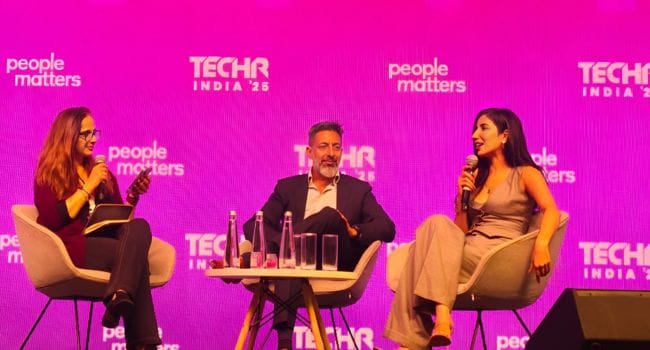
In a power panel discussion, Parul Gulati and Sohrab Sitaram unpack how visionary leaders craft brand identities that don’t just chase relevance.
In a high-voltage session that blended humour, honesty, and hard-earned wisdom, Parul Gulati, founder of Nish Hair, and Sohrab Sitaram, co-founder of Keventers, took centre stage at TechHR India 2025 to decode what truly gives a brand an edge in today’s fast-moving world.
The power panel, titled “The Branding Edge in a Fast-Moving World,” was a masterclass in being bold, breaking norms, and backing your instincts. Moderated by Neha Markanda from Google, the session took off with rapid-fire questions, and quickly turned into a striking manifesto for new-age leadership in India.
Customer First. Always.
When asked about the one metric that keeps them up at night, Sitaram was unequivocal: “Customer. Everything begins and ends with the customer. We track their behaviour, we take their feedback seriously, and most importantly, we learn from them continuously.”
The message was clear: in a noisy market where attention is fleeting, what endures is trust, and that is built one experience at a time.
Gulati, on the other hand, offered a sharply focused goal: “No errors. That’s the big obsession this year, for me and my team. Perfection in execution, every single time.”
At a time when many entrepreneurs wear chaos as a badge of honour, Gulati’s message stood out as a call for discipline, process and excellence.
The Underrated Virtues of Founders
When Neha posed a provocative question, “What’s the most underrated quality in a founder?”, both speakers peeled back the curtain on what it really takes to scale a brand in India.
Sitaram's response was blunt: “Being relentless about money. You have to be obsessed with getting people to part with their money. It’s not something people talk about enough, but it’s critical.”
Gulati agreed, only with a twist: “Shameless relentlessness, especially when it comes to marketing. You’ve got to keep pushing your product out there, no matter what. People forget quickly, you have to keep reminding them.”
In an environment where the default advice is often to “be humble” or “stay authentic,” both founders made it clear: there’s no room for passivity if you’re trying to build something big.
The Real India Is the Real Opportunity
When the discussion turned to India’s explosive potential, both founders lit up.
“Population helps,” Gulati began, with characteristic candour. “But more than that, India is finally seeing itself. Earlier, everything was curated. But now, thanks to social media, people are seeing the real India. Everyone is connected, and everyone wants to look a certain way. That’s what’s driving consumption.”
She went on to highlight a deeper cultural shift, the rise of financially independent women and the emergence of women building products for women.
“I was shocked no one saw hair extensions as a serious market,” she said. “I’m not the smartest woman out there. So why didn’t anyone else think of it? Especially when hair loss is such a personal topic. I think I’ve helped normalise that conversation a bit, whether by dancing, entertaining, or just talking about it openly. People trusted me because I was myself.”
This vulnerability, broadcast through social media and magnified by confidence—created not just a product, but a movement.
Sitaram echoed her optimism about the India story. “India is a phenomenal market, and Indian customers are fantastic. What’s underrated is our acceptability, if you bring something fresh, something passionate, Indians embrace it.”
But his key insight was this: “You have to build a business where the customer becomes part of your story. That’s where the magic happens.”
This shift, from transactional branding to co-created storytelling, is what Sitaram believes defines the brands of tomorrow.
Being Bold Isn’t a Strategy—It’s a Survival Skill
If one theme dominated the conversation, it was this: you have to be radically different.
In Sitaram's words, “Don’t try to be slightly better, be completely different. You can’t just chase relevance; you have to create it.”
This daring spirit has defined Keventers’ journey from a legacy dairy brand to a Gen Z-favourite milkshake and dessert company. Rebranding an iconic name required not just creative campaigns, but calculated risk-taking—and above all, deep listening.
Gulati added that standing out doesn’t always mean being loud; sometimes, it means being precise. “In our case, it meant being the first to talk about hair extensions in India in an open, empowering way. We didn’t just create a brand, we opened up a whole category.”
Both founders reinforced a simple truth: in today’s world, if your brand is not audacious, it’s invisible.
Vulnerability is Your Superpower
For founders used to pitching perfection, Gulati and Sitaram's honesty was refreshing.
Gulati admitted: “I didn’t know if this would work. I didn’t have a backup plan. But I knew I had to try. And over time, I got more comfortable in front of the camera. I didn’t wait for someone else to validate my product, I became my own spokesperson.”
Her ability to be real, playful, and unapologetically visible turned Nish Hair from a niche idea into a national conversation.
Sitaram added: “Today, people respond to empathy and compassion. That’s a shift. You can now lead with kindness. You can be real. That was not the case earlier.”
The Founder's Edge: A Personal Connection
What became clear through the panel was that the real branding edge lies in founder energy. The willingness to obsess over details, to stay uncomfortable, to put yourself out there, again and again, is what separates forgettable brands from iconic ones.
And in this age of AI, algorithms, and automation, both Parul and Sohrab reminded the audience that the biggest differentiator is still the human behind the business.
“Everyone’s trying to automate their way to relevance,” said Sitaram. “But if you want to stay relevant, stay close to your customer.”
Or as Gulati put it, “Be shameless. Be relentless. Be real. That’s the playbook.”
Takeaways for Today’s Leaders
The conversation may have centred around branding, but the implications went far deeper—into culture, leadership, and the future of work. Here are five takeaways from the session that HR and business leaders won’t want to forget:
Obsession with execution matters. Perfection is not a myth, if it’s the goal.
Customer obsession isn’t a department, it’s a mindset. Every team, every function must listen, learn, and act.
Dare to be different. Better is not enough. Bold is the new baseline.
Empathy is now a competitive advantage. Lead with compassion, your people and customers will respond.
Your story is your edge. Be visible. Be real. Don’t outsource authenticity.
Innovating and shaping business decisions in a niche and dynamic industry
When building personal brands, how important do you think the founder’s voice is?
How do you both look at your growth journeys?
Pivotal moment of growth journey
Differentiating in a competitive segment
Topics
Author
Loading...