







Business
The K-Shaped Organisation: The Rise of the 100x Super Employee





The organisation is not flattening. It is splitting. A few people will do the work of hundreds. Everyone else will wonder what happened.
By Farooq Adam
1. The Shape of the New Organisation
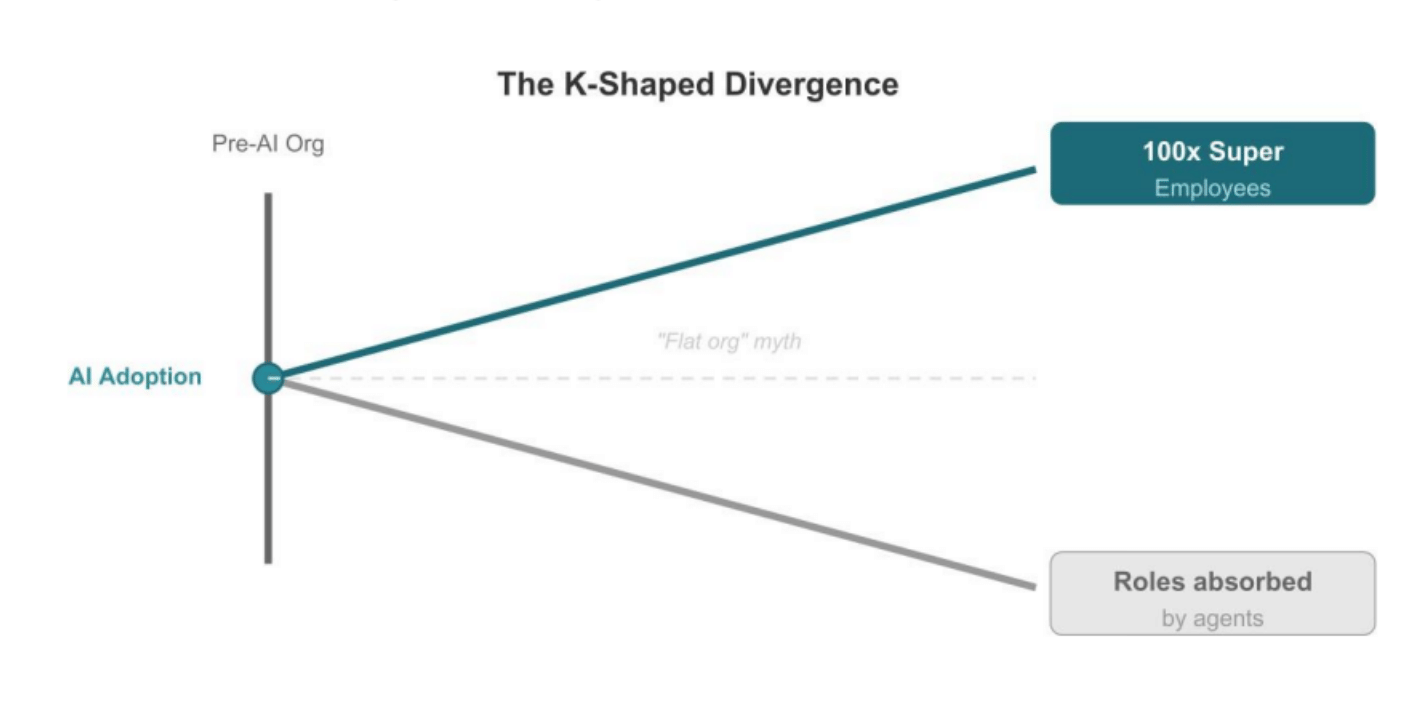
Organisations have spent decades debating whether to be flat or hierarchical, centralised or decentralised. Matrix or functional. Hub-and-spoke or federated. AI makes that entire debate irrelevant. The new organisational shape is none of these. It is K-shaped.
In economics, a K-shaped recovery describes a divergence where two groups move in opposite directions and never reconverge. One arm goes up. The other goes down. The same dynamic is now playing out inside every organisation that takes AI seriously. A small group of people are pulling away from everyone else at an accelerating rate. Their output is not two times, or five times greater. It is a hundred times greater. They define problems, direct agents, ship solutions, and move to the next problem in the time it takes a traditional team to finish its alignment meeting.
The divergence is permanent. The bottom arm of the K is not "people who need more training." It is people whose roles have been absorbed into the agentic layer entirely. The coordination work, the relay work, the reporting work, the scheduling work: agents do all of it now. No amount of upskilling bridges this gap because the gap is not in skill. It is in orientation. One group has reimagined what they are. The other is still defending what they were.
2. The Super Employee
The pattern is visible across every function. The market is drowning in people who can rearrange components and starving for people who can own an outcome end to end. Set the direction, make decisions without committee drag, and ship. These are not managers. They are not specialists. They are something new: individuals who operate across traditional functional boundaries usingAI as their execution layer.
A Super Employee is not someone who works a hundred times harder. They are someone who directs a hundred times more surface area. They are not constrained by functional boundaries because they do not recognise them. They see the problem, not the org chart. They use whatever tool gets them to the outcome fastest. They do not ask whose job it is. They do it.
The implications are uncomfortable. You do not need five hundred people if twenty of themare100x-ers. But you cannot fire the four hundred and eighty first and hope the twenty emerge. The twenty emerge by being given space, autonomy, and problems worth solving. The four hundred and eighty shrink as the work naturally migrates to the people, and the agents, that can execute it faster.
The Super Employee is not a better version of an existing role. They are a new category of worker, one that makes entire layers of the traditional organisation redundant. The product manager who also builds, sells, and measures is not an enhanced product manager. They are the replacement for a product manager, a designer, a front-end engineer, and a data analyst combined. Fewer seats, vastly more scope.
3. Why K-Shaped, Not Flat
The popular narrative is that AI is a rising tide. Everyone learns to use it. Everyone gets more productive. The organisation gets flatter. Power democratises. This story is comforting. It is also wrong.
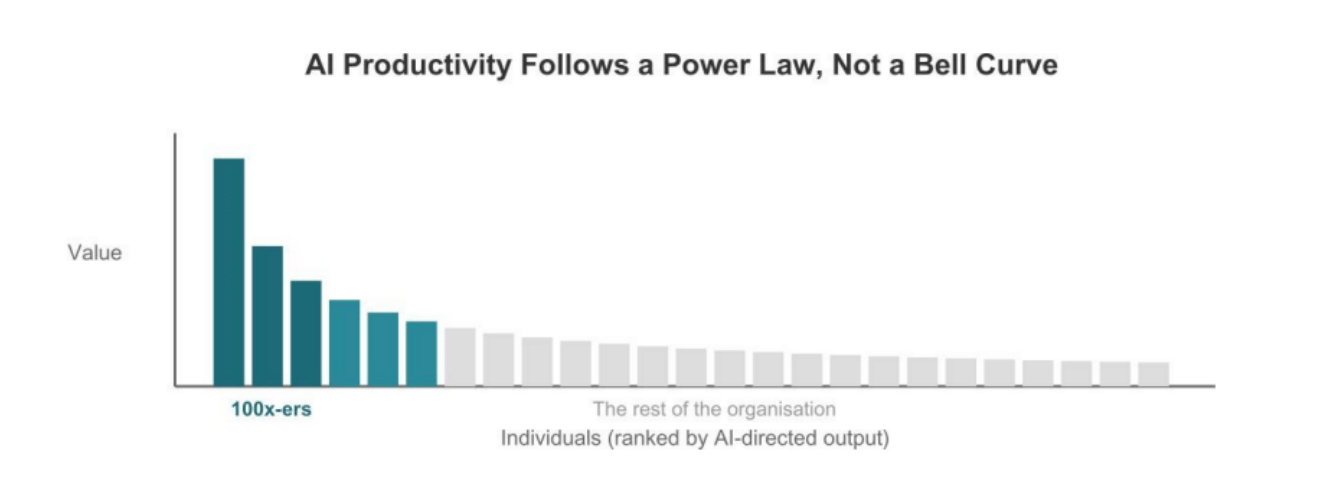
Productivity gains from AI follow a power law, not a normal distribution. A few people get dramatically better. Most people get marginally better. And a meaningful number get worse in relative terms, because they now have to compete with the output of the few. The engineer who ships a feature in a day makes the team that takes a sprint look expensive, not thorough.
The K shape emerges organically. You do not design it. You observe it. The top arm is the group that self-selects into Nirvana. The bottom arm is everyone else, not because they are bad at their jobs, but because the jobs themselves no longer exist as human work. The middle is hollow. There is no middle management in a K-shaped organisation because there is nothing left to manage. Agents handle coordination. Policies handle governance. The Super Employees handle direction. The frontline handles the irreducibly human work of serving customers.
4. Hiring, Grading, and Compensation
If the K-shape is real, then every HR system designed for the traditional pyramid is broken. Hiring must change first. You are not hiring for roles. You are hiring for orientation. Can this person direct AI? Can they define a problem without being handed a brief? Can they operate across functions without waiting for permission? A candidate who shows you a side project where they used agents to solve a problem in a domain they have no formal training in is more valuable than one with a decade of experience in a single vertical.
Grading must follow. The old system maps to tenure and scope within a function. None of that matters in a K-shaped org. The new grading has one axis: how much surface area can you direct with AI? A twenty-five-year-old who directs agents across three domains is more valuable than a vice president who manages one team doing one thing.
Compensation follows inevitably. If twenty people produce the output of five hundred, they should be compensated accordingly. The K-shape demands that compensation follows value creation, not headcount hierarchy. This is uncomfortable for every existing compensation framework. It is also the only framework that will retain the people who matter most.
5. The Leadership Mandate
Leaders do not get to choose whether the K-shape happens. It is already happening. In every organisation where AI has been adopted seriously, a small group is pulling away. They are shipping more, creating more, defining more, and they are doing it while the rest of the organisation is still scheduling meetings about how to use AI.
The choice is whether to recognise it, accelerate it, and build the organisation around it, or to pretend the old pyramid still works and watch the 100x-ers leave for somewhere that values them. The pyramid worked when execution was human, coordination was manual, and every additional unit of output required an additional unit of labour. None of those conditions hold any more.
The K-shaped organisation is not a strategy. It is a diagnosis. The only question is which arm of the K you are building for.
About the author: Farooq Adam is the Founder of Fynd, a technology-driven retail platform.
Topics
Loading...