







Training Development
6 themes to understand a CLO role





A People Matters and Right Management research shows that there is a growing need for CLOs in Indian organizations
A key question for organisations in today’s operating environment is the question of business readiness. The external market demands products and innovations at a fast pace and the demand supply gap in talent continues to be every business corporation’s biggest headache. In today’s environment there is a big need of an individual who can act as the bridge between the present and the future to ensure that the organisation has an ‘always-ready’ workforce. Preparing an ‘always-ready’ workforce is not easy as it sounds because it requires not just an in-depth understanding of the business and the industry, but also a thorough knowledge of existing talent conditions inside the organisation.
While this type of an interface does exist in a few organisations in some form or the other in the West, the role is fairly new in India. The Chief Learning Officer (or CLO) is an individual who resides within the talent management function, and acts as the source of business-driven talent initiatives within the organisation. S/he acts, not just as the builder of organisational capability, but also as the eyes and ears of the business within the organisation. This individual carries the mind of the business leadership and the heart of organisational talent. K. Ramkumar, Executive Director, ICICI says, “The CLO’s role is to hold the conscience of the organisation in one hand and its competitiveness on the other.” People Matters, in collaboration with the global talent management and career management workforce solutions company, Right Management conducted a pan-industry study among 83 CEOs, CHROs, and practicing CLOs in Indian corporations to explore the future of this role. It is clear that the role will grow in importance as Indian corporations enter a period of sustainable growth in the coming times.
So who is the CLO, and what are the hats that business leadership in an organisation expects a CLO to wear? The study identifies six critical themes around which a CLO role is evolving in organisations
Theme 1 - An “Undercover” Agent: Maturity of the CLO Role
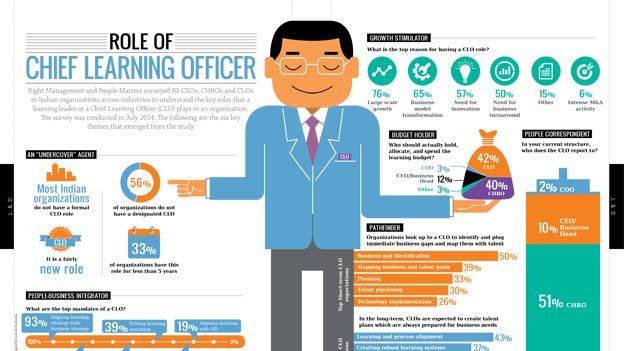
While the CLO exists in some form in many organisations, most do not have a formal designation attached to it. . The survey identifies that 56 per cent of organisations do not have a designated CLO role in their organisations. Even in organisations where the role does exist, it is fairly new. A third of the participants polled reveal that they’ve had a formal CLO role for less than five years.
The role is thus best defined as one being ‘undercover’ in most of the organizations and its impact is understood, but not completely articulated yet. Moreover, the role is being done in bits and pieces in almost all organizations – and is recognised as Talent Management, Organization Development, Learning and Training /Capability Building. The CLO’s role should be about capability building, and not so much about systems and processes of learning, which are better addressed through OD and talent management. The role of ‘Chief Learning Officer’ could also be an aggregator of these roles to add more organization level value and alignment with the business.
Theme 2 - People-Business Integrator: Expectations from the CLO Role
A CLO’s primary responsibility is to prepare the organisational workforce of the future. By designing learning interventions, creating succession plans, and defining the organisation’s culture a CLO integrates business objectives with people priorities. 93 per cent of business leaders in the survey expect the CLO to align the organisation’s learning strategy with the business strategy.
Being a steward of the organization culture and driver of change are also part of the key responsibilities of a CLO’s job. Managing culture and change is a huge need for organisations and a CLO plays a critical part in facilitating that. Anand Pillai, Sr. Executive Vice President & Chief Learning Officer, Reliance Industries Ltd. says, “The CLO is also the chief culture officer or the chief change officer because 90 per cent of culture revolves around learning and integrating them with capabilities.”
Theme 3 - Growth Stimulator: Trigger for creating the CLO role
When does an organisation need a CLO? Organisations are unsure if there is any particular point in terms of size or scale when they should start thinking about having a CLO. The fact is, having a CLO is a function of the phase of growth that the business and the industry expects to have and not about the size or scale that it currently operates in. The influence of a CLO in enabling large-scale growth comes across as the biggest driver of introducing this role in the organisation. 76 per cent of the 83 leaders surveyed in the study conclude that the top reason for having a CLO role in their organisation is large-scale growth.
Meenal Jadhav, Director, Talent Management, Schneider Electric says, “Size does not determine when an organisation should have a CLO role. Even an organisation which is getting close to 150 people should start thinking about having the CLO role if they plan to grow rapidly and determine how to evolve and change as an organisation.” Almost a fifth of the organisations surveyed (17 per cent) are planning to introduce this role in the next 3 years as they enter a phase of growth and expansion.
Theme 4 - People Correspondent: The ideal positioning of CLO in the organization
It is also important to understand where exactly a CLO needs to reside to have maximum impact. While it is true that the CLO acts as an agent of the business, her/his role is to understand talent issues and challenges on the ground. CLOs in 51 per cent of organisations report to the CHRO and not to the CEO or the business head. CLOs in only 10 per cent of organisations reside outside of talent management and report directly to the CEO or business head.
Talent inside an organisation seeks meaningful careers and simple training interventions are proving to be ineffective. A CLO’s job is to understand the needs of the workforce on the ground and tie them with the goals and objectives of the business. Jacob Jacob, Chief People Officer, Apollo Hospitals Enterprise Ltd. says, “In the modern day, people are looking for meaningful careers. That can only happen if the CLO becomes an agent of meaningful careers.”
Theme 5 - Budget Holder: Financial empowerment for learning in the organization
CHROs hold learning budgets in most organisations. But is he the right person to plan, execute, and deliver learning budgets? Having the aptitude and acumen for running the learning function as a profit and loss centre will be key to the CLO role. Anuranjita Kumar, Managing Director, Country Human Resources Officer, Citi says, “The CLO should be somebody who has a commercial sense and great business acumen so that s/he can connect the pieces of the business.”
In the survey, 49 per cent of respondents reveal that the CHRO holds and controls the learning budgets in their organisation. At the same time, when they were asked about who should ideally hold and control the learning budget in an organisation, a majority (42 per cent) say that learning budgets should be under a CLO and not a CHRO.
Theme 6 - Pathfinder: Who makes for a successful CLO – The CLO Success Profile
CLOs need to carve their own path to contribute to the effectiveness of the business. The expectations from a CLO should be no different from that of any other leadership role in the organisation. A CLO needs to be an agent of driving change and building capability. His understanding of business needs has to be paramount.
Two very important aspects of a CLO’s job is driving change and building capability. As a result, a CLO also needs to have his/her ears on the ground to understand the real issues. Not surprisingly, after business acumen, most leaders believe that essential ingredients of the CLO experience include culture building and people relations. 78 per cent of the leaders taking the survey feel that good CLOs need experience in culture building. In addition to that another 65 per cent feel that a good CLO is one with great people relations experience.
A CLO, thus, serves as a pathfinder for the organisation’s talent by leveraging people experiences and connecting them to the goals of the business. Their focus is hence on creating a leadership pipeline and succession plan for the organization. J. Prasad, CHRO, ING Vysya Bank Ltd. says, “Driving change and building capability are two of the most important experiences that help a CLO build business acumen.”
It is inevitable that in the coming 2-3 years the CLO role will come into prominence and will become a viable leadership position in organisations. The role is a mix between a business role and a talent management role. Hence, anybody from the business or the talent management function can aspire for the role of a CLO. In addition, any organization that wants to be sustainable in the long run should have a CLO role to help the transformation process. As a value-add for employees, a CLO can bridge the gap between learning and individual career aspirations, thus making the employee an integral part of any organization’s growth story. As the importance of the role grows, a clearer path and role definition will evolve for a CLO. Over the next few years we plan to pursue this objective with more rigor and enable CLOs around the country to play the role they are meant to.
Topics
Author

Loading...