







Employee Skilling
ATLAS SkillTech University's Siddharth Shahani on building talent for a lifetime of growth






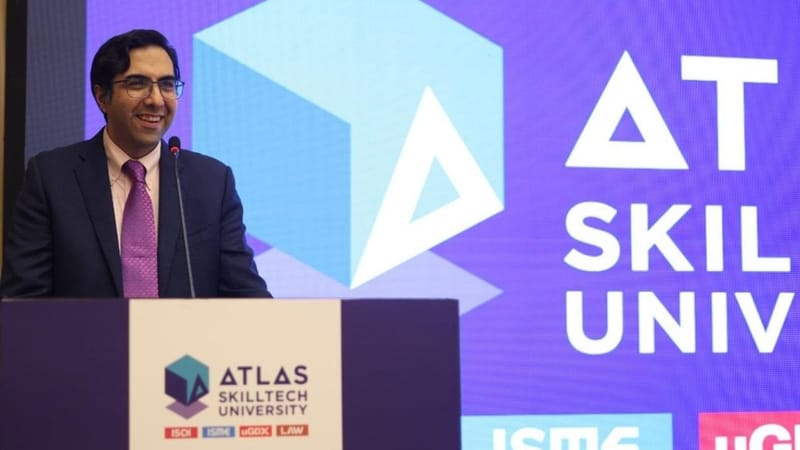
Drawing on experience across industry and higher education, Siddharth Shahani believes the future of work begins with the future of learning.
Every generation inherits a different definition of career readiness. For today's graduates, it is unlikely to be measured by the mastery of a single discipline or profession. It is increasingly defined by the capacity to navigate ambiguity, connect ideas across domains and continue learning as work itself evolves. That shift places higher education at the centre of one of the most important talent conversations of our time.
Having worked at the intersection of business and education, Siddharth Shahani has watched this transition unfold from both sides. After beginning his career at McKinsey & Company in London, he now serves as Co-founder and Executive President of ATLAS SkillTech University, where he is helping reimagine how institutions prepare students for an increasingly dynamic world of work.
"Education and industry are united by a shared purpose to develop people. When they come together as partners, students graduate with a deeper understanding of the world they are ready to contribute to," he says.
Rethinking what makes talent future-ready
The qualities that define talent, Siddharth says, are shifting alongside the workplace. Technical expertise still matters, but employers increasingly want people who can think across disciplines, solve problems with confidence and keep learning as their roles grow. Curiosity, initiative and adaptability are becoming as valuable as technical knowledge.
"Organisations are investing in people who can grow with the business. That calls for an approach to education that develops both strong academic foundations and the ability to apply knowledge in real situations," he says.
This is where the exchange between universities and industry becomes particularly valuable. Universities bring academic depth and intellectual rigour; industry brings current practice and a live view of how organisations are changing. Together, the two make curricula more relevant, teaching more responsive and graduates better prepared for what modern workplaces expect without diluting academic excellence.
Why higher education must mirror the workplace
The greatest opportunity for higher education, Siddharth believes, lies in classrooms that reflect the realities of work. Organisations rarely solve problems within the boundaries of a single discipline. Decisions are shaped by collaboration, shifting priorities and a range of perspectives. Bringing those dynamics into the classroom helps students build the judgment a connected professional world asks of them.
A growing body of evidence reinforces this approach. According to the World Economic Forum, 81% of employers expect to prioritise experience when assessing skills for hiring, a strong case for weaving real work into higher education.
"The workplace doesn't present problems chapter by chapter, and neither should education," he says. "When industry becomes an integral part of the academic experience, students gain a richer understanding of how knowledge is applied, how decisions are made and how organisations create value."
At ATLAS SkillTech University, that thinking shows up in an academic experience shaped by industry engagement, entrepreneurship, experiential learning and real-world problem-solving, so students gain the confidence to put what they know to work.
Preparing talent for a lifetime of growth
For Siddharth, the best education leaves graduates with the confidence to take on new opportunities, the judgement to make sense of uncertainty and the appetite to keep learning as their careers unfold.
"As educators, our responsibility is to prepare students for careers of continuous growth, leadership and meaningful contribution," he says.
Careers will keep taking unexpected turns, he notes, but the qualities behind long-term success stay steady: intellectual curiosity, resilience, sound judgement and a willingness to keep evolving. These are the attributes that enable individuals to create value across different roles, industries and stages of their professional journey.
By the end of the conversation, one thing is clear: Siddharth's vision for higher education is built around people as much as the profession. The greatest contribution universities can make, he believes, is to shape individuals equipped to succeed at work and to keep growing, leading and contributing throughout their lives.
Topics
Author
Loading...