







Employee Skilling
The growth coach: Scaling beyond the boardroom





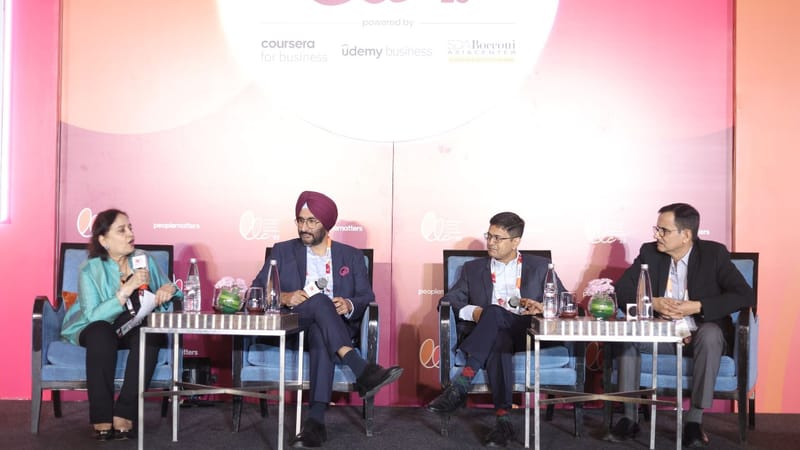
At the People Matters LLC Conference 2025, leaders explored how to scale coaching beyond the C-suite and build a culture of everyday leadership
In every organisation, growth often hides behind a simple question: Who do we become when someone believes in us?
Because belief is a strange kind of sunlight that doesn’t push you to bloom but rather simply reminds you that you can. It’s a manager turning a mistake into a lesson, a mentor turning hesitation into courage. Growth, then, isn’t always about targets or titles but about the version of ourselves that wakes up when someone says, “You’ve got this.”
At The People Matters Learning Leader and Culture Conference 2025, the Power Panel on Coaching at Scale: Strengthening Succession Beyond the C-Suite explored what it truly takes to make development an inclusive, systemic, and sustainable force. Moderated by Madhvi Lall, Managing Director, Head - HR India, Deutsche Bank, the discussion brought together leaders who have walked the path of turning potential into performance: Dr Rajorshi Ganguli, President & Global HR Head, Alkem Laboratories; Gurucharan Singh Gandhi, CHRO, Vodafone Idea; and Sachin Gaur, Global Head - Learning, Capability, Change, Org. & Leadership Development, Dr Reddy's Laboratory.
Growth in discomfort
The session opened not with definitions, but with reflections. The audience poll revealed what most already suspected: that real growth rarely comes from formal workshops. And that is precisely where this discussion began: how can organisations replicate that deeply personal experience of coaching, at scale, and beyond the upper echelons of leadership? When asked to recall a transformative coaching moment, each panellist spoke of discomfort and gratitude.
Gurucharan shared that most of his learning came from conversations that felt harsh in the moment but transformative in hindsight. “Most of the things that led to my own transformation didn’t feel that good when I was going through them,” he said. One such conversation pushed him from sales into HR, a move that defined his later career.
Sachin Gaur echoed the sentiment, describing a difficult feedback conversation at Deloitte University that forced him to confront his own limitations. “It felt incriminating, like I wasn’t good enough. But that moment changed me. Change is never just professional; it’s personal first,” he reflected.
For Dr Rajorshi Ganguli, impactful coaching began with belief. “My best managers placed me in roles that shook me out of complacency. They believed I could do it, even when I doubted myself,” he shared.
The patience problem
If the benefits of coaching are so evident, why is it still confined to leadership programmes or one-off interventions? The panellists unpacked the organisational and cultural barriers.
Gurucharan Gandhi brought attention to the ROI conundrum, which is that coaching's effects are frequently long-lasting and intangible. “At an institutional level, the lag between investment and visible results makes organisations hesitant. Much of the benefit is anecdotal, not analytical,” he explained.
Sachin Gaur added that organisations often misdiagnose coaching as a universal fix. “We assign a coach to anyone struggling, hoping it works. But hope is not a business instrument. We rarely check if the person is receptive or if coaching is the right intervention at all,” he said.
Dr Rajorshi Ganguli identified time commitment, misconceptions, and mindset as major barriers. “Everyone wants quick fixes. Many think coaching is HR’s job. But coaching should be integral to every manager’s role. You shouldn’t become a people manager unless you are, at heart, a coach,” he asserted.
Madhvi tied it back to a cultural context. “Our education system rewards being told what to do. Coaching requires thinking for yourself, and that takes patience, something leaders often lack,” she said.
From skill to system
The conversation then turned toward solutions: what would it take for coaching to become business-as-usual, a seamless part of how organisations perform, grow, and succeed?
Rajorshi emphasised selecting and promoting leaders with coaching mindsets. “If that innate quality isn’t there,” he said, “no amount of training can create it later.” He also emphasised that proximity leaders should spend time developing, shadowing, and coaching future successors. “Succession planning doesn’t happen through PowerPoint slides or AI tools,” he said. “It happens when leaders sit with their people, year after year, guiding them through real experiences.”
Sachin offered a three-tier framework that his organisation uses:
Performance Coaching: Peer-led guidance focused on achieving excellence in current roles.
Behavioural Coaching: Targeted for high potentials with specific developmental needs.
Executive Coaching: For senior leaders who represent the organisation externally and need to refine presence, communication, and influence.
He claimed that this multi-layered intentionality links impact to investment and makes coaching objective. “We see a quicker impact in performance coaching,” he added, “and it helps us invest smarter.”
Guru shared an example from his previous organisation: 30 leaders, each mentoring 10–12 employees over a year, with structured goals and periodic check-ins. “We made coaching a ritual,” he said. “When you announce the exam date, everyone becomes a good student. Accountability makes culture real.”
Culture of coaching
The panel concluded with a shared vision: coaching must evolve from an HR-led initiative to a cultural language of growth. As Madhavi Lall summed up, “What gets measured gets done, and what gets rewarded gets done even better. Coaching must connect to business impact, performance, engagement, and succession. Only then will it move from the boardroom to the broader organisation.”
Large-scale coaching may be the link between potential and performance in a society where expectations are high and leadership pipelines are narrowing. It is not a luxury for a select few but rather a way of thinking for many.
Author
Loading...