







Employee Skilling
What will matter more than technical skills in the next five years of GCC hiring? Catalyst Brands’ India Head HR explains






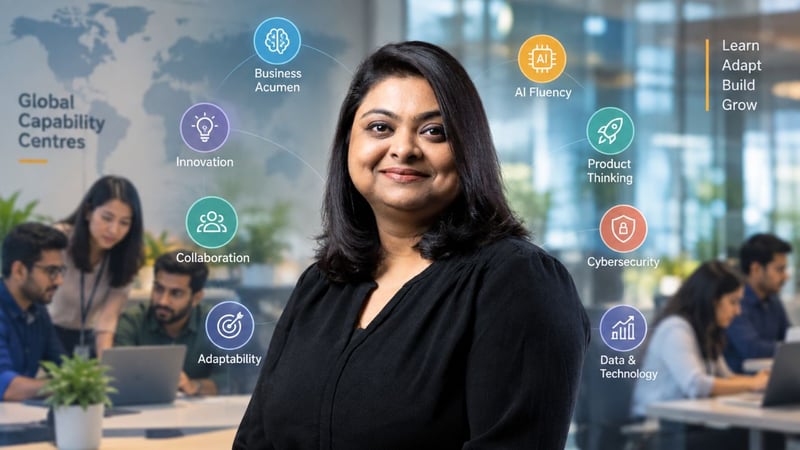
As work keeps changing, Nirguna Tilwankar says GCCs must build an environment where employees learn through real problems, mentoring and cross-functional exposure.
As Global Capability Centres (GCCs) take on more complex work, the challenge for organisations is no longer simply finding people with the right technical expertise. The bigger question is whether those skills will remain relevant as technology, business priorities and the nature of work continue to change.
For retail organisations, GCCs are bringing together expertise across technology, data, product engineering, cybersecurity, customer experience and other functional and technical areas to drive business outcomes globally.
This is making business acumen, product thinking, innovation, adaptability and collaboration across global teams increasingly important alongside technical excellence.
The challenge is particularly significant as AI changes the skills required for work faster than traditional hiring and learning cycles can keep pace. Rather than trying to predict every skill the business will need, GCCs are looking at how effectively talent can learn, adapt and build new capabilities as those needs evolve.
“The reality is that we cannot hire people for every skill the organisation will need five years from now. So the smarter strategy is to hire people who have demonstrated that they can continuously acquire new skills as the business needs evolve,” Nirguna Tilwankar, Director and Head of Human Resources, Catalyst Brands India, said in an exclusive interview with People Matters.
Hiring for learning velocity
For Catalyst Brands' Bengaluru GCC, the challenge has not been access to talent. Bengaluru has talent at scale. The bigger challenge has been contextualising that talent to the business quickly enough.
Tilwankar explains with an example,“A candidate may have strong functional or technical capabilities, but understanding the customer, commercial model, brand priorities and how decisions are made is critical to how quickly that expertise translates into impact. This has placed greater emphasis on creating an ecosystem where employees can learn the business while doing the work.”
The approach could include stronger partnerships with global teams, greater exposure to business leaders, structured SME mentoring and deliberate on-the-job learning. Culture and connectivity are also important to ensure teams feel closely connected to the business.
For Tilwankar, this creates an important distinction between hiring talent and integrating capability. Talent acquisition gets people through the door, but capability integration determines how quickly they create value.
AI shifts the capability question
This emphasis on learning becomes even more relevant as GCCs move from AI awareness towards AI-enabled work.
The key challenge is no longer simply teaching employees how to use AI tools, but helping them understand how to apply those tools in the context of real work.
Employees need to be able to apply AI to real business problems, challenge its output, exercise judgement, redesign processes and understand when human intervention remains essential.
“We cannot PowerPoint our way to AI adoption. Real capability is built when people are solving real problems, experimenting in a safe environment and learning from someone who understands both the business context and the work itself,” Tilwankar commented.
This is where SME mentoring and on-the-job learning become particularly important. This helps employees understand the why behind the work, make better judgement calls and learn how to redesign work rather than simply execute it faster.
From AI literacy to impact
The approach to AI capability is structured around AI Literacy, Education, Adoption and Inspiration. While literacy, education and adoption create the foundation, experiential learning and SME mentoring are intended to help employees develop the business acumen and problem-solving skills needed to apply AI meaningfully.
The wider challenge is that skills are changing faster than traditional learning programmes can keep up. “Rather than identifying one critical skill and training everyone on it, the focus is on creating a self-sustaining learning ecosystem where employees continuously learn, apply, unlearn and adapt,” Tilwankar elaborated.
This learning philosophy is structured around the “Talent Arch”. Its cornerstones are leadership development and mindset, followed by continuous skill-building aligned to evolving business needs. The capstone is blended learning and career experiences, including mentoring, cross-functional exposure and stretch opportunities, as Tilwankar pointed out.
“My belief is that the next generation of GCC capability will not be built by creating more training programmes. It will be built by creating more learning moments inside the work itself,” she mentioned.
The skills gaining value
As AI automates more routine work, the skills that become increasingly valuable are those that help employees navigate complexity and make decisions in context.
Tilwankar identifies business judgement, systems thinking, adaptability, learning velocity, cross-functional collaboration and the ability to frame the right problem for AI to solve among these capabilities. The shift, she commented, is towards orchestration over execution.
Future-ready GCC talent therefore needs to be capable of navigating ambiguity, connecting information and solving problems that have not been solved before.
That also changes how organisations assess adaptability during hiring. Rather than simply asking candidates whether they are agile or adaptable, the focus is on evidence of how they have responded when circumstances changed.
“Have they learned something outside their original expertise? Have they worked through ambiguity? Have they adapted their approach when something stopped working? Have they been able to move between problems rather than simply repeat a familiar solution?” Tilwankar questions.
People who combine expertise with curiosity, learning agility, problem-solving and comfort with change and collaboration, communication, customer focus are also part of that equation.
Connecting expertise across markets
The same capability-building approach extends beyond individual employees. As expertise sits across multiple markets, time zones and functions, distributed knowledge can create complexity, but it can also become a strategic advantage.
“No single location can hold every perspective or capability an organisation needs. A business leader in one location may bring customer and commercial context, while a GCC can bring scale, functional depth and technology capability. Another location may hold specialised domain expertise,” Tilwankar attributed.
The opportunity lies in bringing these different perspectives together around a common problem rather than trying to eliminate the complexity created by distributed expertise.
“The organisations that will move ahead will be those that shift from thinking about knowledge transfer as an event to knowledge flow as an organisational capability,” she added.
For Tilwankar, the future is therefore not about bringing all expertise into one location or one meeting, but creating an organisation where the right expertise can come together around the right problem, wherever it sits.
Technology versus capability
AI is expected to support associates in generating greater value in their roles, allowing people to spend more time on problem-solving, business decisions, creativity and collaboration.
That makes capability-building central to how work evolves. The focus is on building a workforce that combines technical and domain expertise with AI fluency, adaptability and human judgement.
“The next generation of high-performing GCCs will not simply be technology centres or talent centres. They will be learning organisations with the ability to continuously reinvent their capabilities. That is the real competitive advantage.”
The next evolution of GCCs, therefore, is from centres that absorb work to organisations that continuously build business capability.
“Technology may create advantages for a period of time. Capability created through technology and business acumen will generate value that compounds over time,” she concluded.
For Tilwankar, technology and capability are not competing investments. Technology without capability rarely delivers its promised value. AI platforms, automation tools and cloud capabilities can be acquired, but an organisation's ability to help its people learn faster, adapt faster and convert technology into better business outcomes is harder to replicate.
And that brings the five-year hiring question back to its core: rather than trying to predict every skill the workforce will need, GCCs need to identify people who can continue to acquire new skills as those needs evolve.
Author
Loading...