







HR Effectiveness
Beyond automation: Why AI’s real HR value lies in redesigning work





The real measure of AI-powered HR is not how many tasks it completes, but whether it improves talent movement, reshapes jobs and helps leaders make better business decisions faster.
The first gains from AI in HR are relatively easy to count: fewer tickets, shorter processing cycles, lower administrative effort and leaner support structures. The more consequential question begins after those metrics improve, what has changed for the business?
“Automation is when the process becomes faster. Transformation is when the way work gets done changes completely,” said Manish Shukla, Global Head HR–Corporate and Head-HR Strategy, Dr. Reddy’s Laboratories.
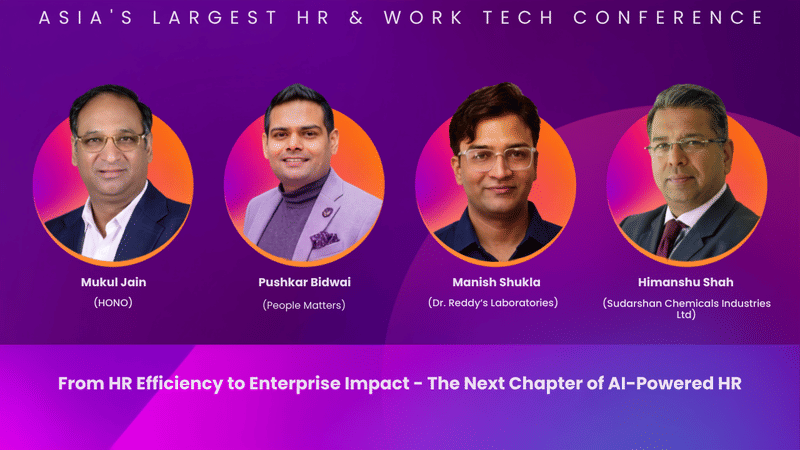
That distinction shaped the People Matters LinkedIn Live, From HR Efficiency to Enterprise Impact: The Next Chapter of AI-Powered HR. Shukla was joined by Himanshu Shah, Global Head of Total Rewards, HR Technology and HR Service Delivery, Sudarshan Chemical Industries Ltd.; and Mukul Jain, Founder and CEO, HONO.
The leaders agreed that AI creates enterprise value when organisations connect it to workforce redesign, business performance and the quality of decisions, not simply the speed of HR processes.
Efficiency is the entry point, not the outcome
Dr. Reddy’s has built more than 50 automations across its centralised global HR operations. Shukla said these interventions have reduced onboarding time by about 70% and payroll effort by 50%.
At the company’s scale, approximately 3.3 million HR transactions annually, even incremental efficiencies can create substantial savings. More importantly, its standardised HR services model has enabled the organisation to support business expansion without increasing support headcount at the same rate.
The model was tested during the integration of an acquired consumer healthcare business, where HR services were extended with minimal additional capacity.
The value, therefore, was not simply faster execution. It was the organisation’s ability to absorb growth without recreating processes, teams and costs every time the business expanded.
For Jain, this requires organisations to begin with the problem they need to solve rather than the technology available to them. “If you know your problem, that is half the work done,” he said.
The priority could be productivity, talent retention, employee experience, hiring quality or revenue growth. What matters is establishing the intended outcome before choosing and scaling the AI intervention.
When skills become visible, internal talent moves faster
Disconnected systems remain one of the biggest constraints on AI-powered HR. Performance records, compensation data, learning histories and employee experience information may all exist, yet offer limited value if they cannot inform a common decision.
Dr. Reddy’s internal talent marketplace, Unbound, brings together data from its performance, compensation and core HR systems, alongside employees’ experience, education, skills and gig assignments.
The platform uses skills as the organising currency of mobility. Employees can discover internal opportunities and understand the capabilities, exposure and experience they need to qualify for them.
According to Shukla, the company previously filled roughly one in every four vacant positions internally. It now fills about one in 2.5 positions from within. Each internal placement in India can avoid costs running into double-digit lakhs while reducing vacancy time and retaining institutional knowledge.
The larger shift is from reacting to vacancies to continuously matching capability with opportunity. Instead of waiting for a role to open and beginning a search, the organisation gains a clearer view of where relevant talent already exists.
Shah argued that workforce intelligence must also connect with finance, operations and commercial data. Productivity, absenteeism, people costs and capability gaps eventually affect yield, revenue and profitability. Bringing those functions into the design early also makes AI investment a shared business priority rather than an HR technology request.
Agentic AI finds an early win in employee queries

Some of agentic AI’s most practical early applications may emerge from routine work rather than complex autonomous decisions.
Dr. Reddy’s has created a tiered query-resolution model in which standard policy and process questions are handled at Level 0 by an AI-enabled system. Queries requiring progressively greater expertise move to HR operations, centres of excellence and, finally, HR business partners.
Shukla said approximately 80% of queries are now addressed at Level 0, another 10% at Level 1 and only 5-7% reach specialist teams. Very few require the attention of an HR business partner.
Employees receive faster responses without having to wait for HR teams operating across different time zones. At the same time, HR professionals regain capacity for business partnership, organisational design and workforce planning.
Shah sees a second opportunity on the business side. AI agents can bring together data on productivity, compensation, workforce planning and pay equity, replacing fragmented spreadsheets with forward-looking analysis. The objective is to shorten the distance between insight and action.
Jain said the next phase will require HR platforms to work with the wider enterprise technology environment. Connecting models, agents, databases and application programming interfaces can help leaders draw intelligence from multiple systems through a single interaction.
He also expects organisations to need more professionals who combine functional understanding with technology and AI skills—people capable of translating a business problem into a usable solution and driving adoption within the function.
Redesign the role before automating it
Installing AI does not guarantee that people will use it well. Adoption depends on whether employees understand the technology, managers trust its outputs and jobs are redesigned around what it can do.
“It is not simply a turn of the switch which is going to make the change happen. It is as much a people change as it is a technology change,” Shah said.
At Dr. Reddy’s, work is being examined across three components: transactions, engagement and expertise. AI is applied primarily to the transactional layer, creating more room for judgement, relationships and specialist contribution.
Shukla used the role of a brand manager to illustrate the approach. If transactional work occupies 20-30% of the role, redesign could bring it down to about 5%, allowing more time for market engagement, product positioning and competitive analysis.
This task-level view creates a more useful workforce conversation than asking whether AI will replace an entire job. It allows organisations to decide which tasks should disappear, which capabilities should grow and how the role can contribute more directly to business performance.
Human judgement remains central, particularly where decisions carry strategic, ethical or personal consequences. AI may sharpen the evidence available to leaders, but it should augment rather than replace accountability.
Measure how quickly the business can act

Shukla proposed three measures for evaluating enterprise impact: top-line growth, margin expansion and decision velocity.
AI should help the business reach more customers with the same workforce, launch products faster and support expansion without proportionate overhead growth. It should also give leaders timely intelligence on markets, products and workforce risks so they can intervene sooner.
Decision velocity may be harder to isolate as a financial metric, but its consequences eventually appear in growth and margins. A faster, better-informed decision on talent deployment, product strategy or workforce capacity can materially alter a business outcome.
For Shah, the test is whether AI helps HR anticipate people issues before they become operational problems. Sudarshan Chemical Industries is using connected data to forecast people costs across six-, 12-, 18- and 24-month horizons, helping HR, finance, operations and commercial teams evaluate future implications together.
“How can I use AI to anticipate workforce or people issues before they become business problems?” he asked. “That is where enterprise value gets created.”
AI’s first chapter in HR was about clearing administrative work. Its next chapter will be judged by what the organisation does with the time, intelligence and capacity it gains.
Continue the conversation at TechHR India 2026
The questions raised in this discussion, how to redesign work, connect workforce intelligence with business outcomes and preserve human judgement as AI scales, will be taking centre stage of People Matters TechHR India 2026, happening on 6-7 August at Yashobhoomi, New Delhi.
Under the theme Orchestrating Growth With A Human Edge, business, people and technology leaders will examine what it takes to move AI from scattered pilots to measurable enterprise impact.
Join the movement where the next chapter of work will take shape. Register now for People Matters TechHR India 2026.
Topics
Author

Loading...