







HR Effectiveness
‘Lead with failure’: Ranveer Brar on growth and reinvention at TechHR India 2026


 ||
||

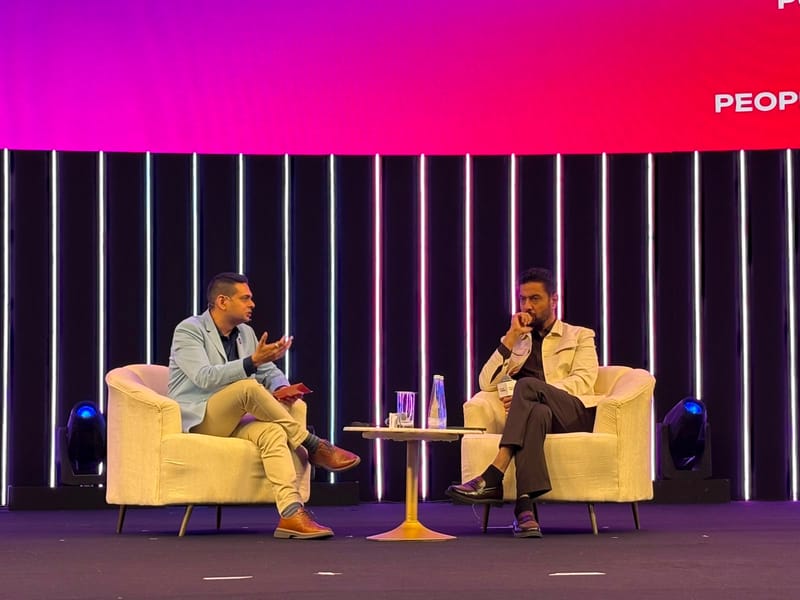
At TechHR India 2026, Ranveer Brar challenged HR and business leaders to stop hiding failure, resist the comfort of past success, and treat every setback as raw material for reinvention.
For leaders, success presents an unusual risk. What worked once becomes a playbook. The playbook becomes a habit. And eventually, experience itself can make reinvention harder.
Ranveer Brar knows something about refusing to stay inside one definition of success.
Chef, restaurateur, author, storyteller, creator and actor—his career has repeatedly moved beyond the identity that first made him successful. But at People Matters TechHR India 2026, Brar argued that reinvention does not begin with chasing the next opportunity.
It begins with discomfort.
“Am I uncomfortable?” is a question he keeps asking himself.
“Because if there’s no discomfort, there’s no growth,” he said during the fireside chat, ‘Create. Reinvent. Repeat.: Ranveer Brar On The Recipe Of Leading The Legacy’.
For HR and business leaders dealing with AI disruption, changing skills and business models that are becoming obsolete faster, that question carries organisational weight too: Has your organisation become too comfortable with what made it successful?
Reinvention needs an anchor, not another leadership persona
Constant reinvention creates another danger: leaders can become whatever their environment rewards.
Brar’s counterweight is authenticity.
“If it is not mean, I’m not me,” he said.
His approach to finding that authenticity is unconventional. Instead of continually asking Who am I?, he suggests identifying who you are not. Every opportunity, decision and interaction becomes a filter.
For senior leaders, that becomes increasingly difficult as the stakes rise. Bigger roles bring more constituencies to satisfy, more pressure to conform and more reasons to avoid saying no.
Yet transformation demands leaders who retain a point of view.
The real challenge is not simply whether leaders can change fast enough. It is whether they can change without becoming disconnected from the values and judgement that make their leadership credible.
For HR, that also raises a question about leadership development: are organisations building leaders capable of independent judgement, or simply producing executives who have mastered the organisation’s existing playbook?
If failure is unacceptable, experimentation is only a slogan
A professional kitchen gave Brar an early education in something organisations still struggle to institutionalise: failure.
“You fail daily, and you learn naturally,” he said.
Every new dish carries uncertainty. Not everything that is created makes it onto the menu. Not everything customers try succeeds.
That shaped a provocative view of risk: what matters is not eliminating failure, but understanding what scale of failure the organisation is prepared to tolerate for the reward it wants to create.
This should resonate strongly with leaders pushing AI experimentation and business transformation.
Organisations routinely ask teams to innovate, experiment and move faster. But if performance systems punish every unsuccessful attempt, employees quickly learn the real message: experiment only when success is already predictable.
Brar’s own experience made the lesson personal.
After becoming one of India’s youngest five-star executive chefs at 25, he went to the US and entered the restaurant business. When his Boston venture collapsed, he went from early professional success to a period without a home.
That failure became one of the defining experiences of his career.
“Success has taught me nothing. If I have to share my learnings, they only come from failure.”
His message to leaders was therefore not to sanitise the journey.
“If you really don’t want to take yourself too seriously, wear your failures on your sleeve.”
For HR leaders, there is a cultural question embedded in that statement: Does your organisation merely celebrate success, or does it have a credible mechanism for learning from intelligent failure?
Experience is valuable—until it becomes a template
The higher someone rises, the larger their library of successful decisions becomes.
That experience is an advantage. It can also become a blind spot.
Brar drew naturally from the kitchen. Ingredients change. Temperature changes. The environment changes. Applying exactly the same technique does not guarantee exactly the same outcome.
Business is increasingly similar.
A talent strategy that succeeded three years ago may not answer an AI-shaped skills market. A management practice designed for one generation may not work for the next. A transformation playbook built for digitisation cannot simply be relabelled for AI.
Yesterday’s success can become tomorrow’s constraint when leaders stop examining whether the conditions have changed.
Brar’s answer was presence: approach the problem in front of you before reaching automatically for the solution behind you.
For organisations, that means developing leaders not simply for pattern recognition, but for judgement—the capability to know when the old pattern no longer applies.
AI handles more of zeroes and ones. Humans need to own the space between them
Brar’s most interesting argument for the TechHR audience came through his interpretation of AI.
He sees value in machines taking on more of the deterministic work—data, analytics, sorting and choices that consume professional time without necessarily requiring the full range of human imagination.
“We should be happy,” he argued, if it gives people more time to do better work.
Then he offered an evocative metaphor.
“Zero and one is science. Art happens between zero and one. You express yourself between zero and one. Your individuality lies between zero and one.”
Mathematically, infinitely many numbers exist between zero and one. For Brar, that space represents the possibilities technology should allow humans to explore.
It creates a useful challenge for CHROs.
As organisations automate jobs, are they merely removing tasks and counting productivity gains? Or are they intentionally redesigning roles so people can spend the recovered capacity on judgement, relationships, creativity and problem-solving?
The AI productivity dividend matters. The human-capability dividend may matter even more.
If automation saves five hours of someone's week but the organisation simply fills those five hours with more routine work, very little has been reinvented.
Transformation fails when people become afraid of the organisation
Brar also touched on a problem familiar to anyone leading a large enterprise.
People can begin believing the organisation is bigger than they are.
Perhaps it is a century-old institution. Perhaps it is an intimidating hierarchy, an important title or a pay cheque employees are frightened to lose. Gradually, people stop questioning. Then they stop expressing opinions.
Eventually, the organisation gains compliance but loses originality.
That becomes especially dangerous during AI transformation, when many employees are already uncertain about how their roles will change.
Brar called for leaders to humanise ecosystems rather than demonise them.
For HR leaders, the implication is direct. Psychological safety cannot sit separately from transformation strategy. If employees believe questioning a decision, admitting uncertainty or challenging an established approach will cost them professionally, the organisation will struggle to get the experimentation it needs.
You cannot ask people to reinvent the business while making them afraid to challenge it.
The leadership legacy is the capacity to keep creating
That ultimately reframed the idea of legacy running through TechHR India 2026.
Legacy is often associated with what leaders leave behind. Brar’s perspective suggests it can be equally about what they make possible next.
Create.
Learn whether it works.
Accept that some things will fail.
Question the template.
Reinvent.
Then create again.
For HR leaders, that means designing cultures where capability is continuously renewed. For CEOs and business leaders, it means refusing to confuse the business model that produced yesterday’s success with the one that will produce tomorrow’s growth.
And for both, AI makes the responsibility sharper.
Technology will increasingly take care of more things that can be reduced to predictable choices. Leadership will be tested by what organisations do with everything that cannot.
That is the space between Brar’s zero and one—the messy, distinctly human territory of imagination, judgement, courage, failure and reinvention.
And perhaps that is where the next generation of organisational legacy will actually be built.
Not by preserving yesterday’s recipe, but by creating organisations confident enough to keep rewriting it.
Topics
Author
Loading...