







HR Technology
Automation helps humans evolve





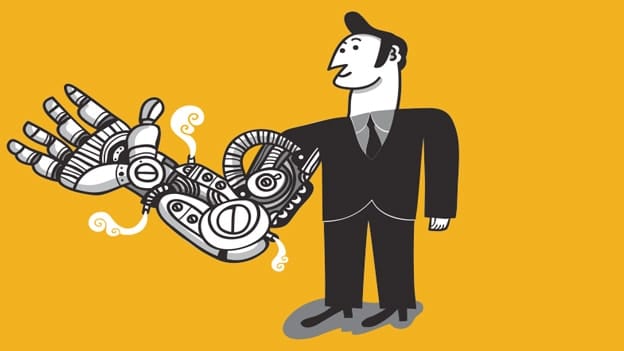
So what happens when machines replace humans at the workplace? A look the options humans are left with in such a scenario
While the debate rages on the effect of technology adoption, automation and artificial intelligence on job cuts, a relevant question that comes up is regarding the quality of jobs. Let’s first understand the meaning of technology or technique, in general. Any approach that saves human effort can be deemed as technology. A pulley is as much a technology as a computer, except one is low-tech, and the latter is high-tech.
Now let’s cast a wider net and look at the essence of human evolution in the last 1000 years. It would become quickly apparent that our evolution is punctuated with technological advancements. The printing press, steam engine, electricity, assembly line, gasoline engine, and you name them, most of these ‘general purpose technologies’ have helped humans take a leap in the evolutionary trajectory. So the debate between technology and human labour is not necessarily new.
Every time a technology gets introduced, it threatens the dominance of incumbents. Remember the way the dominance of the church was questioned with the introduction of the printing press; for now, anyone can have a personal copy of the bible. Or, for that matter, when electricity became commonplace, it led to productivity improvements at the workplace and convenience at homes. This so-called ‘creative destruction’ is the norm of technology-led human evolution.
'Creative destruction’ is the norm of technology-led human evolution
Not only that a technology advancement is an indication of human evolution, but also the very cause. Each such advanced technology results in humans getting engaged with more significant tasks and higher-order activities. Regardless of your strength, why would you want to give away the utility of a pulley while fetching water from the well? It’s that you would want to apply your saved time and efforts to doing something else, something better.
Having understood that technology, including dynamite, might create a disruption or a disturbance in the short run, but is nevertheless helpful eventually, we must address the question of the role of humans in the face of technological advancements.
Humans are uniquely endowed with the capacity to create. Our minds draw juices from solving problems, and the moment a problem is solved we would like to move on, or else it becomes boring. That’s exactly where technology steps in. If you look at the places which are heavily automated, one commonality is repeatability of the task and desired reliability of the outcome. Right from factory automation with the help of robotics, to office automation with the advent of massive computation and communication power, the tasks are getting done faster, cheaper, and error free. While hitherto scores of humans might have been busy performing such chores, at the hindsight, it becomes apparent that such was not the best utilization of human labour. Think of the office boy who passes on files from one table to another before e-mails became commonplace.
So what happens when machines replace humans at the workplace? Humans are left with broadly two choices. One is to fight back and show some resistance, and the second is to move on to do more evolved tasks. Now, evolution doesn’t come easy, for it calls for some real skills, and courage to develop yet newer ones. That is the desired response of the people, both white-collar and blue-collar, who have been ‘hit’ by automation. As a matter of fact, they are hit out of mediocracy into an opportunity to be doing something still better with their available talent and time. The analogy is that when cars became popular, horse-carriages were out, but some of the people re-skilled to become drivers because they still were the best guides around the city. The same applies to the current scores of employees who fear machines. Machines are nudging us from becoming machines!
Topics
Author

Loading...